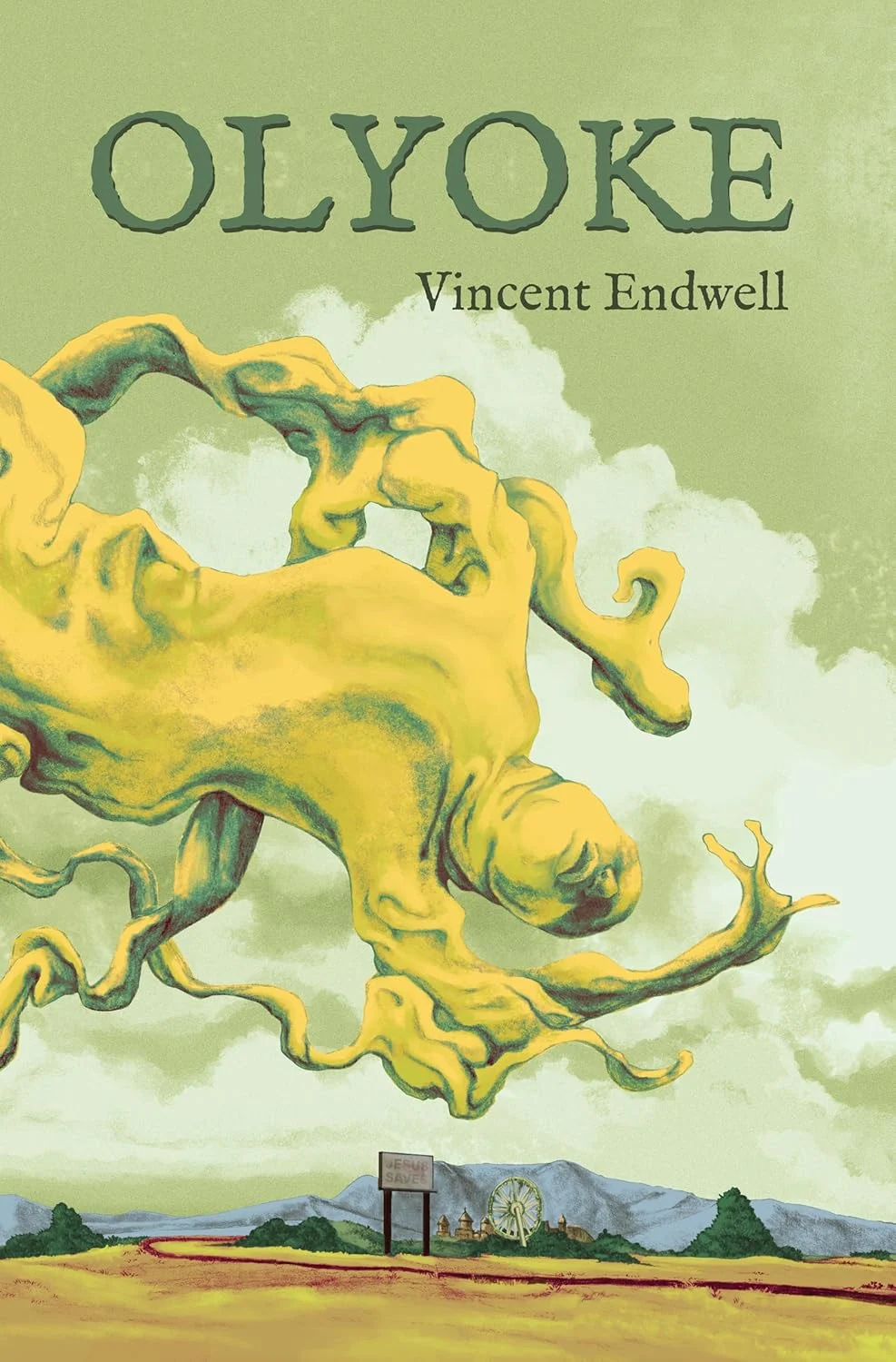
In the landscape of contemporary weird fiction, few debuts have arrived with the singular, unsettling gravity of Vincent Endwell’s Olyoke. Marketed as a collection of linked short stories, the book defies standard literary categorization. It functions less as a traditional anthology and more as a fragmented scripture—a collection of "found" parables salvaged from the psychological wreckage of an Appalachian cult. By weaving together themes of linguistic decay, bodily metamorphosis, and the crushing erosion of free will, Endwell has crafted a work that feels less like a product of modern imagination and more like an artifact unearthed from a forgotten, fevered reality.
Deeply indebted to the Lovecraftian tradition and explicitly invoking the nihilistic spirit of Robert Chambers’ The King in Yellow (1895), Olyoke invites the reader into a town that operates by its own distorted physical and moral laws. It is a work of existential dread, a literary puzzle box that refuses to provide the catharsis of a "neat" ending, opting instead to leave its mysteries to fester in the reader’s mind long after the final page is turned.
The Genesis of the Mythos: Hieronymus Johnson and the Smokey Mountain Apocalypse
The collection opens with a framing device that immediately establishes the book’s tone: the salvaged, fire-damaged writings of the self-proclaimed prophet Hieronymus Johnson. The narrative conceit—that these pages are all that remains of a man who perished in a cult-related fire—lends the text a supernatural aura of authenticity.
Endwell’s prose in these sections mimics the cadence of the King James Bible crossed with the dense, alien structure of ancient epic poetry. In an excerpt from the opening pages, Johnson writes: "It was the advent of First Winter when the raven-thinkers arrived unto the ville and commenced their proclamation… The Pestulance was coming, and it was coming swift as Eurus from the East."
For the uninitiated reader, this opening is intentionally opaque. It demands a surrender of expectations. While Endwell occasionally pushes his invented archaisms to the point of linguistic confusion—where words feel less like creative choices and more like grammatical errors—the effect is undeniably atmospheric. The goal is to simulate the "Book of the Blue Ridge Apocalypse," a task at which Endwell largely succeeds. When the language strikes the right balance between ancient solemnity and modern decay, it inspires a profound, trembling sense of awe.
Chronology of the Uncanny: Navigating the Olyoke Tapestry
The stories within Olyoke do not follow a linear progression; rather, they exist as a series of concentric circles, each illuminating a different facet of the town’s occult infrastructure.
- The Early Manifestations: The collection introduces us to "The Modeling Resin," a poignant study of grief and inherited trauma. Beth-Anne, a social worker, finds her past collapsing into her present as she investigates a boarding house linked to her sister’s mysterious death.
- The Physical Manifestations: In "The Strange Case of the Collapsible Man," the horror becomes tactile. An estate company tasked with liquidating Egyptian artifacts finds themselves besieged by a wooden automaton capable of infinite physical expansion and contraction, blurring the line between inanimate object and sentient threat.
- The Temporal Distortions: "Pyramid" serves as a nexus point for the book’s larger mystery. Following the death of his grandfather, a protagonist named Frank inherits a clock that functions as a portal to a mystical, time-dilated desert. This story cements the idea that Olyoke is not just a place, but a condition.
As the reader progresses, these disparate threads begin to knot. The "sore, red eyes" that appear as a background detail in early chapters are revealed to be harbingers of a systemic infection. In "Itch," this manifests as a visceral, body-horror account of a woman stripping the skin from her own eyelids, while "Love in The Reem" tracks a doomed courtship during a plague, where the characters’ refusal to acknowledge the death of the environment around them—symbolized by dying red frogs—acts as a terrifying critique of willful human ignorance.
Supporting Data: The Modernity of Folklore
One of the most striking aspects of Olyoke is Endwell’s mastery of non-traditional narrative formats. He demonstrates a keen ear for the voices of the digital age, utilizing mediums like social media threads and podcast transcripts to ground his cosmic horror in the mundane.
"The Wandering Daughter," told through a Reddit-style forum, explores the dark history of "Hailey Land," a fictional amusement park that serves as a thinly veiled, sinister parody of the religious kitsch found throughout the American South. The dialogue here is sharp, cynical, and deeply immersive, mirroring the way internet communities obsessively piece together fragments of "lore" in search of a truth that is often more terrifying than the silence.
Similarly, "Wine and Crime Club—Episode 121: A Cursed Play and Quality Rosé" utilizes the podcast format to discuss a fictional, cursed play titled A Pyramid Fit for a King. The meta-commentary is brilliant: the hosts, in their casual, banter-heavy style, unwittingly describe the very forces that are about to consume them. The description of the play’s opening night—where actors performed for 14 hours because they believed something was watching them—serves as a chilling metaphor for the performance of reality itself.
Critical Implications: Style, Substance, and the "Simile Trap"
Despite the brilliance of its worldbuilding, Olyoke is not without its technical friction. A common critique in Lovecraftian literature is the tendency to prioritize atmosphere over pacing, and Endwell occasionally falls into this trap. When the narrative pauses to engage in exhaustive, heavy-handed description, the sense of urgency—so critical to horror—diminishes.
Furthermore, there is a noted "simile obsession" that occasionally muddies the prose. When Endwell is at his best, his imagery is razor-sharp. When he falters, the similes become crutches that distance the reader from the action. Lines like, "Wrapping your mind around it was like trying to get too little paper around too large a box," feel forced and unnecessary, while the misuse of words like "limpid" as a noun suggests an over-reach that threatens to pull the reader out of the narrative trance.
However, these are minor blemishes on a largely sophisticated work. The author’s ability to conjure dread is undeniable. The final story, "The Celebration," brings the themes of the book to a shattering conclusion. By focusing on Maggie Warner, a director whose play The Winsome Daughter mirrors the reality-warping properties of the book’s own lore, Endwell creates a recursive loop of storytelling. The figure of "The Whistler"—a persona that bleeds from Maggie’s dreams into her waking life—is a masterclass in the slow-motion erosion of individual identity.
Conclusion: A Cult Classic in the Making
Olyoke is a challenging, often punishing read, but it is one that rewards the dedicated "reader-detective." It is a book that demands to be cross-referenced, diagrammed, and discussed. While it occasionally suffers from the excesses of its own ambition, those very excesses contribute to the book’s singular, morbid charm.
In an era where our collective sense of agency feels increasingly fragile, Vincent Endwell has tapped into a primal fear: the idea that we are not the masters of our own narratives, but merely puppets in a play that began long before we arrived and will continue long after we are gone. Olyoke is a haunting addition to the canon of Appalachian horror, a testament to the idea that some doors, once opened, can never truly be closed. Readers should proceed with caution; the town of Olyoke is waiting, and it has a way of worming its way into the marrow.