The landscape of speculative fiction and its intersection with modern technology, social discourse, and the arts has reached a critical inflection point. As tech titans increasingly co-opt the tropes of science fiction to justify terrestrial agendas, critics are pushing back, demanding a return to the humanistic roots of the genre. Simultaneously, the entertainment industry continues to mine its archives for new iterations of classic horror and sci-fi, even as the global community mourns the loss of iconic figures like Sam Neill.
This report synthesizes the latest developments across the speculative cultural sphere, examining the friction between visionary narratives and the pragmatic, often messy, reality of the 21st century.
I. Silicon Valley’s Selective Sci-Fi Problem
The relationship between Silicon Valley and science fiction has long been symbiotic, but as recent analyses suggest, the influence has become increasingly parasitic. In a profound critique published by Aeon, Ali Rıza Taşkale argues that tech leaders have effectively "grafted their politics" onto stories of a better future, stripping away the genre’s original intent.
The Misappropriation of Hari Seldon
The most glaring example of this trend is the adoption of Isaac Asimov’s Foundation by figures like Elon Musk. While Asimov’s "psychohistory" championed the power of anonymous, collective civic action and the preservation of mundane infrastructure—libraries, diplomacy, and committees—Musk’s interpretation focuses exclusively on the "lone visionary" archetype. By framing the multiplanetary colonization of Mars as an existential "civilizational imperative," critics argue that Musk immunizes his ventures from necessary scrutiny regarding labor practices and environmental costs.
The Scientific and Ethical Fallacy
The critique is not merely ideological; it is grounded in scientific reality. Astrophysicists Arwen E. Nicholson and Raphaëlle D. Haywood have challenged the feasibility of terraforming Mars, noting that even best-case scenarios result in an atmosphere of concentrated CO2, incompatible with human life. Furthermore, the ethical argument—highlighted by Andrew Russell and Lee Vinsel—points to the "trickle-down science" fallacy. As the poet Gil Scott-Heron famously remarked during the Apollo era, focusing on extraterrestrial expansion while ignoring systemic inequality on Earth remains a moral failing. The argument remains: should we be prioritizing a "Whitey on Mars" narrative while real-world infrastructure on Earth crumbles?

Beyond Mars: Bezos, Thiel, and the Frontier
The pattern repeats with Jeff Bezos, who draws inspiration from Gerard K. O’Neill’s The High Frontier. While O’Neill envisioned democratic, wide-scale space colonies, Bezos’s application appears to prioritize the engineering scale while discarding the democratic governance and collective ownership that O’Neill deemed essential. Similarly, Peter Thiel’s obsession with Robert Heinlein’s The Moon Is a Harsh Mistress—a novel often misunderstood as a libertarian manifesto—ignores the reality that Heinlein’s lunar society was built upon the backs of coerced prisoners and fragile social bonds.
II. Chronology: Milestones and Departures
The current cultural moment is marked by a blend of retrospection and new, provocative output.
- 1969: Jim Henson’s experimental television work, The Cube, is rediscovered. A surreal exploration of confinement, it remains a testament to the creator’s range beyond his iconic Muppet work.
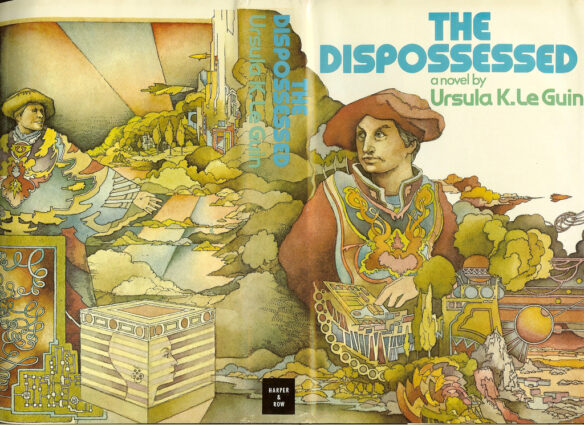
- 1974: Ursula K. Le Guin publishes The Dispossessed: An Ambiguous Utopia. Now 52 years old, the work remains a cornerstone of anarchist, non-violent speculative literature.
- 1993: Sam Neill captivates global audiences as Dr. Alan Grant in Jurassic Park, a role that would define his cinematic legacy.
- 2026: A series of developments mark the current year, including the release of Mike Flanagan’s Carrie adaptation, the rise of ground-based robotic warfare in Ukraine, and the passing of Sam Neill.
III. Supporting Data: The Enduring Power of the Mundane
The case of The Dispossessed by Ursula K. Le Guin offers a sharp contrast to the modern tech-billionaire narrative. Le Guin wrote the novel not as an escapist fantasy, but as a deliberate study of pacifism and non-violent resistance, heavily influenced by the social climate of the Vietnam War era.
Unlike the "infinite growth" models proposed by modern tech giants, Le Guin’s work focused on the "value of failure" and the "strength of what is weak." The novel’s enduring status—having never gone out of print since its 1974 debut—speaks to a reader base that values complexity over the simplified, techno-optimist narratives currently dominating Silicon Valley discourse.
IV. Official Responses and Industry Shifts
The creative industries are responding to these shifts in consumer and political taste with varied strategies.

The "Flana-fam" and the Modern Horror Pivot
Director Mike Flanagan’s upcoming Carrie series for Prime Video marks a deliberate shift in how classic horror is treated. By moving away from the "clenched-fist" portrayal of the past, Flanagan’s version emphasizes a "wide-open" teenage experience, aiming to highlight themes of empathy and bullying that resonate with the digital age. This modernization suggests that the industry is looking to bridge the gap between legacy IP and contemporary social anxiety.
The Robotic Revolution in Conflict
The transformation of ground warfare in Ukraine serves as a grim, real-world application of robotic technology. Unlike the high-concept, software-heavy drones of the sky, ground robots are being built by "welders and grease monkeys." These machines—delivering supplies, hauling ammunition, and capturing trenches—are proving more essential than traditional infantry in certain contexts. This shift underscores a broader trend: the most effective technology is often that which solves immediate, gritty problems rather than that which promises abstract, long-term salvation.
V. Implications: Whose Vision Will Prevail?
The overarching question of our time is not whether science fiction will shape reality—that process is already well underway—but rather, whose version of that reality will prevail.
The Dominance of Fantasy in Comics
In the realm of comics, creators like Kelly Thompson are pushing against the limitations of legacy characters. Her work on DC’s Absolute Wonder Woman illustrates a successful pivot toward high fantasy, allowing characters to exist in specialized lanes (Superman as sci-fi, Wonder Woman as fantasy). This fragmentation of roles prevents the "pigeonholing" of female characters and allows for more nuanced storytelling.
The Critique of "Woke" vs. Substance
The critical discourse surrounding recent failures, such as the Supergirl film, is also evolving. As creators like Princess Weekes point out, the debate should move past the simplistic "anti-woke" versus "woke" binaries. Instead, the focus should be on whether a narrative works on its own terms, whether it honors the character’s history, and whether it offers a compelling vision of the future.
The Passing of an Icon
The death of Sam Neill at 78 has prompted a wave of tributes that emphasize his grounded, humanistic approach to acting. His preference for his New Zealand farm over the "frustrations" of Hollywood highlights the same tension seen in the works of Le Guin: the choice between the artificiality of the limelight and the genuine, lived-in reality of the human experience.
Conclusion
As we look forward, the tension between the "visionaries" of Silicon Valley and the humanistic, collective-focused traditions of classic science fiction will only intensify. The challenge for the next generation of storytellers and consumers is to reclaim the genre from those who would use it as a thin veil for private profit and ego. Whether through the lens of literature, television, or the raw reality of the battlefield, the stories we tell about the future will inevitably define the future we build. By revisiting the works of Le Guin, interrogating the motives of tech titans, and supporting honest, nuanced storytelling, we ensure that our future remains a shared project rather than a private frontier.