Nana Wu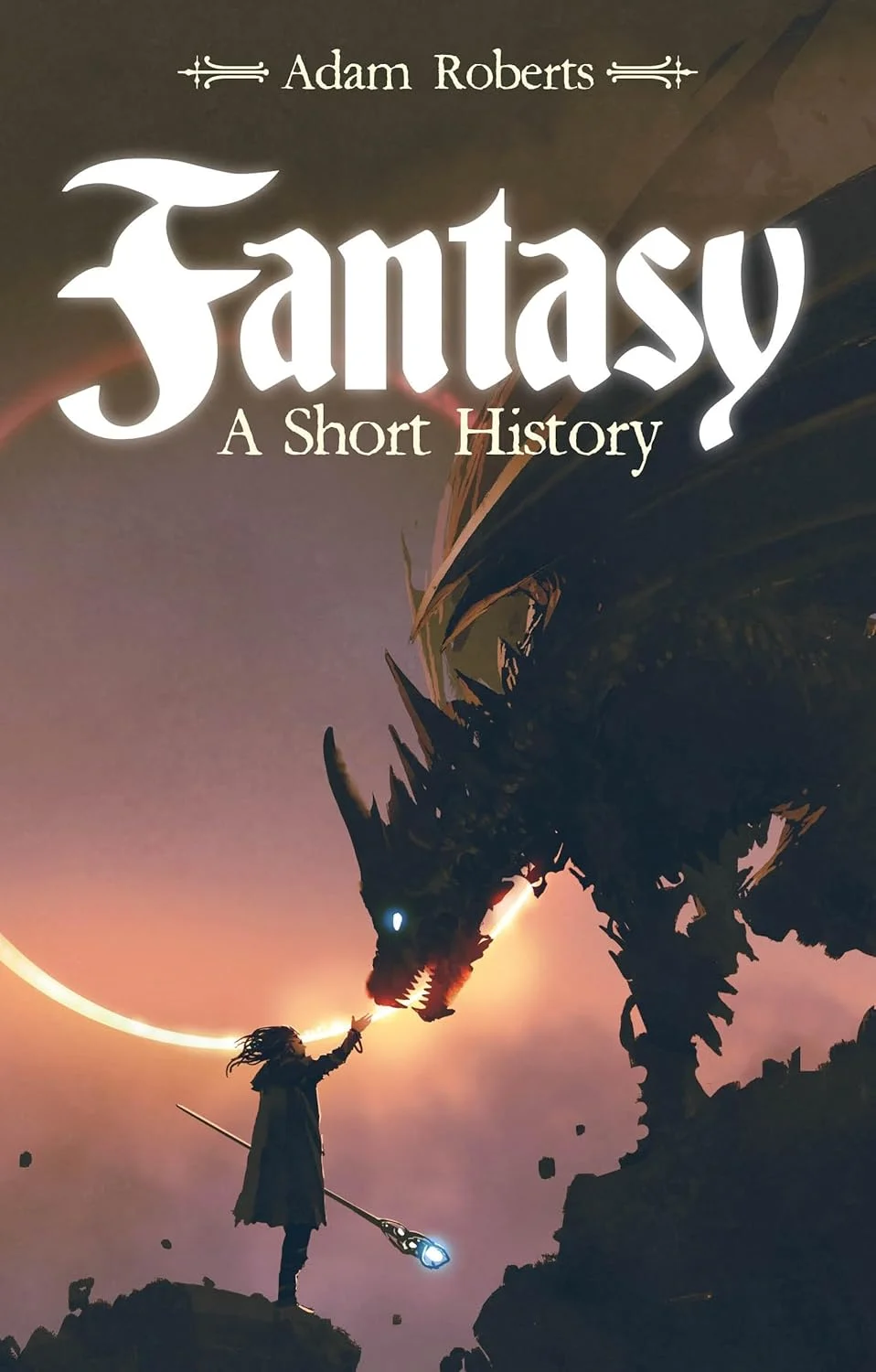
In the modern academic landscape, the divide between Science Fiction (SF) and Fantasy is often treated as a binary of logic versus wonder. While SF is frequently characterized as the literature of cognitive estrangement—a medium for hypothesis-testing and the interrogation of technological change—Fantasy is relegated to the role of a re-enchanter. It is the literary endeavor that seeks to restore magic to a world stripped of its mystery by industrialization, capitalism, and rationalist discourse.
In his latest work, Fantasy: A Short History, Adam Roberts—a scholar whose 2006 seminal text The History of Science Fiction fundamentally altered our understanding of speculative genres—attempts to map the sprawling, tangled, and often contradictory lineage of the fantastic. Roberts posits that while SF serves as the "Other" to received religion and realism, Fantasy emerges as the "Other" to science fiction itself.
The Anatomy of the Genre: Defining the "Short History"
At its core, Fantasy: A Short History is an ambitious attempt to provide a coherent genealogy for a genre that is notoriously difficult to categorize. Roberts argues that while myth and legend are ancient, "Fantasy" as a distinct literary genre is a comparatively recent phenomenon. This distinction is crucial to his thesis: one can only seek to "re-enchant" a world that has already been disenchanted.
Roberts traces the roots of the genre through Victorian medievalism, the allegory of John Bunyan, and the folk-tale tradition of the Brothers Grimm. He explores how these disparate threads coalesced into the modern fantasy landscape, anchored by the foundational pillars of J.R.R. Tolkien’s Middle-earth and C.S. Lewis’s Narnia.
The Tree and the Trunk: A Structural Analysis
Roberts utilizes the metaphor of a tree—a baobab or a banyan—to describe the growth of the genre. The roots are deep, pulling from Romantic nationalism and the völkisch traditions of the 19th century, while the branches stretch into the contemporary era. However, Roberts is quick to point out that the genre’s reliance on magical and mythic idioms makes it inherently resistant to liberal rationalism. He notes that the "fantasy past" is an idealized construct, designed both to reflect and critique the anxieties of modern, disenchanted industrialism.
Chronology: From Allegory to the Age of Sequels
The evolution of the genre, as presented by Roberts, is a journey from the isolated allegories of the early modern period to the hyper-prolific, franchise-driven landscape of the 21st century.
The Foundation (19th Century – Mid-20th Century)
The genre found its footing through the intersection of children’s literature, Gothic horror, and the "secondary world" construction popularized by Tolkien. Roberts highlights how authors like Lord Dunsany and James Branch Cabell paved the way for the mid-century explosion of the genre, where authors like Ursula K. Le Guin and Peter S. Beagle began to experiment with the constraints of the form.
The Expansion (1970s – 2000s)
The late 20th century saw the commodification of fantasy. With the influence of Dungeons & Dragons and the growth of paperback fantasy lists, the genre shifted toward the "series" format. Roberts observes a pivotal transition during this era: the emergence of "fantasy as a theme park." Readers began to crave immersive, self-enclosed worlds that they could visit repeatedly. This shift led to the rise of what Roberts calls "dissipating epic prolixity," where series become less about a singular narrative arc and more about the continuous expansion of a fictional universe.
The Contemporary Era: "Instauration" and Critique
In the modern landscape, Roberts identifies a trend he calls "instauration"—a concept borrowed from John Clute. Instauration is essentially "fix-it" storytelling on a world-building level. Modern authors are not merely creating new worlds; they are actively rebuilding the "temples" of their predecessors, addressing the inherent biases—such as white supremacy or rigid hierarchical structures—found in the classic texts of the mid-20th century.
Supporting Data and Critical Perspectives
Roberts does not shy away from critiquing the giants of the industry. His analysis of Brandon Sanderson, Robert Jordan, and George R. R. Martin provides a fascinating look at why these authors remain commercial powerhouses despite, or perhaps because of, their specific tropes.
- George R. R. Martin: Roberts characterizes the A Song of Ice and Fire series as a "blood-soaked hypocrisy," where readers can enjoy the trappings of chivalry while simultaneously reveling in the subversion of those very ideals.
- J. K. Rowling: Roberts identifies the Hogwarts setting as a "Panopticon-like space." He argues that the series evolves into a narrative where the older generation is systematically required to sacrifice the younger, creating a dark, surveillance-heavy atmosphere that permeates the later books.
- Video Games: Roberts addresses the rise of the digital medium, noting that while titles like Skyrim are significant forms of contemporary fantasy, they are often "instrumentalizing" and "flattening" compared to literature, due to their reliance on goal-oriented, often violent gameplay loops.
Official Responses and Scholarly Reception
The academic community has largely received the book as a provocative, if inevitably incomplete, guide. While some critics have pointed out the gaps in his coverage—such as his relative silence on non-English traditions, comics, or graphic novels—the consensus remains that Roberts has provided a vital framework for future study.
The author’s focus on prose style and verbal nuance—such as his observation of Le Guin’s etymological world-building in Earthsea—demonstrates a deep respect for the craft. His willingness to acknowledge his own biases while simultaneously analyzing the mass appeal of authors he personally dislikes provides a refreshing layer of honesty to the critique.
Implications: The Future of the Fantastic
What are the implications of a genre that is constantly looking backward, yet desperately trying to rectify the sins of its past?
The Tension of Boundaries
The central tension identified by Roberts is the ecotone between commerce and imagination. The fantasy genre is currently caught in a cycle of "re-running the ritual." As readers, we are often drawn to fantasy to escape the crushing weight of modern reality. However, as the genre matures, the demand for these stories to be more inclusive, more diverse, and more self-aware has become the primary engine of innovation.
The "Saddest Words in English"
Roberts concludes his history by referencing the final lines of Tolkien’s The Return of the King: "Well, I’m back." For the fantasy reader, this is the ultimate paradox. We enter these worlds to escape, yet the goal of the best fantasy—the kind that engages with the "instauration" of broken systems—is to provide us with the tools to return to our own world with a clearer, more critical perspective.
Conclusion
Adam Roberts’ Fantasy: A Short History is a monumental, if bounded, achievement. It serves as a compass for navigating the dense, often overwhelming thicket of modern fantasy literature. By grounding his analysis in the history of ideas—and acknowledging that the genre is as much about the "disenchanted present" as it is about the "enchanted past"—Roberts has provided a essential text for anyone interested in why we continue to tell stories of magic, dragons, and impossible worlds in an age of silicon and steel.
Whether or not one agrees with his assessment of specific authors or his exclusion of non-prose media, the strength of the book lies in its ability to synthesize a chaotic, vast genre into a readable, thoughtful, and ultimately hopeful history. It reminds us that even when we are deep in the woods of a secondary world, the path back to reality is always present, provided we know how to look for the trail markers.


 Basiran
 Lina Irawan