

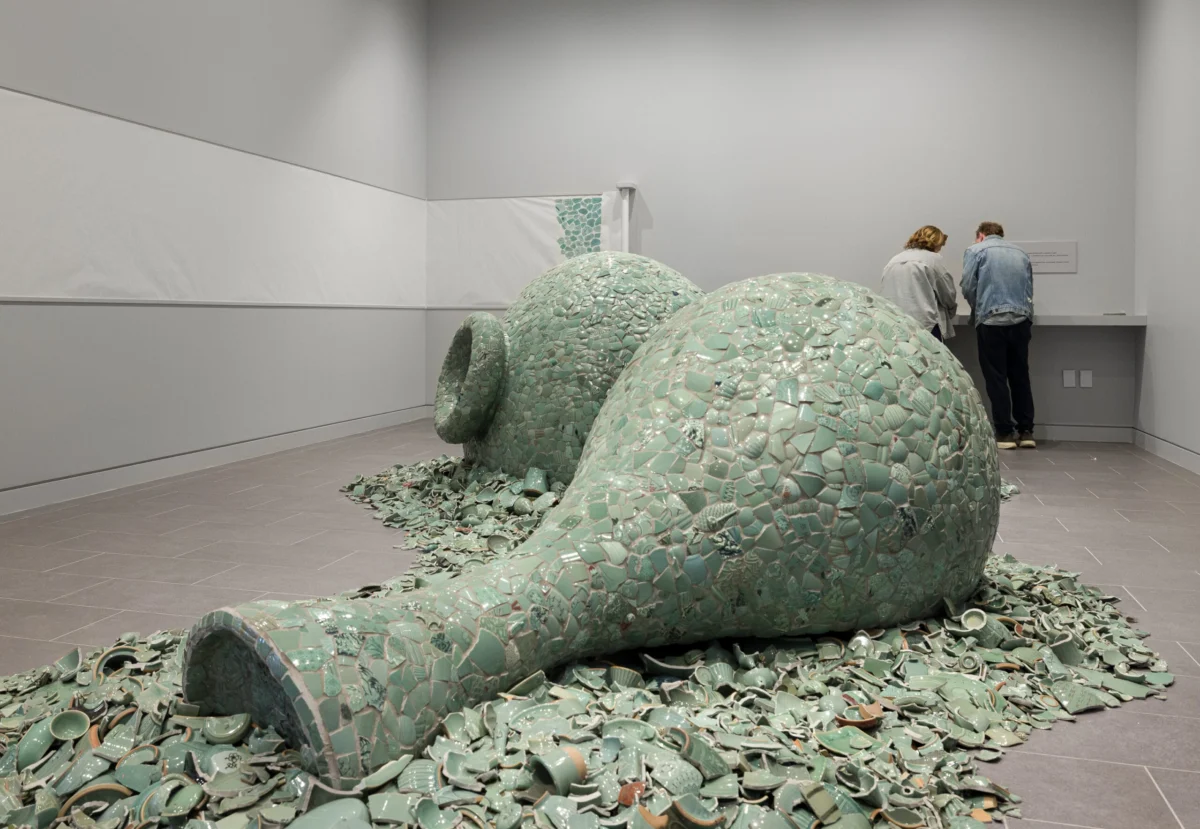
In the serene, light-filled expanse of the Green-House at Green-Wood Cemetery in New York, an extraordinary transformation of material and meaning has taken root. Artist Jean Shin has unveiled Celadon Landscape, a breathtaking, large-scale installation that utilizes nearly two tons of porcelain fragments to create a dialogue between the weight of history and the fluidity of the present. The work, which features a monumental pair of vessels appearing to spill their contents into a shimmering pool of green, stands as a meditation on the beauty found in the discarded and the resilience inherent in the fragmented.
The Core Concept: Redefining Beauty in Fragmentation
At its heart, Celadon Landscape is an exploration of the life cycle of objects. Shin, a New York-based artist renowned for her ability to breathe new life into mass-produced materials, has gathered thousands of shards—broken cups, saucers, and pots—that were once deemed unusable by artisans in South Korea.

By repurposing these ceramic remnants, Shin challenges the traditional valuation of art objects. In Korean history, celadon—a type of pottery characterized by its iconic pale green-blue glaze—has long been held as a pinnacle of aesthetic and cultural achievement. Traditionally, these objects are revered for their perfection and preservation. Shin, however, pivots the viewer’s attention to the "imperfect"—the waste piles generated during the creation of these masterpieces. In doing so, she argues that these fragments are not merely trash; they are vessels of memory, pulsing with the history of the hands that shaped them and the culture that birthed them.
A Chronology of Creation: From Icheon to New York
The journey of Celadon Landscape is as layered as the mosaic work itself. The project originated from Shin’s deep engagement with the ceramic heritage of South Korea. During extensive visits to Icheon, a city world-renowned for its pottery production and ceramic history dating back to the 10th century, Shin witnessed the staggering volume of material cast aside by contemporary makers.

Phase 1: Material Acquisition and Curation
Shin spent months working alongside local ceramicists, collecting thousands of discarded fragments. These pieces were not chosen at random; they were curated based on their texture, color, and historical resonance. Each shard represents a failed attempt, a kiln accident, or a production error, effectively acting as a silent witness to the rigorous standards of traditional craft.
Phase 2: Structural Design and Fabrication
Once the materials were transported to the United States, the process of reconstruction began. Collaborating with Miotto Mosaics Art Studios, Inc., Shin undertook the complex task of organizing these two tons of porcelain into a cohesive, large-scale sculpture. The design required an intricate engineering approach to ensure that the "spilling" effect—the transition from the rigid vessel form to the fluid, floor-level pool—appeared both organic and structurally sound.

Phase 3: Installation at Green-Wood
The installation was meticulously placed within the Green-House at Green-Wood. The site itself, a place dedicated to memory and the passage of time, provides a poignant backdrop for a work that seeks to honor the "memory" of discarded objects. The installation opened to the public, marking the second iteration of the project, and is slated to remain on view through January 17.
Supporting Data and Technical Scope
The scale of Celadon Landscape is best understood through its quantitative and material complexity:

- Weight: The installation utilizes approximately 4,000 pounds (nearly two tons) of porcelain shards.
- Materiality: The shards consist of authentic celadon-glazed porcelain, sourced directly from the production centers in and around Icheon, South Korea.
- Artisanal Input: The fabrication process involved a collaborative effort with Miotto Mosaics, ensuring that the structural integrity of the mosaic could withstand public viewing while maintaining the delicate, fragmented aesthetic intended by the artist.
- Dimensions: The piece occupies a significant portion of the gallery floor, designed to mimic an archaeological excavation where the vessels appear to be unearthed from the ground itself.
The Artist’s Perspective: "Beauty in the Imperfect"
In her official commentary, Jean Shin underscores the philosophical shift she hopes to inspire in her audience. "Celadon vases occupy a prized place in Korean cultural history—objects of reverence, painstakingly made and carefully preserved," Shin explains. "In Celadon Landscape, I shift the gaze to what is usually discarded: thousands of broken ceramic shards. I see in their imperfection not loss, but beauty—fragments that still pulse with the memory of Korea’s enduring legacy."
Shin’s work has long functioned as a bridge between environmental consciousness and cultural identity. By focusing on the diaspora experience, she uses the act of "repair" as a metaphor for the immigrant journey—a process of gathering pieces of a heritage that has been scattered, broken, and reassembled in a new environment.

Societal and Environmental Implications
The implications of Celadon Landscape extend far beyond the aesthetic. By placing discarded industrial waste at the center of a high-art installation, Shin forces a reckoning with modern consumption patterns.
Environmental Care and Sustainability
The work serves as a silent, powerful indictment of the "throwaway culture" that defines much of contemporary manufacturing. By reclaiming two tons of material that would otherwise languish in a landfill, Shin advocates for a circular approach to art and production. She challenges the viewer to consider the environmental footprint of our material desires and the potential for "re-creation" rather than destruction.

Community and Identity
The piece also serves as a study in community. The collaboration with South Korean artisans highlights the interconnectedness of global craft communities. Furthermore, the installation invites viewers from all backgrounds to consider their own relationship with "brokenness." In a world that often demands perfection, Celadon Landscape offers a space for communal reflection on how we piece together our identities from the fragments of our past.
A Legacy of Engagement
As the exhibition continues its run at Green-Wood, it serves as a testament to the power of public art to transform institutional spaces into sites of critical inquiry. By choosing a location steeped in history, Shin invites a conversation about the persistence of memory. The vessels, though physically damaged and incomplete, are presented as objects of newfound dignity.

For those who wish to follow the trajectory of Shin’s work or engage with the ongoing discourse surrounding her installations, the artist maintains an active presence on social media, providing glimpses into her studio practice and the conceptual foundations of her upcoming projects.
Conclusion
Celadon Landscape is more than just a sculpture; it is a profound act of preservation. It reminds us that our history is not solely defined by the pristine, finished objects that we curate in museums, but also by the shards we leave behind. Jean Shin’s mastery lies in her ability to take these remnants—the ghosts of production—and weave them into a landscape that speaks to the endurance of culture and the beauty of healing.

As the installation invites visitors to walk among the "pool" of green fragments, they are invited to walk through history itself—a history that is, by its very nature, broken, beautiful, and continuously being made anew. Through her vision, the discarded is redeemed, and the broken is made whole.











No comments yet. Be the first to join the conversation!