Laily UPN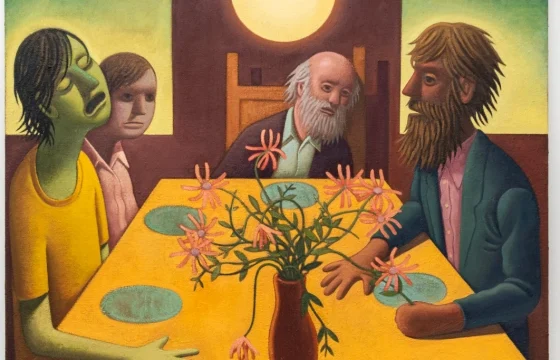
Introduction: A Return to the Canvas
HESSE FLATOW is proud to announce the opening of Franklin, a poignant new exhibition of paintings and works on paper by Nat Meade. Marking the artist’s third solo presentation with the gallery, the exhibition serves as a profound meditation on the cycles of life, the weight of paternal legacies, and the quiet resilience of the human spirit. On view through April 18, 2026, Franklin invites viewers into a dreamlike, allegorical world where the mundane intersections of family life are elevated to the status of myth.
Meade, whose practice has long been defined by his ability to bridge the gap between personal narrative and universal archetype, reaches a new level of emotional maturity in this body of work. By weaving together the threads of his own identity—as a father, a son, a partner, and an academic—Meade constructs a visual language that is at once deeply specific and hauntingly familiar.
The Chronology of a Creative Evolution
To understand the significance of Franklin, one must look at the trajectory of Meade’s career. Over the past decade, the artist has consistently interrogated the human condition, moving from early figurative explorations of isolation toward a more complex, multi-generational storytelling.
- The Early Years (Formative Influence): Meade’s initial works often focused on the individual’s struggle against nature. His subjects were frequently depicted as being at the mercy of turbulent winds and crashing waves, serving as metaphors for the uncontrollable forces of the psyche.
- The Middle Period (Existential Validation): As his practice matured, Meade moved toward the "lone traveler" trope. These paintings sought existential validation, questioning the role of the individual within a modern, often alienating, societal structure.
- The Current Era (The Legacy of Franklin): Following the recent passing of his father, Meade’s focus shifted inward. The current exhibition is the culmination of years of contemplation on what it means to inherit, perpetuate, or break cycles of trauma. The introduction of younger figures—children and adolescents—into his compositions signals a departure from the "storm-tossed" narratives of the past, favoring instead a focus on reconciliation and renewal.
Thematic Architecture: Decoding the Allegory
Meade’s work does not rely on traditional portraiture. His figures are not specific individuals, but rather actors in a recurring drama of human nature.
The Paternal Ghost
The title of the exhibition, Franklin, is a cryptic reference to the 1974 horror classic The Texas Chain Saw Massacre. By invoking the film’s portrayal of a deranged, claustrophobic patriarchal family, Meade acknowledges the "inner turmoil" inherent in lineage. He does not shy away from the darker aspects of the father-son dynamic: the violent impulses, the lust for power, and the weight of inherited trauma.
In several works, we see ghostly specters hovering over the main subjects. These figures, reminiscent of the soul peeling away from the body in animation, represent the shedding of burdens. They are simultaneously ghosts of the past and the potential for a lighter future.
Mythological Resonance
Meade intentionally anchors his contemporary figures in historical and literary iconography. A vulture picking at a corpse evokes the eternal, agonizing punishment of Prometheus; a bearded, crawling figure calls to mind William Blake’s Nebuchadnezzar, a king undone by his own hubris and desire for dominion. These references serve to universalize Meade’s personal experiences, suggesting that the struggles of a modern father are merely the latest chapter in a very old, very human story.
The Shift Toward Harmony: A New Visual Vocabulary
Perhaps the most striking development in Franklin is the introduction of younger figures, whose presence serves as a visual counterpoint to the heaviness of the adult world.
From Turbulence to Stillness
While previous series saw figures fighting against the elements, the youth in Franklin exist in a state of grace. In one composition, a boy steers a boat by the light of a radiant torch, his path seemingly unclouded by the baggage of his predecessors. In another, an adolescent reaches into a secluded cove to touch the sea floor, surrounded by anemones and starfish. These scenes of discovery replace the "crashing waves" of earlier works with "calmer seas."
The Guiding Hand
In a central piece, Meade depicts two pairs of legs—one adult, one child—submerged in a shallow, tranquil pool. The adult tenderly guides the child. This imagery of mentorship and gentle navigation represents the core of the exhibition’s message: that by acknowledging the "rocky histories" of the past, one can provide a safer passage for the next generation. It is an act of healing that recognizes the necessity of both the struggle and the resolution.
Supporting Data: The Psychological Landscape
The emotional weight of Franklin is not merely stylistic; it is supported by the artist’s deliberate use of space and color to create a sense of "allegorical distance." By placing his figures in environments that feel both domestic and otherworldly, Meade allows the viewer to project their own experiences onto the canvas.
- Intergenerational Dynamics: The recurring motif of legs and feet—dangling from clouds, treading in pools—serves as a grounding element. They emphasize the physical reality of the human body, even as the narrative explores metaphysical concepts like birth, death, and the soul’s departure.
- Sublimation of Impulse: The gallery notes highlight that Meade’s characters are often "visibly sublimated." This refers to the psychological process of channeling base, aggressive, or painful impulses into productive, artistic, or social expressions. This is the central labor of the artist: turning the "insurmountable heaviness" of grief and memory into a tangible object of beauty.
Official Commentary: The Artist’s Intent
While Meade remains a quiet observer, the curation of Franklin speaks volumes about his current philosophy. Through his work, he posits that vulnerability and pain are not weaknesses, but necessary precursors to acceptance. By embracing the "absurd, somber, and humorous tropes" of existence, he creates a space that is "rife with human nature."
HESSE FLATOW’s presentation underscores this by keeping the installation intimate. The exhibition is designed to allow viewers to move through the rooms as if moving through the stages of a life cycle—from the shadows of the patriarchal past to the bright, potential-filled horizons of the youth.
Implications: The Resilience of the Human Spirit
The implications of Franklin extend beyond the gallery walls. At a time when societal divisions are often framed as insurmountable, Meade’s work offers a refreshing perspective on progress. He does not suggest that the past can be erased or that the "ghosts" can be entirely banished. Instead, he argues for the "stubborn resilience of human nature."
The exhibition suggests that we are all, in some way, navigating the waters left behind by our predecessors. Whether we are the ones steering the boat with a torch or the ones tentatively wading into the cove, the act of "reaching in" to touch the sea floor—to engage with the world as it is, rather than as we fear it to be—is where healing begins.
Conclusion: A Must-See Exhibition
Franklin is more than an exhibition; it is an act of reconciliation. By confronting the "violent and antagonistic impulses" of the past, Nat Meade has created a collection that is deeply moving and intellectually rigorous. It is a rare show that manages to be both a personal exorcism and a public invitation to reflect on one’s own lineage.
As the exhibition continues its run through April 18, 2026, it serves as a reminder that even in the face of death, trauma, and the complex, often messy reality of familial bonds, there is space for grace. For those who seek art that does not merely decorate but challenges and consoles, Franklin is an essential experience. Through these paintings, Meade proves that while we may be born from history, we are not defined by its weight—provided we are willing to guide, and be guided, toward calmer waters.


 Asep Darmawan
 Basiran