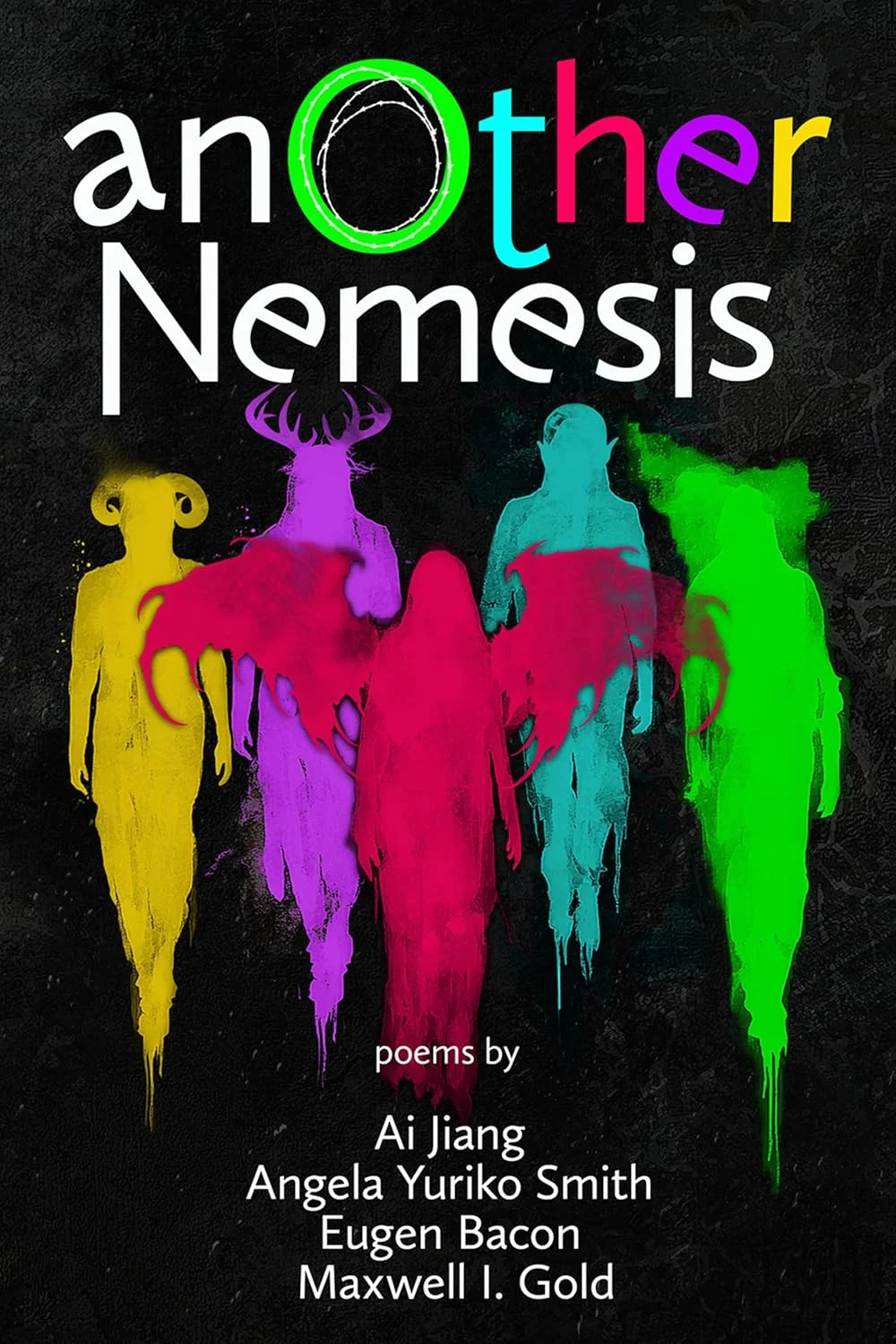
Collaborative literary projects often function as a high-wire act. By bringing together multiple distinct voices, authors face an inherent structural challenge: how to reconcile individual visions while maintaining a coherent collective narrative. In anOther Nemesis, a new anthology featuring the combined poetic efforts of Ai Jiang, Angela Yuriko Smith, Eugen Bacon, and Maxwell I. Gold, this tension between the individual and the collective is laid bare. While the collection succeeds as a powerful tapestry of feminist, anti-colonial discourse, it leaves readers questioning whether the architectural decisions behind its assembly truly serve the work, or if they act as barriers to a more cohesive dialogue.
The Political Horizon: A Cohesive Core
Whatever questions may arise regarding the book’s internal structure, its political mission is undeniably sharp and unified. The four poets share a fierce, uncompromising feminist and anti-colonial perspective that permeates every page. In this regard, anOther Nemesis is remarkably consistent. It offers a window into a global, multi-racial, and multi-ethnic project of resistance, one that prioritizes forward-thinking imagination over passive reflection.
The collection is organized into four distinct, numbered sections: "The Colonizers," "Primal Sources," "Nameless Others," and "Crooked Ontologies." Within each section, the reader encounters the poems in a rigid, repeating sequence: first Ai Jiang, then Angela Yuriko Smith, followed by Eugen Bacon, and finally Maxwell I. Gold. Each cluster is preceded by a "Behind the Poems" note from the respective author. This mechanical repetition creates a predictable rhythm, ostensibly providing an arc that the reader can navigate. However, as the reading progresses, the strict adherence to this pattern begins to feel arbitrary, leading to the central critique: does the structure enhance the poetry, or does it merely impose a shell upon it?
Conceptual Organization vs. Narrative Flow
The titles of the sections signal an intent to organize the book around conceptual frameworks rather than narrative arcs. This is a common strategy in contemporary poetry, intended to guide the reader through shifting intellectual landscapes. "The Colonizers" sets the stage as the opposition; "Primal Sources" posits an origin point for power; "Nameless Others" centers the subaltern subjects in whose name the resistance is mounted; and "Crooked Ontologies" acts as a theoretical framework for anti-colonial existence.
Yet, there is a fundamental mismatch between these high-concept headers and the actual experience of reading the poems. The titles suggest a logical progression or a dialogue between different phases of political engagement, but in practice, the sections feel largely interchangeable. It becomes difficult for the reader to discern why a particular poem was assigned to a specific section. While the themes of life under contemporary capitalism and the need for feminist resistance are present throughout, the poems rarely engage with one another across the boundaries of the authors’ distinct clusters. They remain parallel lines that never quite intersect.
The "Behind the Poems" Paradox
The inclusion of authorial notes at the start of each segment is a thoughtful inclusion, promising to bridge the gap between the poems and the section titles. However, these notes often exacerbate the sense of isolation between the works. While the notes themselves are often poignant and intellectually rigorous—particularly Eugen Bacon’s evocative reflections on the trauma of erasure in "Nameless Others"—they frequently fail to illuminate the connection between the poems and the broader themes of the section.
Instead, these notes serve to further silo the authors. By directing the reader’s focus toward the specific, personal history of the individual poet and their particular artistic process, the notes pull the reader away from the collection’s overall structure. Rather than helping the book coalesce into a single, unified text, they encourage the reader to view each author’s contribution as a standalone object. This turns the anthology into what feels like four separate, nested chapbooks that have been loosely bound together rather than integrated.
Individual Approaches to the Political
Despite the structural friction, the individual voices within the collection are profound, each offering a distinct lens on the shared political project.
Angela Yuriko Smith: Mythic Modernity
Smith’s project is perhaps the most formally consistent. Her use of the haibun—a form combining prose and haiku—to channel mythological figures into contemporary settings is a highlight. By casting figures like Circe as content creators and Cassandra as a social media prognosticator, Smith bridges the gap between ancient archetypes and modern digitally-mediated alienation. While the repetitive nature of her language reinforces the shared vision of her subjects, it occasionally slows the momentum of the collection.
Ai Jiang and Eugen Bacon: The Innovation of Intensity
Ai Jiang’s work stands out for its formal experimentation. Her use of redacted acrostics and her focus on the borders and boundaries of the nation-state provide some of the most conceptually innovative moments in the book. Jiang’s work circles the structures of oppression with a surgical, reflective quality.
In contrast, Eugen Bacon offers a visceral "presencing." Her poetry is less concerned with reflection and more focused on the immediacy of physical and political violence. In lines like "The calmness of the gun before a bullet shatters your face," Bacon refuses the reader the comfort of abstraction. This viscerality creates a striking, necessary contrast to the more contemplative modes found elsewhere in the collection.
Maxwell I. Gold: The Utopian Treatise
Maxwell I. Gold provides a necessary, albeit different, contribution: the strand of utopian critique. His poems, such as "The Assimilation of Gods That Were Never Gods," lean into a directness that borders on the didactic. While his work provides a clear, hopeful vision for the future, it occasionally sacrifices poetic ambiguity for the sake of the message, feeling more like a treatise in verse than a lyrical exploration.
Implications for Collaborative Poetics
The ultimate question posed by anOther Nemesis is one of value: what does the anthology gain from its collaborative format? The book succeeds in offering a broad, kaleidoscopic view of feminist and decolonial poetics. It proves that the "political" can be an aesthetic virtue, not merely a thematic background.
However, the structural tensions within the volume—the mismatch between the conceptual sectioning and the internal content—suggest a missed opportunity. The anthology does not fully leverage the potential for a genuine, interactive dialogue between the four poets. When a collection of this ambition is presented, the reader expects a conversation; instead, they are given a series of statements.
The book acts like a tectonic plate shifting under pressure; the energy is immense, but the resulting "fault lines" between the sections prevent the work from achieving a singular, unified impact. While readers interested in the intersection of poetry and political theory will find much to admire in the individual contributions, the collection as a whole remains a study in the difficulties of collaboration. It is a work of significant political merit, yet it leaves one wondering if a more fluid, less rigid structure might have allowed these four powerful voices to resonate more deeply with one another.
Ultimately, anOther Nemesis stands as a testament to the fact that while shared political goals are a necessary starting point, they are not a substitute for an integrated architectural vision. The poets have provided the raw, brilliant material; the task of reconciling that material remains a challenge for future collaborative endeavors of this nature.