

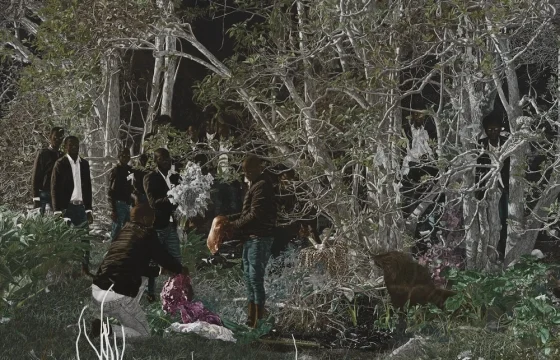
In the hushed, cavernous spaces of the contemporary gallery, South African painter Cinga Samson invites viewers into a nocturnal realm where the boundaries between the physical world and the metaphysical unknown dissolve. His latest exhibition, Ukuphuthelwa, is not merely a collection of oil paintings; it is a sustained meditation on the act of perception, the failure of representation, and the spiritual intensity of sleeplessness. On view through April 18, 2026, the exhibition marks a profound evolution in Samson’s practice, challenging the viewer to look beyond the static image and engage with a vast, kinetic reality.
The Semantic Depth of the Night
The title of the exhibition, Ukuphuthelwa, is drawn from the artist’s native isiXhosa. While it is often colloquially translated as "insomnia," Samson is quick to reject the medicalized, negative connotations associated with the English term. For the artist, the condition is not a malady to be corrected, but a state of heightened spiritual alertness—a "sensitivity that deepens in the dark."
This conceptual framework is mirrored in his signature aesthetic. Samson employs an occluded palette—dominated by carbon, deep Prussian blues, and near-black tones—to construct scenes that seem to emerge from the void. These are not dark paintings in the traditional sense, but works that explore the architecture of shadow. Figures, dogs standing in overgrown velds, and indigenous flora are rendered with a forensic precision that feels both grounded and deeply alien, inviting a slow, contemplative engagement that resists immediate categorization.
A Chronology of Artistic Inquiry
Samson’s trajectory has long been defined by his attempt to grapple with the "existential gravity" of painting. The development of the Ukuphuthelwa series represents the culmination of a multi-year inquiry into the limitations of the signifier.
- Early Career: Samson initially gained recognition for his moody, often ceremonial portraiture, which questioned the historical representation of the Black body in Western art history.
- The Transition (2023–2024): The artist began to move away from purely figurative narratives, increasingly incorporating landscape and symbolic motifs that hinted at a broader, less tethered existentialism.
- The Ukuphuthelwa Period (2025–2026): Moving into 2026, the work reached a new level of abstraction regarding the "truth" of an image. The current exhibition features works such as Umlindo (Watcher) and Tshee, which serve as focal points for this period of intense, disciplined output.
- Exhibition Timeline: The exhibition officially opened in early 2026 and will remain on public display until its conclusion on April 18, 2026, serving as a significant touchstone for contemporary African art.
The Gulf Between Sign and Referent
At the heart of Samson’s new body of work is a philosophical quandary: how does one create a "true and honest painting" when the image can only ever function as a relative symbol?
Samson posits that there is an unbridgeable gulf between the static, painted sign and the fluid, living experience it gestures toward. He acknowledges that his technical mastery and convincing realism might invite the viewer to search for fixed meanings, yet he insists that his work is designed to confront the viewer with the inherent instability of interpretation.
Consider the recurring figure of the dog in works such as Intsingiselo II (2026). A Western viewer might interpret the dog through the lens of loyalty and domesticity. Conversely, an amaXhosa perspective might recognize the dog as a symbolic conduit for ancestral protection and guidance. Samson does not choose between these interpretations; rather, he celebrates the "open-ended nature" of the symbol. The paintings act as catalysts for meaning, acknowledging that the image is never the equivalent of the reality it reflects, but merely a threshold.
Ritual and the Vernacular of the Divine
The thematic structure of the exhibition is anchored by the aesthetics of ritual. In Umlindo (Watcher), figures gather in a forest clearing, clutching bouquets of wildflowers and lengths of fabric. The scene possesses the visual grammar of a ceremony, yet the purpose, addressee, and outcome of the ritual remain purposefully obscured.
Samson argues that the ritual itself is secondary. "The ritual itself is not the important thing—it’s an opening to what exists beyond," he explains. By utilizing the visual language of ritual, he addresses a collective human need for orientation in a vast, unknowable universe.
This sense of mystery is furthered by the use of isiXhosa titles like Imfihlo (Secret) and Intsingiselo (Meaning). These titles serve as linguistic signposts that acknowledge the inadequacy of translation. Just as the paint cannot fully capture the spirit of the subject, the English translation of an isiXhosa concept cannot fully capture the cultural and spiritual weight of the original. Meaning, for Samson, lives in the interstice between two languages and the gap between paint and reality.
Technical Mastery: The "Magic Trick" of Light
Technically, Samson’s work is characterized by a "flickering" quality—an optical rhythm that grants visibility to his nighttime scenes. He describes his approach to light as "a magic trick," utilizing transparency and layers to build chromatic density.
A key innovation in the Ukuphuthelwa series is the artist’s decision to leave the pupils of his figures’ eyes unpainted. This stylistic choice is transformative:
- Porosity: The unpainted pupils allow "light" to circulate through the figure, integrating them into the atmosphere of the painting.
- De-personification: Without pupils, the figures cease to be specific, personified identities. They become "human forms" enmeshed with the landscape, stripping away the hierarchy where the subject masters the object.
- Transparency: By leaving sections of the under-drawing visible, Samson highlights the constructed nature of the image, inviting the viewer to see the "trick" while simultaneously being moved by the result.
In works like Isiganeko (2026), the application of thin glazes wiped back to reveal the under-drawing creates a brooding density that is both physical and psychical. It is a testament to an artist who is comfortable letting the viewer see the mechanics of his labor, thereby demystifying the act of creation to heighten the mystery of the result.
Implications: The Sublime in the Ordinary
The ultimate implication of Ukuphuthelwa is a re-enchantment of the mundane. By imbuing ordinary objects, people, and landscapes with an unexplained, lingering mystery, Samson suggests that the divine is not found in an elsewhere, but is present in the "vernacular of all things."
The sublime, often defined by the oscillation between the approachable and the overwhelming, is the bedrock of this series. Whether it is the brilliant white of a moonwashed cloud in Tshee (2026) disrupting a cold, eerie night, or the "mute enormity" of a rocky crag in Sithini ngelilitye (2026), Samson is cataloging moments of awe.
His figures do not look outward; they do not seek to engage the viewer in a traditional sense. Instead, they exist in a state of "shared knowledge" with the environment. The bird in flight, the bowing foliage, the vigilant dog, and the figure are all part of a single, coherent, and mysterious whole.
As the exhibition runs its course through April 2026, Ukuphuthelwa stands as a profound challenge to the contemporary gaze. It asks the viewer to move beyond the desire for definitive interpretation and instead embrace the "hypersensitivity" of the wakeful. In Cinga Samson’s hands, painting becomes a conduit for something far greater than representation—it becomes a bridge to the unnameable, linking the viewer to the vast, complex, and deeply spiritual reality that remains in motion just beyond the edge of our perception. By embracing the limits of what he can paint, Samson successfully touches upon the infinite.










No comments yet. Be the first to join the conversation!