Nana
Nana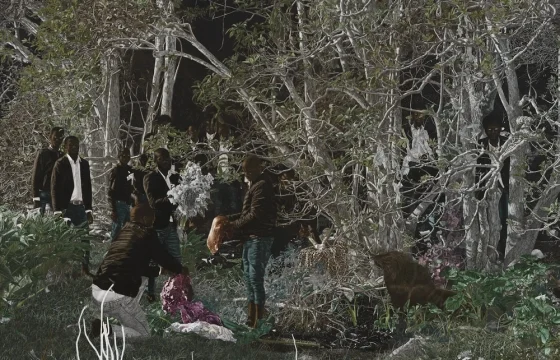
Introduction: A State of Spiritual Alertness
South African artist Cinga Samson’s latest exhibition, Ukuphuthelwa, is not merely a collection of oil paintings; it is a profound meditation on the limits of human perception and the vast, unnameable reality that persists just beyond our reach. The title, derived from the artist’s native isiXhosa, translates directly to "unable to sleep." Yet, unlike the clinical, pathologized Western notion of "insomnia"—often viewed as a deficit to be cured—Samson’s Ukuphuthelwa describes a state of heightened spiritual alertness. It is a sensitivity that intensifies in the darkness, inviting a contemplative engagement with the mysteries of the mundane.
On view through April 18, 2026, the exhibition serves as a significant milestone in the career of one of South Africa’s most compelling contemporary voices. Through a signature palette of deep Prussian blues, carbon blacks, and near-obscured tones, Samson invites viewers to step into a nocturnal realm where figures, dogs, and native flora become vessels for a deeper, existential inquiry.
The Philosophy of the Image: The Gulf of Representation
At the heart of Ukuphuthelwa lies a fundamental question that has haunted painters for centuries: how does one create a "true and honest painting"? For Samson, the act of painting is inherently paradoxical. He views his role not as a mirror to reality, but as a maker of symbols—signs that point toward a truth they can never fully encompass.
The Limits of the Sign
Samson posits that there is an unbridgeable gulf between the static, painted sign and the fluid, chaotic experience of existence. His technical mastery—marked by deft brushwork and convincing realism—might lead a viewer to assume that his works are literal interpretations of their subjects. However, the artist intentionally frustrates this impulse. He asserts that an image can only ever be a relative symbol, never the equivalent of the reality it reflects.
Consider the recurring figure of the dog in works like Intsingiselo II (2026). A viewer unfamiliar with the artist’s cultural context might read the dog as a symbol of domestic loyalty. Conversely, an amaXhosa viewer might interpret the same figure through the lens of ancestral protection and guidance. By embracing these divergent, subjective interpretations, Samson highlights the instability of meaning. He does not disguise the limitations of his medium; instead, he uses those limitations to gesture toward that which exceeds the representable.
Chronology and Context: The Evolution of a Vision
The journey to Ukuphuthelwa has been defined by a consistent, rigorous exploration of the "vernacular of the divine." Since his emergence on the international stage, Samson has moved away from traditional portraiture toward more atmospheric, ceremonial compositions.
- Early Period: Samson’s early work focused on the intimacy of the figure, often exploring identity within the constraints of social and historical narratives.
- The Mid-Career Shift: A gradual move toward larger, more complex landscapes and multi-figure scenes began to define his aesthetic, emphasizing the "existential gravity" of his subjects.
- 2026 – The Present: Ukuphuthelwa represents a culmination of these themes. The paintings created for this exhibition suggest a transition from representing the subject to representing the energy that binds the subject to its environment.
Each piece in the current exhibition, from the enigmatic Imfihlo (Secret) to the evocative Intsingiselo (Meaning), was meticulously crafted over the past two years, reflecting a period of intense focus on the "instability of interpretation."
Supporting Data: Technical Mastery and the "Magic Trick"
Samson’s technical approach is as much a part of the message as the subject matter itself. He treats light like a "magic trick," utilizing a unique rhythm of flickering visibility that shifts across the canvas.
The Anatomy of the Void
A defining feature of the series is the use of transparency. In Isiganeko (2026), Samson applies thin glazes and then wipes them back, allowing the under-drawing to remain visible. This technique serves two purposes: it lends a brooding, chromatic density to the figures and creates a sense of psychical unsteadiness.
The most striking detail, however, is the treatment of the eyes. In all of his figures, the pupils are left unpainted. By stripping the figures of their pupils, Samson denies them the ability to "look" in a traditional sense. They are not personified individuals; they are porous forms, enmeshed with the atmosphere of the landscape. They do not possess the world; they are a part of it. This choice reinforces the idea that the figures’ knowledge comes not from an outward gaze, but from a shared, internal understanding of the world they inhabit.
Official Perspectives: The Artist’s Quandary
In recent discussions regarding the exhibition, Samson has been vocal about the "heavy" nature of his work. He describes the sky and the landscape not as passive backdrops, but as active participants in the drama of existence.
"The sky can be so friendly, but sometimes so heavy, dark, so scary," Samson notes. "It’s the same energy, but it exists in different forms."
This statement highlights the artist’s engagement with the concept of the "sublime"—a state of being where one feels both overwhelmed and drawn to the vastness of the unknown. In works like Tshee (2026), where a brilliant moonwashed cloud cuts through a void of night, Samson captures this oscillation between the approachable and the overwhelming. The painting does not offer comfort, but it does offer an encounter with a "mute enormity" that feels both ancient and immediate.
Implications: The Divine in the Vernacular
The implications of Ukuphuthelwa extend beyond the walls of the gallery. By utilizing isiXhosa titles, Samson forces a negotiation between two languages—a process where meaning, much like the relationship between the painting and the referent, slips through the interstices.
A Collective Need for Orientation
In Umlindo (Watcher) (2026), figures gather in a forest clearing, holding bouquets and fabrics. The scene carries the unmistakable grammar of a ritual, yet the specific purpose of that ritual remains absent. For Samson, the ritual is merely an "opening to what exists beyond." It speaks to a universal, collective need for orientation in a world that often feels chaotic or devoid of structure.
The Immanent Magic
Ultimately, Ukuphuthelwa argues that the divine is not found in some distant, otherworldly realm. It is present in the "vernacular of all things"—in the bowing foliage, the vigilant dog, and the bird caught mid-flight. The exhibition serves as a call for the viewer to cultivate a similar "hypersensitivity."
When Samson speaks of painting as a "thing that links us to God," he is careful to define his terms: "By God, I mean everything." This radical inclusivity is the crux of the exhibition. By stripping away the pretense of representation, Samson creates a space where the ordinary is revealed to be extraordinary.
Conclusion: A Lingering Presence
As the exhibition remains on view through April 2026, it stands as a testament to the power of the unnameable. Samson’s work does not aim to resolve the mysteries it presents; it aims to sustain them.
Ukuphuthelwa asks us to consider what we might discover if we were, like the artist, unable to sleep—if we remained awake to the flickering light, the shifting shadows, and the quiet, persistent majesty of the world around us. In the end, the paintings function not as answers, but as portals. They invite us to dwell in the darkness, to find the sublime in the mundane, and to recognize that the most profound truths are often those that reside in the spaces between what we know and what we can only feel.
Through his mastery of form, light, and silence, Cinga Samson has successfully created an environment where the "authority of the unnameable" is not only acknowledged but celebrated. It is an exhibition that demands not a quick glance, but a long, slow, and ultimately transformative way of seeing.

 Sagoh
Sagoh
 Lina Irawan