

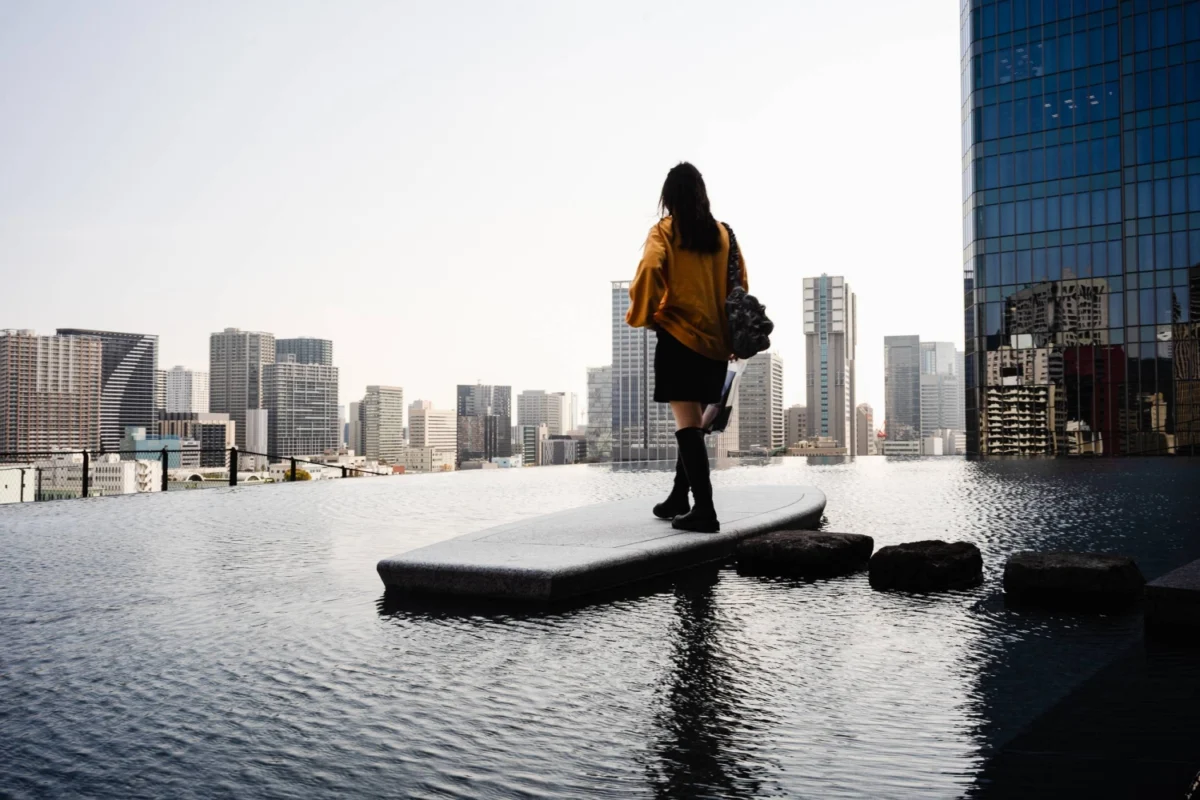
Minutes into exploring Takanawa Gateway City, a realization dawns: the traditional, frantic pace of Tokyo’s street-level navigation feels increasingly like a relic of a bygone era. A woman and her child glide silently past on a self-driving, hydrogen-powered “Iino” transport—a curved, wood-paneled vessel that looks more like a piece of high-end minimalist furniture than a public transit vehicle. Moments later, a group of businessmen drift by on another, followed by a father and son. They are moving with an effortless grace that makes those of us still walking look like we are participating in a slow-motion protest against the future.
Most tourists who visit Tokyo eventually return home insisting the city “lives in the future.” If Japan’s latest megadevelopments are to be believed, that future is not a cold, metallic dystopia, but a hyper-efficient, highly curated, and exceptionally pleasant shopping mall.
The Genesis of a Global Gateway
Opened in March by JR East, Takanawa Gateway City represents one of Japan’s most ambitious urban redevelopment projects to date. Billed as a "global gateway" designed to withstand the next 100 years, the project is a masterclass in modern planning. It features the Kengo Kuma-designed Museum of Narratives—a cultural landmark intended to ground the hyper-modern site in history and storytelling—alongside integrated office towers, retail galleries, and expansive greenery.
The project is the cornerstone of JR East’s "Greater Shinagawa Area" initiative. As Tokyo prepares for the future integration of the Chuo Shinkansen maglev line, which will slash travel times between Tokyo and Nagoya, the Takanawa development serves as the critical transit and commercial heartbeat of the capital’s southern corridor.
Chronology of a Transformation
The evolution of the Takanawa district is a multi-stage project aimed at revitalizing Tokyo’s aging urban infrastructure.
- 2020: The Takanawa Gateway Station, also designed by Kengo Kuma, opens to the public. Drawing inspiration from the geometry of origami and the soft lighting of traditional shoji screens, the station functions more like an upscale wellness retreat than a transit hub.
- 2023: The completion and opening of Azabudai Hills signal a shift toward "integrated city" planning, where public and private boundaries are intentionally blurred.
- 2024: The opening of Shibuya’s Sakura Stage further advances the trend of massive, privately-managed transit-adjacent hubs.
- March 2026: The official launch of Takanawa Gateway City introduces the "Iino" robotic mobility fleet and the Museum of Narratives, marking a new benchmark in experiential urban design.
The Logic of the "Compact City"
The branding surrounding Takanawa Gateway City is not merely marketing fluff; it is a direct response to a mounting demographic crisis. With Japan’s population aging rapidly and urban density increasing, the "compact city" model has become a necessity.
According to the Cabinet Office’s latest annual report, 29% of Japan’s population is now 65 or older, with 16% over the age of 75. By 2070, these figures are projected to swell to 38% and 25%, respectively. In this light, the wide, obstacle-free paths and the seamless "Iino" transport system are not just luxuries—they are essential tools for accessibility.
"We need to make the outdoor space very comfortable, because that’s for everybody," says Jun Mitsui, CEO of the architectural firm Jun Mitsui & Associates. His firm, which played a pivotal role in the design of Azabudai Hills, emphasizes that the primary goal of these developments is to remove the "gates" between the public sidewalk and private commercial spaces. "If you live in Tokyo, you don’t sense the boundary between public and private. That sense of ‘no boundary’ is vital for psychological accessibility."
Retail as the Economic Engine
While the park spaces and museums provide the "soul" of the development, retail remains the engine. The Takanawa complex incorporates a NEWoMan retail center, echoing the successful model used at Shinjuku Station. However, the retail experience has been re-engineered for a post-online-shopping world.
At Mimure, a polished space within the complex, shoppers can move from a supermarket stocking locally sourced pickles and ¥1,300 miniature pineapples into a high-design dining area. The space is illuminated by bubbly, avant-garde light sculptures and surrounded by manicured indoor greenery.

Ludo Pittie, a consultant with the global urban design firm WSP, notes that physical retail is currently undergoing a existential pivot. "How do we bring people out to our shops?" Pittie asks. "It’s about maximizing the experience. It must be unique, enjoyable, and memorable—something that far exceeds the passive act of scrolling on a phone."
The Critics: A "Colony for the Rich"?
Not everyone views this clinical, curated future with unbridled optimism. Riken Yamamoto, a Pritzker Prize-winning architect, has been a vocal critic of the current wave of megadevelopments. Earlier this year, he warned that Tokyo risks turning into a "colony for the rich," where commercial efficiency and luxury aesthetics are prioritized over the chaotic, vibrant, and messy social character that once defined the city’s identity.
Critics argue that by sanitizing the urban experience, developers are removing the "friction" that makes a city a living, breathing organism. The narrow, serendipitous alleys of Yanaka or the neon-drenched intensity of Kabukicho provide a sense of place that a climate-controlled, corporate-managed plaza may never replicate.
However, defenders of the new model point to the practical limitations of older districts. For an elderly resident or a young parent with a stroller, the "messy" stairways and cramped alleys of historic Tokyo are not charming—they are barriers. The new developments, by contrast, offer a level of universal design that arguably makes the city more inclusive for those who have been traditionally marginalized by the physical constraints of the urban environment.
Designing for Longevity and Community
The ultimate test for Takanawa Gateway City will not be its opening-month foot traffic, but its performance 30, 50, or 100 years from now.
"We’ve been creating public spaces ever since we started creating cities," Ludo Pittie notes. "There are spaces that are centuries old that still work amazingly well. The key is simplicity and human connection."
Jun Mitsui agrees, proposing a metric for success: the "hometown test."
"In order to make a development into a ‘hometown,’ you have to have diverse places for kids to play and spaces that elderly people can enjoy at the same time," Mitsui says. "Intergenerational interaction is fundamental to aging well. If you make friends there, you feel attached to the neighborhood. And then, the neighborhood becomes your hometown."
Implications for the Future
As Tokyo continues to evolve, the tension between the "old city" and the "new city" will only intensify. The shift toward these mixed-use, privately-managed, and technologically-integrated hubs is a response to the reality of a globalized workforce and a shrinking, aging domestic population.
For now, the vision of the future is clear: it is a place where you can grab a high-end coffee, work remotely from a station bench, and watch a maglev train pull into a station designed with the elegance of a Japanese garden. Whether this creates a sustainable "hometown" or merely a transient "colony for the rich" remains to be seen. But as the "Iino" pods glide past the glass-fronted offices of Takanawa, one thing is certain: the way we navigate the city has changed forever, and the future, for better or worse, has arrived on schedule.












No comments yet. Be the first to join the conversation!