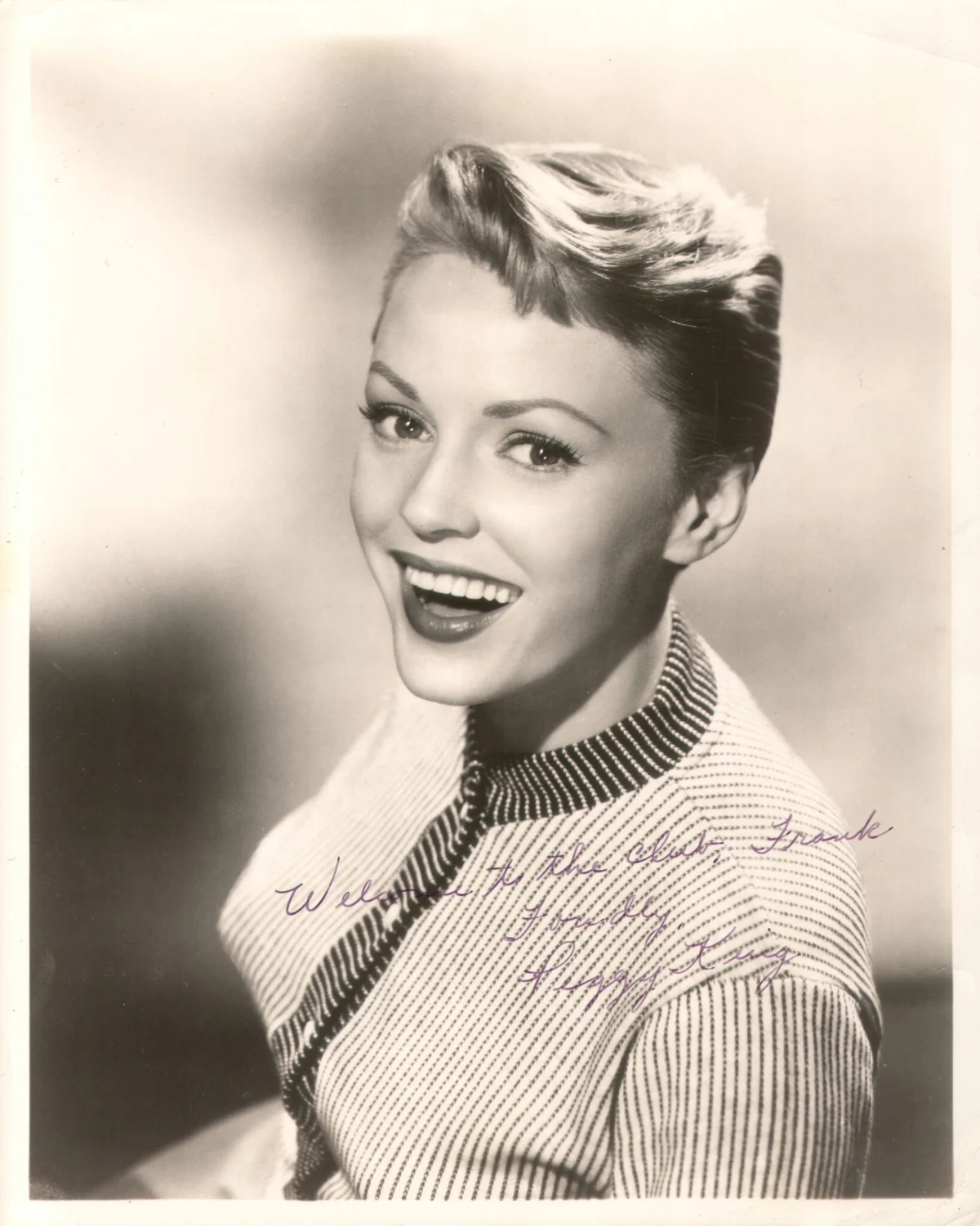
Peggy King, the effervescent singer and actress whose radiant personality and vocal prowess defined the burgeoning landscape of 1950s American television, has died. She was 96. Her passing was confirmed by her longtime publicist, Alan Eicher, who noted that King died Sunday at the Saunders House Assisted Living facility in Wynnewood, Pennsylvania, following a battle with Alzheimer’s disease.
For a generation of viewers accustomed to the transition from radio to the flickering black-and-white screens of the mid-20th century, King was a ubiquitous presence. Whether she was trading quips with George Gobel or crooning standards on the variety programs that dominated the era, King’s brand of optimism and musical dexterity earned her a permanent place in the pantheon of American entertainment.
A Career Defined by Charisma and Rhythm
Born on February 16, 1930, in Greensburg, Pennsylvania, to parents Floyd Henry King and Margaret Finan, Peggy King’s journey to stardom began long before she became a household name. After graduating from Ravenna High School, her early career took root in the Midwest, where she found work on Cleveland radio stations. Her natural talent for vocal performance eventually caught the attention of industry heavyweights, leading her to become a featured regular on The Mel Torme Show for CBS.
It was this early exposure that laid the groundwork for a transition to the medium that would define her career: television. By the time she reached the peak of her popularity in the mid-1950s, King was more than just a singer; she was a versatile performer capable of bridging the gap between musical comedy, dramatic acting, and variety hosting.
The Rise of "Pretty Perky Peggy King"
King’s career truly accelerated when she secured a regular spot on The George Gobel Show from 1954 to 1957. It was here that host George Gobel bestowed upon her the moniker "Pretty Perky Peggy King." The nickname was not merely a bit of alliterative showmanship; it captured the essence of her stage persona—a bright, infectious, and deeply talented performer who seemed to embody the post-war American spirit.
Her impact was immediate and measurable. In 1955, she was nominated for an Emmy Award for Best Female Singer, a testament to her vocal reach. That same year, she had the prestigious honor of performing "Count Your Blessings" at the Academy Awards. By 1958, she was co-hosting the Emmy Awards, further cementing her status as a premier talent in the television industry.
Chronology: A Lifetime on Stage and Screen
To understand the scope of Peggy King’s contribution to mid-century pop culture, one must look at the breadth of her work, which spanned recordings, film, and nearly every major television variety hour of the era.
- 1952: King signs a contract with MGM, leading to a cameo in the acclaimed Vincente Minnelli film The Bad and the Beautiful. She also contributed her vocals to the film’s soundtrack.
- Mid-1950s: Signed to a long-term contract with Columbia Records by the legendary Mitch Miller. She produced two best-selling albums and a string of successful hit singles.
- 1954–1957: The "Gobel Years," where she achieved national fame as a regular on The George Gobel Show.
- 1957: King moves into feature film acting with roles in Abbott and Costello Meet the Mummy and the thriller Zero Hour!, where she played a stewardess.
- 1960s and Beyond: Throughout the decades, King maintained a consistent presence in live theater and music, performing in Philadelphia, New York, and Los Angeles.
- 2010: Induction into the Broadcast Pioneers Hall of Fame.
- 2016: The release of her final album, Songs a la King, demonstrating her longevity and enduring connection to her craft.
Behind the Scenes: The "What Ifs" of a Storied Career
While King’s career was marked by immense success, it was also shaped by the capricious nature of the record industry. Perhaps the most famous anecdote in her professional history involves the song "Cry Me a River."
Composer Arthur Hamilton wrote the now-iconic torch song specifically for King. However, in a decision that remains a fascinating footnote in music history, Mitch Miller—the powerful A&R man at Columbia Records—refused to allow her to record it. The song eventually became a signature hit for Julie London, leaving fans to wonder how King’s unique vocal styling might have interpreted the classic ballad.
Despite this missed opportunity, King’s versatility remained her greatest asset. She excelled in television musicals, starring alongside Tab Hunter in Hans Brinker or the Silver Skates and appearing in a musical adaptation of Jack and the Beanstalk with heavyweights like Joel Grey, Celeste Holm, and Cyril Ritchard. Her ability to navigate dramatic roles on hit shows like Maverick and Dragnet proved that her talent was not limited to the musical stage.
Legacy and Official Recognition
Peggy King’s contributions were recognized during her lifetime through both institutional honors and public affection. She was among the inaugural group of celebrities to be honored with a star on the Hollywood Walk of Fame, a physical manifestation of her status as a television pioneer.
Her induction into the Broadcast Pioneers Hall of Fame in 2010 served to solidify her reputation as a woman who helped write the blueprint for the television variety performer. Even in her later years, King did not retire to the sidelines. She continued to perform regularly, bringing her classic repertoire to audiences in Philadelphia, New York, and Los Angeles as late as 2014, showing a relentless dedication to her fans and her art.
Beyond the bright lights, King was a person of deep personal resilience. Her commercial work, including a highly successful campaign for Hunt’s Tomato Sauce, demonstrated her ability to adapt to the changing commercial landscape of the 1950s. She navigated the transition from radio to television with a grace that few of her contemporaries were able to sustain.
Implications of a Life in the Spotlight
The passing of Peggy King marks the end of a chapter in the history of American entertainment. She was part of a cohort of performers who treated television as a live theater space—a place where spontaneity, vocal precision, and personality were paramount.
The decline of the variety show format in later decades changed the way television stars were cultivated, making the career trajectory of a "Pretty Perky Peggy King" a relic of a bygone era. Yet, the implications of her work continue to resonate. She proved that a singer could be a host, a comedian, and a dramatic actor simultaneously. Her career trajectory suggests that the "all-around entertainer" model, once standard, was a formidable path to success that shaped the landscape of modern media.
Furthermore, her battle with Alzheimer’s in her final years has brought renewed attention to the importance of specialized care for aging icons of the entertainment industry. Her family, including her daughter Suzy Rudofker and son-in-law Dwain Goforth, have been stewards of her legacy as she moved out of the public eye.
As we look back at her vast discography and her long list of television appearances—ranging from The Tonight Show Starring Johnny Carson to The Steve Allen Show—it is clear that Peggy King was more than a television star. She was a storyteller who used music and humor to connect with millions of Americans during the most formative years of the television age.
Final Reflections
Peggy King’s life was a testament to the power of talent combined with an unwavering work ethic. From her humble beginnings in Greensburg to the heights of Hollywood, she remained a symbol of the "perky," indomitable spirit that defined the optimism of mid-20th-century America.
While she may no longer be here to grace the stage or the screen, her recordings—and the memories of those who watched her bring joy to living rooms across the nation—remain. She leaves behind a legacy of professionalism, grace, and an enduring, vibrant musical footprint that will be studied and appreciated for generations to come.
In the words of those who knew her best, Peggy King didn’t just perform; she lived her music, leaving a "pretty perky" mark on the history of television that will never truly fade.