

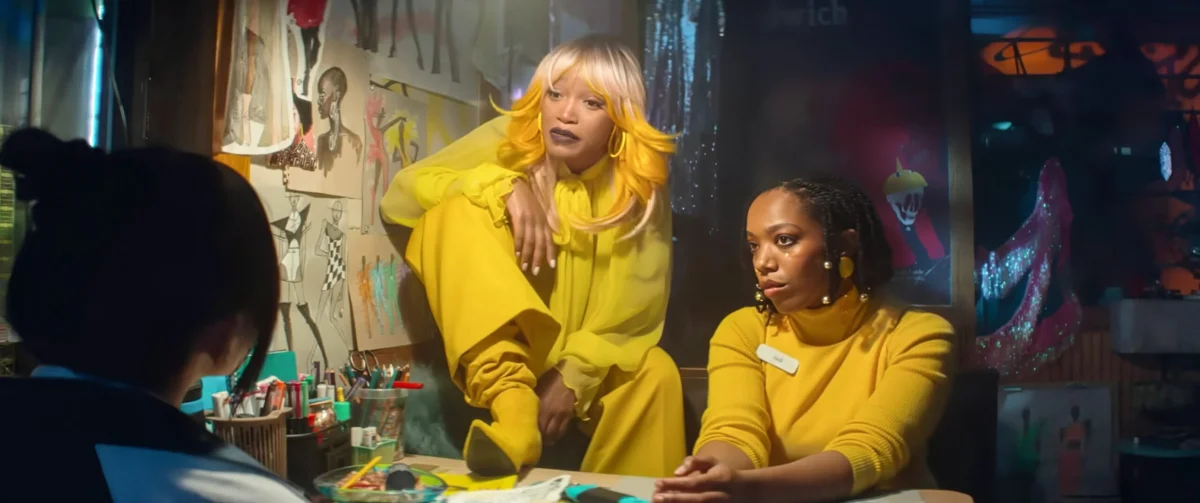
Boots Riley has never been one to color within the lines. Whether through his groundbreaking hip-hop roots with The Coup or his shift into surrealist, politically charged filmmaking with Sorry to Bother You and the Amazon series I’m a Virgo, Riley has consistently utilized the medium of film as a weapon against the status quo. His latest feature, I Love Boosters, arrives as his most ambitious, chaotic, and structurally defiant project to date.
The film follows Corvette (played by Keke Palmer), a young woman navigating the economic landscape of Oakland by "boosting"—stealing—designer clothes from upscale department stores to sell back to her community. While the premise suggests a high-stakes crime caper, the reality of the film is far more expansive, blending dialectical materialism with surrealist action sequences and a sharp, satirical critique of global capitalism.
The Economics of Scale: Doing More with Less
The most striking aspect of I Love Boosters is not just its narrative complexity, but its production efficiency. Produced on a budget of $20 million—a figure Riley notes could easily have ballooned into $70 million had it been managed through traditional industry standards—the film is a masterclass in creative resource management.
In a recent appearance on the Filmmaker Toolkit podcast, Riley addressed the industry’s pervasive tendency to "downsize" creative ambition alongside budgets. "A lot of times, especially in indie film, if you need to cut 30 percent of the budget, you cut 30 percent of the script," Riley explained. "That’s the easy, top-down way to do things. It doesn’t take a lot of ingenuity. People often say the film still has the ‘essence’ of the original idea, but the essence of a good idea is all we’ve got. You cannot sacrifice that."

Rather than diluting his vision, Riley leaned into the constraints. He adopted a strategy of extreme intentionality: limiting set construction, simplifying camera movements, and avoiding the "slickness" of high-end CGI transitions. By doing so, he not only preserved the structural integrity of his script but forced his team to find more inventive, tactile ways to solve visual problems.
A Chronology of Chaos: From Script to Screen
The production journey of I Love Boosters reflects Riley’s philosophy of "intentional friction."
- The Conceptual Phase: Riley began with a script that demanded a scope far beyond its $20 million budget, encompassing everything from teleportation-fueled heists to complex interpersonal dynamics.
- The Design Constraint: To maintain the film’s ambitious scope, Riley implemented a "one-wall" rule for key sequences, drawing inspiration from Peter Greenaway’s The Cook, The Thief, His Wife, Her Lover. By limiting the physical environment, the production team was forced to become more compositionally aggressive.
- The "Boosting" Montage: A central sequence featuring an ensemble cast—including Taylour Paige, Naomi Ackie, and Poppy Liu—performing a massive store clearance under the nose of a villainous designer (Demi Moore) was shot with rigid simplicity. The crew utilized a single angle for van-based transitions, heightening the comedy and the frantic energy of the heist.
- Lo-Fi Innovation: During a high-speed chase involving stop-motion animated villains, the production opted for practical effects over expensive CGI. By using string, simple jumps, and basic compositing, the team achieved a visual result that, while "janky" by modern blockbuster standards, serves the film’s humanistic and kinetic aesthetic.
Supporting Data: The High Cost of Slickness
The film industry often equates "production value" with digital polish. However, Riley argues that this pursuit of slickness is often the enemy of human-centric storytelling.
- Financial Impact: Traditional CGI for a single complex chase sequence can cost upwards of $30,000. By choosing a lo-fi, practical approach, Riley reallocated those funds to sustain the film’s broader narrative requirements.
- Performance Reliability: Riley eschewed the "safety" of multiple takes and varying angles, opting instead to trust his cast completely. "When I see the thing I like, that’s it," he remarked. "I’m not going to do extra safeties. I’ve learned that with music, too—you can keep trying all sorts of stuff, but sometimes the first or second iteration captures the truth."
- The Aesthetic of "Seams": By allowing the audience to "see the seams"—the intentional roughness of the production—Riley creates a visual language that feels inherently authentic. This "jankiness" becomes a stylistic choice rather than a sign of budget failure, mirroring the chaotic, unfiltered energy of the characters’ lives.
Official Perspectives: The Philosophy of the Filmmaker
Boots Riley’s approach is rooted in a deep-seated rejection of the "Hollywood grind," where filmmakers often spend years working on projects they find unfulfilling just to gain the leverage to eventually make the work they actually want.

"Making a movie takes a lot of your life, so I’m always weighing it out," Riley told IndieWire. "I hate the feeling when you’re like, ‘I’m doing this thing that I don’t like because at some point in the future, I’ll be able to do something I actually do like.’ You can fail by spending your life doing episodes of a show that you just mildly tolerate, and not doing your life."
For Riley, I Love Boosters is not just a film; it is a statement on the necessity of staying true to one’s creative impulses. His collaboration with his cast, including the star-studded ensemble tasked with taking down Demi Moore’s antagonist, reflects this trust. By stripping away the layers of corporate film production, he has allowed the core of the story—the struggle against gentrification, the complexities of labor, and the personal dreams of his protagonists—to shine through with startling clarity.
The Broader Implications for Indie Cinema
The success and methodology of I Love Boosters carry significant weight for the future of independent filmmaking. As the industry faces rising costs and a shrinking appetite for original, mid-budget content, Riley’s model offers a blueprint for survival.
1. The Death of the "Safety Net"
Riley’s refusal to shoot "safety" takes or rely on expensive, smooth transitions challenges the industry’s reliance on risk-aversion. His work suggests that a director’s confidence in their vision—and their ability to communicate that to their cast—is a more valuable asset than a massive post-production budget.

2. Radical Resource Management
The "one-wall" technique is more than just a money-saving tactic; it is an exercise in formalist rigor. By forcing the camera to exist in a single space, the film gains a theatrical intensity that CGI-heavy productions often lack. This approach could inspire a wave of filmmakers to seek out "limitations" as a means of unlocking new creative dimensions.
3. The Humanistic Imperative
Perhaps most importantly, I Love Boosters serves as a reminder that the "soul" of a movie resides in its imperfections. By embracing a "rougher" aesthetic, Riley maintains the humanity of his characters. In a world where digital de-aging and seamless VFX are becoming the norm, the visible, tangible effort put into every frame of I Love Boosters provides a refreshing, grounded counterpoint.
Conclusion: A Blueprint for the Future
Boots Riley has proven once again that he is a singular voice in contemporary cinema. I Love Boosters is not merely a heist film about a woman trying to make it in Oakland; it is an indictment of the systems that define our lives, told with the visual inventiveness of a director who refuses to be compromised.
Whether it is his exploration of the "demonic power" of relationships or his scathing look at the exploitation inherent in globalism, Riley packs more intellectual and emotional weight into his 90-minute runtime than most franchises do in a decade. By choosing to "show the seams," he invites the audience into the process, creating a viewing experience that feels as raw, honest, and urgent as the message he is trying to convey.

As I Love Boosters hits theaters, its impact will likely be felt not just at the box office, but in the editing rooms and on the sets of independent filmmakers who are currently learning that a limited budget doesn’t have to mean a limited vision. In the hands of a visionary, the limitations become the art itself.
I Love Boosters, a Neon release, is currently in theaters nationwide.









No comments yet. Be the first to join the conversation!