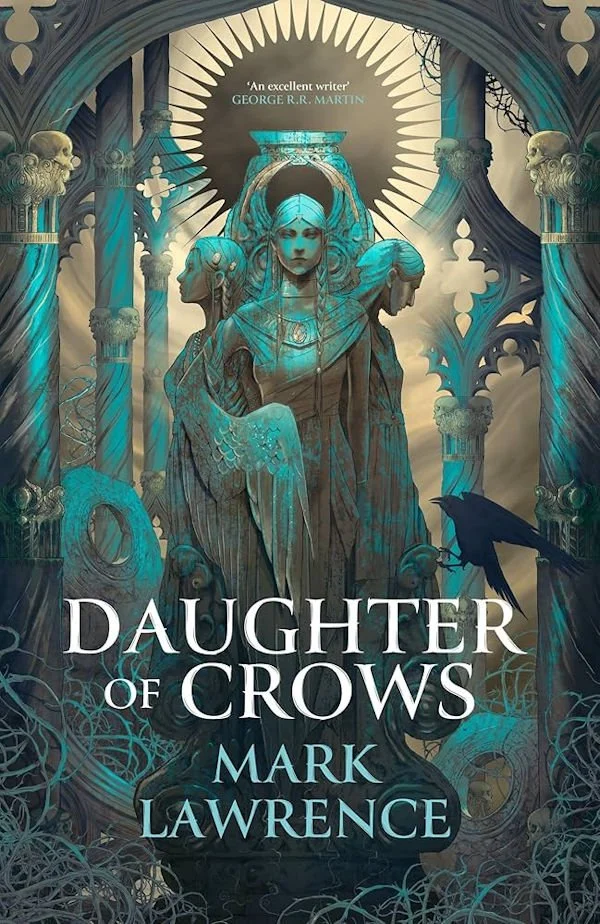
In the landscape of modern grimdark fantasy, few authors possess the surgical precision and moral complexity of Mark Lawrence. With his latest release, Daughter of Crows, the first installment in a new trilogy centered on the "Academy of Kindness," Lawrence has delivered a visceral exploration of trauma, identity, and the long, often bloody shadow cast by the past. The novel introduces us to Rue—a protagonist who defies the traditional archetypes of the genre—and invites readers into a world where mercy is a myth and vengeance is the only currency.
The Core Premise: An Academy of Retribution
The Academy of Kindness is a name that drips with irony. Far from a sanctuary for the gentle, it is a brutal institution designed to forge "agents of retribution." Drawing inspiration from the Furies of classical antiquity—the "Kindly Ones"—the Academy takes in a hundred girls each year, subjecting them to a decade-long crucible of violence and survival. From the necrotic fumes of the "Bone Garden" to the unforgiving sands of the "Wound Garden," the initiates are sculpted into weapons. By the end of their ten-year tenure, only three emerge, forever bound to the oldest, most merciless laws of justice.
The narrative hook is deceptively simple: Rue, a woman who sold herself into this nightmare, has spent a lifetime seeking peace. Now an old woman, she finds her quiet life shattered when war is brought to her doorstep. The result is a violent, explosive revelation of what she is truly capable of—a masterclass in showing, rather than telling, that an elderly protagonist is a force to be reckoned with.
Chronology: A Triple-Layered Tapestry of Trauma
One of the most ambitious aspects of Daughter of Crows is its structural reliance on three distinct, interlocking timelines that chronicle Rue’s life. Unlike standard narratives that track a character’s linear progression, Lawrence utilizes a non-linear approach that highlights the erosion of identity over time.
1. The Twilight Years: The Bitter Survivor
In the present, we meet an elderly, cynical Rue. Lawrence masterfully navigates the intersection of mental acuity and physical frailty. This portrayal offers a refreshing perspective on the aging process, moving beyond the "wise mentor" trope to present a character who is physically hindered by time but sharpened by a lifetime of tactical violence.
2. The Formative Years: The Academy of Kindness
The second narrative thread transports us to Rue’s time as Mollandra. This is the heart of the novel’s "grimdark" appeal. Watching 100 girls pitted against one another creates an environment of unrelenting tension. Here, Lawrence explores the forging of alliances—unbreakable, desperate bonds formed in the shadow of death. The prose is unflinchingly blunt, stripping away the romanticism often found in "coming of age" stories to reveal the scars left by institutionalized trauma.
3. The Eldest: A Descent into Horror
Perhaps the most unsettling of the three timelines is the reveal of Rue’s early childhood, where she acts as the "Eldest" among a group of children trapped in a domestic hell. Held prisoner by parents who exhibit supernatural, abominable qualities, this thread leans into horror. It provides the essential context for Rue’s later choices, revealing the cycle of abuse that necessitates her eventual "sale" to the Academy. It is a haunting exploration of how the worst traits of humanity are passed down, and how survival demands the sacrifice of innocence.
Supporting Data: Why This Matters for the Genre
The significance of Daughter of Crows lies in its subversion of standard fantasy expectations. While most high fantasy focuses on the "growth" of youth, Lawrence forces the reader to confront the "decay" and "accumulation" of age.
- The Theme of Memory: Memory is not merely a plot device here; it is the central character. Lawrence uses memory to illustrate how we are constructed by our pasts—what we suppress, what we hold onto, and how these fragments dictate our survival.
- The Pacing Mechanism: By balancing three distinct timelines, Lawrence avoids the fatigue that often accompanies multi-POV narratives. The lulls in action act as a necessary exhale for the reader, heightening the impact of the sudden, kinetic bursts of violence that define Rue’s life.
- A "Pulse-Driven" Style: The novel is described by critics as "grimdark with a pulse." It does not wallow in misery for the sake of shock value; rather, it finds beauty in the smallest, most fragile acts of kindness and companionship amidst a world of systemic cruelty.
Official Perspectives: An Interview with Mark Lawrence
Following the publication of Daughter of Crows, we had the opportunity to discuss the philosophy behind the book with Mark Lawrence himself.
On the decision to write an elderly female lead:
"The idea to show her old came from forums and social media where the desire to see older female main characters is frequently voiced," Lawrence explained. "I was either meeting that desire or calling their bluff."
On the psychological weight of the narrative:
When asked about the exploration of friendship in a brutal setting, Lawrence noted, "Friendships and relationships are a big part of being human, being both a strength and a weakness. I’ve always been interested in how those early chance encounters help form our foundations."
On the morality of his protagonists:
Lawrence is famous for creating characters who commit heinous acts yet remain compelling. His take on this is refreshingly pragmatic: "They just have to be interesting. That can be as simple as being entertaining—a sense of humor, outrageous behavior, a dedicated focus on murder… anything like that can be simple fun. We don’t worry too much that John Wick kills a hundred gunmen because someone killed his dog."
On the future of the series:
When pressed on whether the trilogy is about discovering Rue’s past or her future, Lawrence’s answer was characteristically enigmatic: "Yes." He noted that "next" is a complicated concept when dealing with a character whose timeline spans several decades.
Implications: The Legacy of the Academy
Daughter of Crows is more than a dark fantasy novel; it is an examination of what it costs to survive. By pitting the concept of "Kindness" against the reality of state-sanctioned violence, Lawrence holds up a mirror to the reader, asking how much of ourselves we are willing to discard in the name of safety.
The implications for the genre are clear: readers are ready for stories that are emotionally ruthless and intellectually challenging. The novel succeeds because it refuses to categorize itself—veering from fantasy to horror to character-driven drama without hesitation.
As the first book in a trilogy, Daughter of Crows succeeds in leaving the reader both satisfied and deeply hungry for the next installment. It leaves us with a lingering, uncomfortable question that Lawrence hopes we carry with us: How have the choices, chances, and traumas of our own lives shaped the people we have become?
For those prepared for a story that is as intellectually demanding as it is visceral, Daughter of Crows is an essential addition to the fantasy canon. It is a testament to the fact that while age may steal our vitality, it provides a depth of field that youth can never replicate. The Academy of Kindness may have produced a monster, but it also produced a survivor—and that survivor is just getting started.