

Introduction: A New Front in the Middle East Conflict
The volatile Strait of Hormuz, long recognized as the world’s most critical maritime chokepoint for global oil supplies, is rapidly transforming into a digital battleground. As the ongoing military conflict between the United States, Israel, and Iran enters its third month, the focus of Tehran’s regional aggression has shifted from traditional oil tankers to the very infrastructure that sustains the global digital economy: undersea internet cables.
In a move that has sent shockwaves through the telecommunications sector, Iranian officials have announced intentions to impose “license fees” on U.S. technology giants for the use and maintenance of fiber-optic cables running beneath the Strait. This development, coupled with veiled threats of sabotage, has forced major tech corporations and Gulf nations to accelerate desperate efforts to build overland, land-based fiber alternatives. The stakes are immense: nearly 99 percent of international data traffic relies on these subsea networks, and any disruption in the Gulf threatens to sever critical data links between the Middle East, Asia, and Europe.
The Chronology of Escalation
The current crisis did not emerge in a vacuum; it is the culmination of months of deteriorating security in the Persian Gulf.
- February 28, 2026: The conflict escalates significantly as U.S. and Israeli forces launch a coordinated aerial and naval campaign against Iranian military installations.
- March 2026: French telecommunications giant Alcatel Submarine Networks officially notifies its regional clients that it can no longer fulfill contractual obligations. The primary reason: their cable-laying vessels are stranded near Saudi Arabia, unable to navigate the increasingly hostile waters. This effectively halts a major Meta-backed project aimed at expanding connectivity across Africa.
- April 2026: Reports emerge of sophisticated Iranian-linked "crypto-scams" designed to lure commercial ships into dangerous areas of the Strait, while drone strikes target data centers in the region, including facilities operated by Amazon Web Services (AWS).
- May 9, 2026: Ebrahim Zolfaghari, a spokesperson for the Islamic Revolutionary Guard Corps (IRGC), issues a public statement on social media: "We will impose fees on internet cables."
- May 14, 2026: Admiral Brad Cooper of U.S. Central Command testifies before the Senate Armed Services Committee, confirming that U.S. forces have destroyed 161 Iranian naval vessels in an effort to maintain freedom of navigation.
Official Responses and the "Protection Fee" Strategy
The Iranian demand, while legally dubious under international maritime law, is being treated as a credible geopolitical threat by analysts. According to state-linked outlets such as Tasnim and Fars, the proposed framework would categorize major U.S. tech companies—specifically Meta, Google, Microsoft, and Amazon—as "users" subject to Iranian jurisdiction.
The proposal dictates that these companies must pay for "license fees" to utilize the cables, while simultaneously mandating that only Iranian entities be permitted to perform maintenance or repairs on the infrastructure.
Windward, a leading maritime intelligence firm, characterized this as a classic extortion play. "Operators face a binary choice," the firm noted in a recent brief. "They can either pay these protection fees and effectively grant Iran regulatory authority over regional seabed activity, or they can accept the reality that any future cable faults will go unrepaired indefinitely."
From Tehran’s perspective, the economics are logical. A single transoceanic cable system represents an investment of $300 million to $1 billion. The proposed "protection fee" is structured to be just low enough to entice corporations to pay to avoid the catastrophic revenue losses associated with a multi-week outage, yet high enough to provide a significant, illicit revenue stream for the Iranian state.
Supporting Data: The Vulnerability of the Gulf
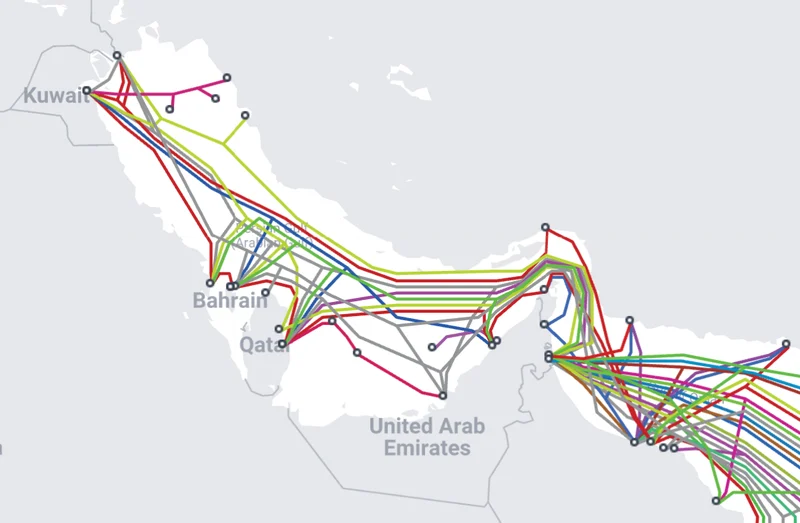
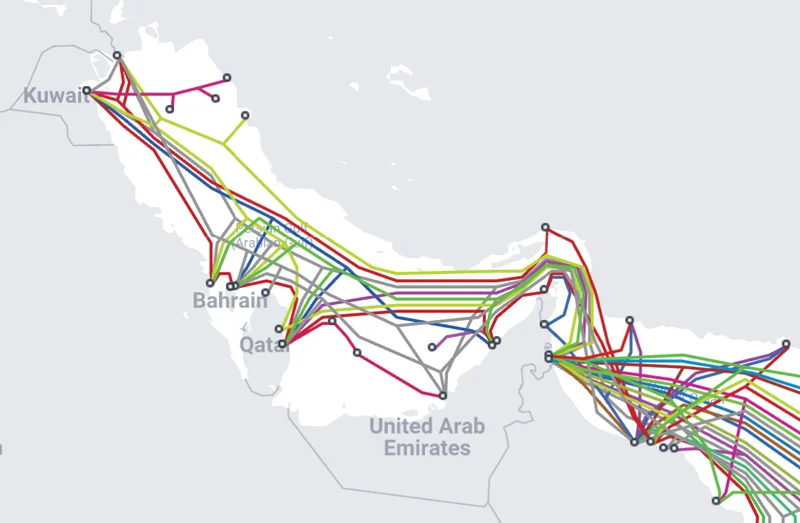
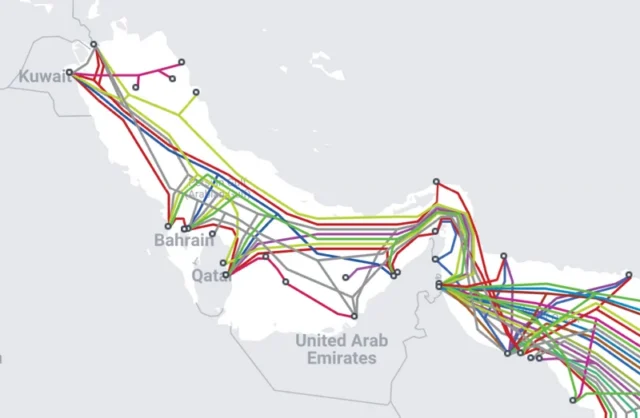
TeleGeography, a premier telecommunications research organization, has highlighted that the Strait of Hormuz is home to critical cable systems, including the Asia Africa Europe-1 (AAE-1), FALCON, and the Gulf Bridge International (GBI) Cable System.
The primary danger is not just a direct missile strike—though that remains a possibility—but the inherent fragility of subsea maintenance. Repairing a cable is a delicate, time-consuming operation. It requires specialized ships to drag massive, weighted grappling hooks along the seafloor to find, lift, and splice the fiber. This process, which can take weeks even in peaceful waters, is currently impossible in the Strait due to the presence of Iranian drones, fast-attack boats, and anti-ship missiles.
Even in the absence of intentional sabotage, the risk of "accidental" damage is extreme. In 2024, a drifting ship in the Red Sea—damaged by Houthi rebels—dragged its anchor and severed three major telecommunications cables. A similar incident in the narrow, heavily trafficked Strait of Hormuz would be a digital catastrophe.
Implications: The Pivot to Overland Infrastructure
In response to the mounting risk, a quiet but intense scramble is underway to bypass the Strait of Hormuz entirely. Tech companies and Gulf states are pivoting toward overland fiber-optic routes, despite the significant geopolitical hurdles involved.
The Land-Based Alternative
The current "Plan B" involves routing data through protected oil and gas pipeline corridors that stretch from the southern reaches of Iraq, through the Turkish border, and into the European heartland. This initiative, spearheaded by the Iraqi telecom firm IQ Networks, has garnered significant interest from Big Tech.
However, the shift to land is far from a silver bullet. These routes pass through some of the most politically unstable territories on earth, including Syria, Iraq, and parts of the Horn of Africa. Unlike subsea cables, which are buried deep beneath the waves, overland cables are susceptible to physical vandalism, state-level censorship, and the whims of regional governments.
The Economic Fallout
For the tech giants, the cost is mounting. Beyond the "protection fees" and the massive capital expenditure required to re-route their infrastructure, there is the ongoing cost of damaged data centers and lost business continuity. The drone strikes on AWS data centers in the region have already forced the company into months of expensive repairs, and other developers have hit the "pause" button on all Middle East projects indefinitely.
The Future of Global Connectivity
The situation in the Strait of Hormuz serves as a sobering reminder of the physical reality behind the "cloud." As the world becomes increasingly reliant on AI, high-speed data processing, and globalized communication, the physical infrastructure that carries that data has become a target.

If Iran succeeds in establishing its claim of authority over the subsea cables in the Strait, it could set a dangerous precedent for other nations to claim "sovereignty" over the deep-sea cables passing through their exclusive economic zones. This would fundamentally threaten the open, global nature of the internet, turning a decentralized network into a series of fiefdoms where connectivity is subject to the political stability and territorial ambitions of coastal states.
As the U.S. military continues to patrol the Strait, the focus will remain on keeping the physical sea lanes open for shipping. Yet, in the modern age, the most vital cargo is the invisible stream of data that powers the world’s financial and technological systems. Protecting that flow will require more than naval power; it will require a complete reimagining of how we build, secure, and diversify the global internet’s backbone. For now, the world waits to see whether the fiber-optic arteries of the Gulf will remain open, or if the digital chokepoint will finally be squeezed shut.












No comments yet. Be the first to join the conversation!