

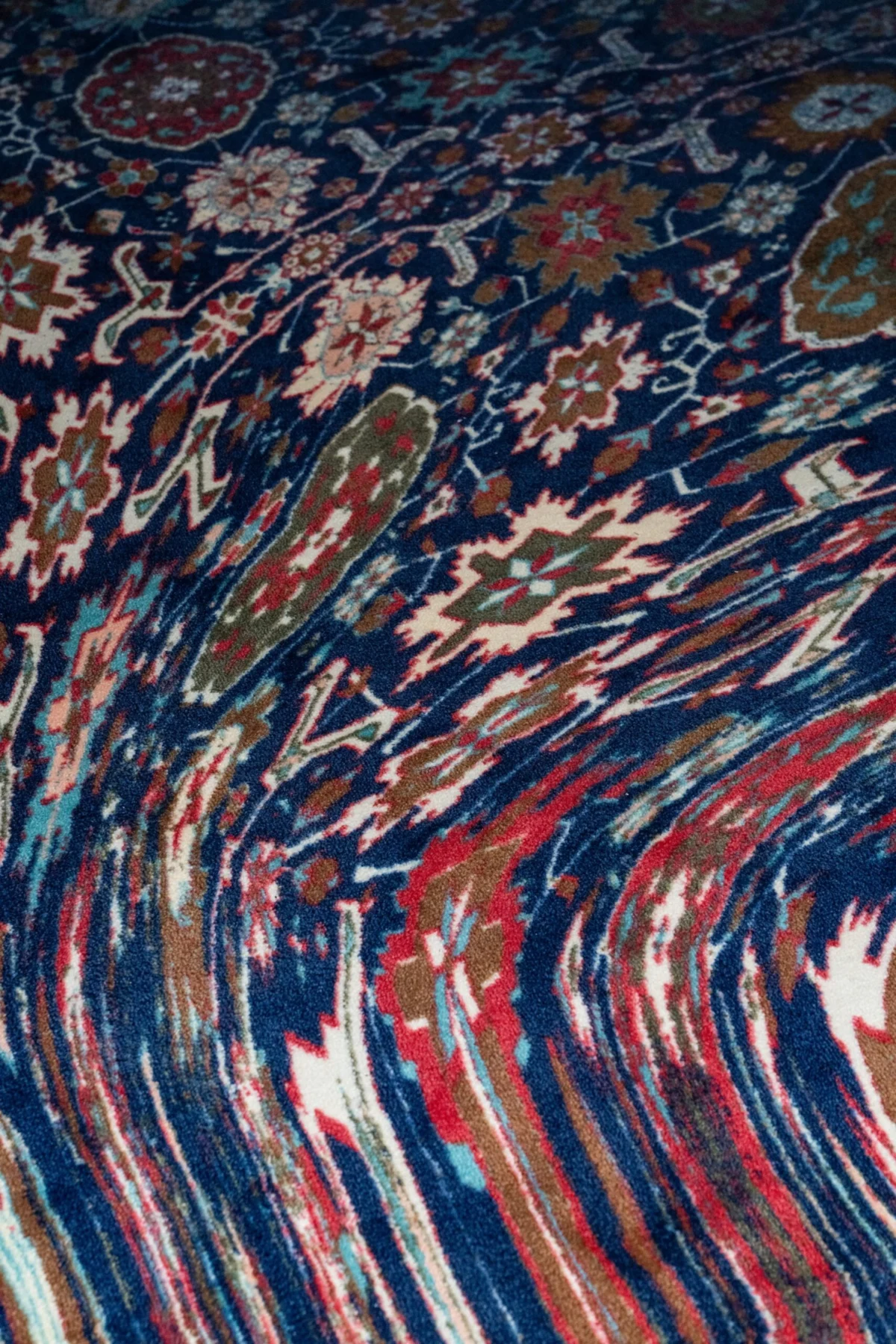
At the 61st Venice Biennale, the Azerbaijani Pavilion has transformed into a sanctuary of both ancient mysticism and cutting-edge quantum theory. Baku-based artist Faig Ahmed, world-renowned for his subversive textile art that renders traditional carpets as digital glitches and liquid pools, has unveiled his most ambitious project to date: The Attention. Curated by Gwendolyn Collaço, the installation is a sprawling, maze-like environment that invites visitors to lose themselves in a physical representation of the intersection between human consciousness and the fundamental building blocks of the universe.
The Architecture of the Ineffable: Main Facts
The Attention is not merely an exhibition; it is an immersive, multi-sensory experience that spans seven distinct rooms at the Campo della Tana. Ahmed, a master of the textile medium, uses the Azerbaijani ornamental carpet—a symbol of history, domesticity, and cultural identity—as a conduit for exploring the nature of existence.

The installation features a massive, site-specific work titled I Can Contain Both Worlds But I Do Not Fit Into This One. This monumental machine-woven carpet acts as a structural narrative, winding through the seven rooms, climbing the architectural elements of the space, and spilling out into the outdoor courtyard in a continuous, flowing runner of vibrant color. By utilizing the carpet as a fluid, dynamic entity rather than a static floor covering, Ahmed challenges the viewer’s perception of space and time.
Central to the exhibit is the interplay between the analog and the digital. The carpets, which appear to liquefy or dissolve, are a physical manifestation of "information overload" in the modern era. Through this, Ahmed addresses the collective grief and fragmented identity of the 21st century, mapping them onto the rigid, historical geometry of traditional weaving.

From Hurufism to Quantum Physics: A Chronological Conceptualization
The intellectual foundation of The Attention is a sophisticated dialogue between two seemingly disparate worlds: 15th-century Hurufi mysticism and modern information theory.
The Historical Context
In the 15th century, the Hurufi mystic tradition proposed a radical worldview: the universe is a coded text. Hurufis believed that reality was composed of letters and numbers, and that by deciphering these, one could understand the divine architecture of existence. This ancient paradigm of a "text-based" reality serves as the cornerstone for Ahmed’s current work.

The Scientific Pivot
Ahmed bridges this medieval philosophy with the work of physicist John Wheeler, specifically his "it from bit" hypothesis. Wheeler’s theory posits that every particle, force field, and even the fabric of spacetime itself derives its meaning from binary choices—the "yes-or-no" answers to the universe’s fundamental questions.
Ahmed’s artistic process acts as the "apparatus" for this theory. By merging the manual, labor-intensive craft of carpet weaving with digital processing, he forces the "bits" of binary code to manifest as the "its" of physical wool and dye. This transition from the digital screen to the tactile loom is not just an aesthetic choice; it is an ontological investigation into how we construct our own cosmologies of belonging.

The Dual Nature of Consciousness: Supporting Data
In his artist statement accompanying the exhibition, Ahmed outlines the duality that has driven his creative output for years. He describes a search for understanding that pulls him in two opposing directions:
- The Objective (The Outward): This path encompasses the empirical sciences—biology, physics, and mathematics. It is a quest for data that can be measured, observed, and verified through external experimentation.
- The Subjective (The Inward): This path traverses the landscapes of spirituality, poetry, and art. It acknowledges that some aspects of human experience—such as the feeling of "being"—are fundamentally unprovable and impossible to share, creating an "inexpressible" reality.
Ahmed’s installation at the Biennale is the physical embodiment of this tension. Works like Entropy Altar exemplify this: the piece utilizes a quantum random number generator to track the presence of visitors, translating their movement into an evolving, unpredictable language. Here, the "objective" data of human motion is filtered through the "subjective" lens of art, creating a living piece of history that changes with every person who enters the room.

Voices of the Biennale: Official Responses and Curatorial Insight
Curator Gwendolyn Collaço has described the exhibition as a meditation on the dialectic between time-honored techniques and the rapid, often disorienting, evolution of digital processes. According to the official exhibition statement, the project is designed to "articulate cosmologies of belonging" in an era defined by constant noise and fragmentation.
The artistic community has responded to The Attention with significant acclaim, noting how the work avoids the pitfalls of purely conceptual art by maintaining a high degree of craftsmanship. By hand-weaving pieces like Ancestors—a work that pulses under black light to reveal a psychedelic, anthropomorphic pattern—Ahmed ensures that the viewer remains grounded in the physical reality of the object, even while their mind grapples with the abstract theories of quantum mechanics.

Theoretical Implications: The Digital and the Divine
The implications of The Attention are far-reaching. By positioning the carpet as a "breathing body," Ahmed asks us to consider how our own identities are woven into the fabric of the digital age.
The Impact of "Information Overload"
We live in an age of constant connectivity, where our attention is the primary currency. Ahmed argues that the "glitch" in his carpets is not a flaw, but a truthful representation of modern consciousness—a mind stretched thin by too much information. When the carpets "pool" or "melt" in his installations, they represent the collapse of order into entropy, mirroring our own struggles to maintain a sense of self in a world that is increasingly mediated by binary data.

Bridging the Gap
The most profound implication of the exhibition is its optimistic view of synthesis. By successfully integrating the mystical, the scientific, the digital, and the analog, Ahmed demonstrates that these fields do not have to remain in conflict. Instead, he proposes a hybrid way of knowing. He suggests that if we view our lives as "coded text," as the Hurufis did, we can reclaim agency over the "bits" of our existence, transforming them into a coherent, albeit complex, narrative.
A Legacy in the Making: Final Observations
The Attention remains on view through November 22 at Campo della Tana, Castello 2124/A–2125, in Venice. For those who witness it, the exhibition is more than just a display of skill; it is a confrontation with the self.

As visitors walk through the maze-like corridors of the pavilion, trailing their eyes over the undulating, knotted, and distended wool, they are forced to confront the binary nature of their own existence. In the hands of Faig Ahmed, the humble carpet becomes a sophisticated, high-dimensional map of the human condition. Whether it is through the psychedelic glow of Ancestors or the quiet, shifting presence of the Entropy Altar, the exhibition succeeds in its ultimate goal: to hold our attention, however briefly, in the space between the known and the unknown.
In a rapidly changing world, Faig Ahmed’s work provides a necessary pause—a moment to look closely at the weave of our reality, to acknowledge the glitches in our perception, and perhaps, to find a new way to belong.









No comments yet. Be the first to join the conversation!