Pevita Pearce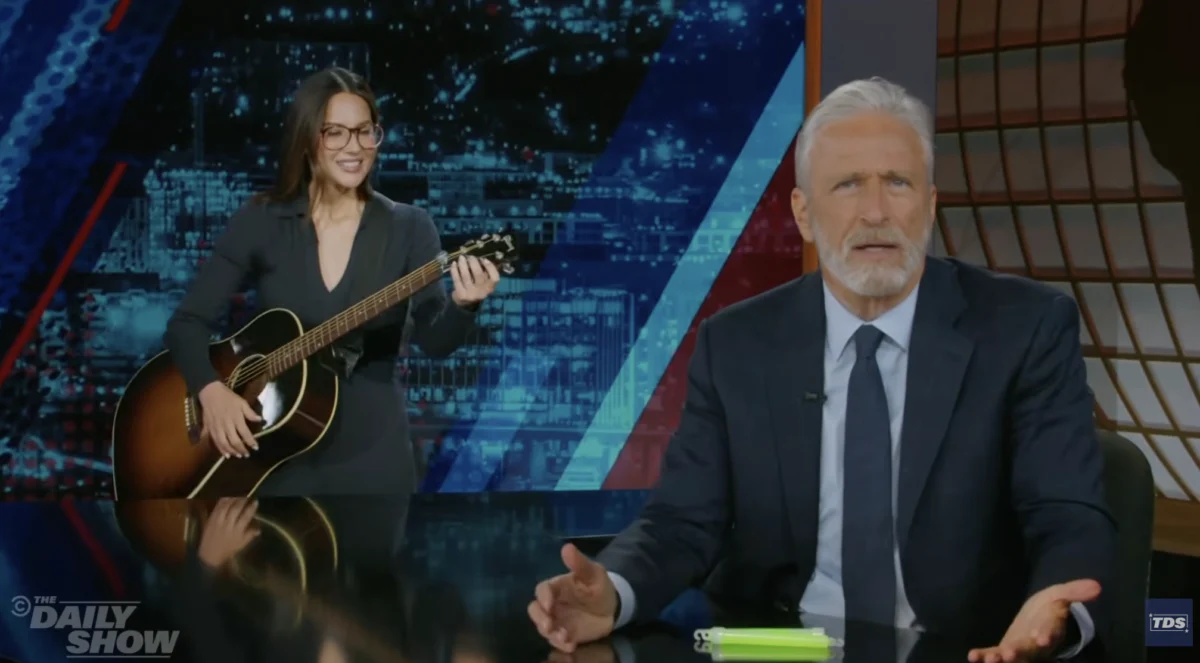
Returning to the helm of The Daily Show following the holiday break, Jon Stewart wasted no time addressing the chaotic political and cultural landscape currently dominating the news cycle. With his characteristic blend of biting sarcasm and world-weary incredulity, Stewart spent his Monday night broadcast tackling the collapsing "Freedom 250" concert—a star-studded event intended to commemorate the nation’s semiquincentennial—and navigating a bizarre, unscripted-feeling interruption by actress Olivia Munn.
The Freedom 250 Collapse: A Talent Agency’s Nightmare
The centerpiece of Stewart’s monologue was the unraveling of the "Freedom 250" concert, a marquee event that has become the latest public relations headache for the Trump administration’s cultural outreach efforts. Following a similar takedown by John Oliver on Last Week Tonight just a day earlier, Stewart dissected the mass exodus of legacy acts who have withdrawn from the event, citing concerns over the concert’s overt political alignment.
The common denominator in this comedic tragedy is Universal Attractions Agency (UAA) and agent Jeff Epstein. Stewart found it particularly ironic—and ripe for satire—that a high-profile talent recruiter would be tasked with assembling a roster for a Trump-associated gala.
“Jeff Epstein of Universal Attractions is in charge of—forgive me—recruiting talent for a Donald Trump party? That’s what you’re telling me?” Stewart asked the audience, his disbelief palpable.
The comic didn’t shy away from the darker implications of the booking agent’s name, leaning into a series of edgy jokes that drew gasps and laughter from the studio audience. When the crowd reacted with a mix of shock and amusement to his rapid-fire delivery, Stewart jokingly chided them, noting, “I didn’t know we had so many Epstein sympathizers in the room!”
Chronology of a Failed Production
The "Freedom 250" saga has been a slow-motion car crash for organizers. What was initially pitched as a non-partisan celebration of American history has devolved into a cautionary tale of celebrity risk management.
- Initial Announcement: The concert was marketed as the premier cultural event of the 250th anniversary.
- The Talent Scramble: Universal Attractions Agency was brought on to secure A-list acts, aiming for a cross-generational appeal.
- The Political Shift: As the event became more inextricably linked with the Trump brand, artist management teams began expressing trepidation regarding potential career blowback.
- The Domino Effect: Following the lead of high-profile industry voices, one legacy act after another began canceling, citing "scheduling conflicts" that thinly veiled political discomfort.
- The Late-Night Roast: John Oliver’s segment provided the critical momentum, highlighting the irony of the situation, which Stewart then amplified with his own segment on Monday.
The implications for the event organizers are severe. The inability to retain talent not only threatens the viability of the "Freedom 250" brand but also raises questions about the current state of cultural diplomacy within the political sphere.
The Negotiator’s Dilemma: Stewart on Iran
Moving from the stage to the geopolitical arena, Stewart turned his sights toward the ongoing Iran-U.S. peace negotiations. Known for his ability to distill complex diplomatic stalemates into relatable absurdity, Stewart mocked the lack of progress.
“You’re the greatest negotiator in the world,” Stewart said, referencing the common refrain from the Trump administration regarding their foreign policy capabilities, “and you’re saying that it’s difficult to bring together two differing sides with competing interests? If only there was a word for closing that gap, a person who could help close it. I don’t know, a ‘gap-a-closenator.’”
The segment underscored Stewart’s long-standing frustration with the rhetoric of modern political negotiation, suggesting that the "art of the deal" often falls short when confronted with the realities of international relations.
A Surreal Interruption: The Olivia Munn Ambush
The final minutes of the monologue took a turn for the surreal when actress Olivia Munn appeared on stage, mid-monologue, to deliver a satirical "send-off" for the host.
Munn, best known for her roles in projects like The Newsroom and Your Friends & Neighbors, entered the frame with the air of someone participating in a high-stakes, yet deeply misguided, tribute. “Jonathan, tonight is about you,” she began, her tone dripping with mock sincerity. “I am here to honor you on one of your biggest, final special sendoff shows. Just like [Stephen] Colbert had a big production, huge stars—everyone loved it—I’m here for you, for that.”
Stewart, visibly confused and attempting to ground the segment, repeatedly reminded Munn that his tenure at The Daily Show is ongoing. “This is a normal Monday show,” he insisted, to little avail.
Munn proceeded to pull out an acoustic guitar, launching into a song that Stewart correctly identified as a repurposed tribute originally intended for Stephen Colbert’s departure from The Colbert Report. When Stewart pointed out the error, Munn’s response was characteristically blunt: “No one cares if you leave.”
The exchange highlighted the playful, often chaotic nature of live television. As the crowd booed in a show of support for Stewart, Munn leaned into the bit, noting that she had missed the cut for the Colbert event and was desperate for a spotlight.
“Really? Oh my God, thank you so much, because there’s really not a lot of options left,” she quipped. “It’s basically just you or the Hot Ones guy [Sean Evans].”
The segment concluded with a sharp jab at the previously discussed "Freedom 250" concert. When Stewart suggested that Munn was welcome to return to the desk without the "pretense" of musical talent, she hit back with: “I can play guitar. How do you think I got booked for the Freedom 250 concert?”
Implications: The Intersection of Comedy and Politics
The Monday night episode of The Daily Show serves as a case study for the evolving role of political satire. In an era where the news cycle is often more bizarre than fiction, hosts like Stewart are finding that the most effective way to address the "Freedom 250" disaster is to lean into the absurdity of the booking process and the fragile nature of celebrity political alignment.
Furthermore, the integration of an unscripted-style guest appearance like Munn’s serves to break the traditional fourth wall of the monologue, providing a layer of levity that balances the heavier political critiques.
Supporting Data: The Talent Agency Landscape
The reliance on major agencies like Universal Attractions Agency for high-profile political events has historically been standard practice. However, the current climate of extreme political polarization is creating a "talent vacuum." Artists are increasingly evaluating the potential for "brand damage" when approached by politically charged organizations.
According to industry analysts, this trend is unlikely to reverse as long as the cultural divide remains the primary driver of political discourse. The "Freedom 250" debacle will likely be studied in public relations and event management circles for years to come as a primary example of how misreading the cultural temperature can lead to a collapse of even the most well-funded projects.
Conclusion
Jon Stewart’s return to The Daily Show was marked by a synthesis of sharp political critique and the high-wire act of improvised television. By tackling the "Freedom 250" failures alongside the stagnation of U.S.-Iran relations, Stewart reminded his audience why his voice remains a central pillar of the cultural conversation. The surprise appearance by Olivia Munn, while comedic, served as a reminder that even in the most serious of political environments, the absurdity of celebrity culture is never far from the surface.
As the "Freedom 250" concert continues to struggle, and as the political landscape remains fraught with tension, Stewart’s role as both a commentator and a disruptor seems more vital—and more entertaining—than ever.

 Nana Wu
 Jia Lissa