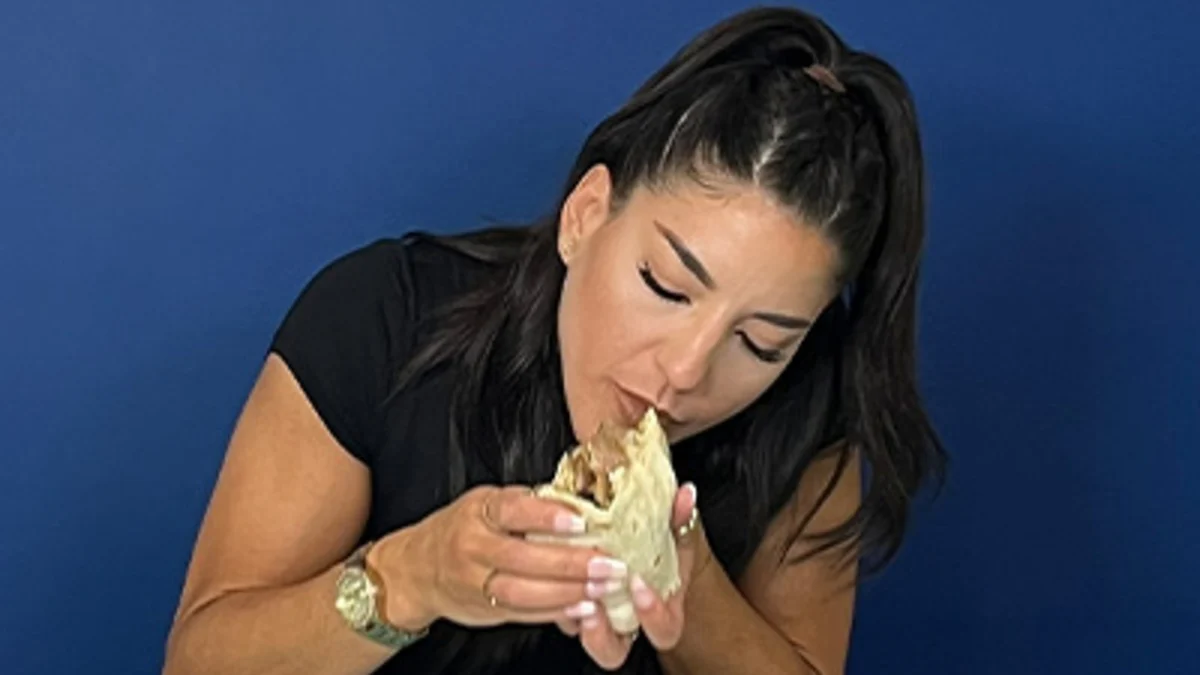
In the high-stakes world of professional competitive eating, fractions of a second represent the difference between obscurity and immortality. On August 4, British speed-eating sensation Leah Shutkever cemented her status as a titan of the sport, reclaiming the world record for the fastest time to consume a burrito. With a blistering time of 30.75 seconds, Shutkever reclaimed a crown that had eluded her for two years, demonstrating the relentless precision and physical discipline required to excel at the highest level of this unconventional athletic pursuit.
The feat, confirmed by Guinness World Records (GWR) at their London headquarters, was not merely a standalone victory; it was part of a triple-crown performance that saw Shutkever shatter two additional records in a single day. Her return to the pinnacle of burrito consumption serves as a reminder of the sport’s increasingly professionalized nature, where speed is dictated by training, technique, and an almost clinical approach to ingestion.
A Chronology of Consumption: The Battle for the Burrito
The rivalry between Leah Shutkever and her counterparts has become a fascinating study in incremental improvement. Shutkever’s relationship with the burrito record is long-standing, beginning with her initial claim in 2019. At that stage, the record was a benchmark of her burgeoning talent, setting the tone for a career that would eventually span dozens of world titles.
By February 2022, during an appearance on the Italian broadcast Lo Show dei Record, Shutkever proved she was not resting on her laurels. She successfully improved her own mark, lowering the time to 32.35 seconds. However, the nature of record-breaking is inherently volatile. Later that same year, American competitive eater Miki Sudo—a formidable force in the industry—clocked a time of 31.47 seconds. Sudo’s performance shaved precious milliseconds off the record, effectively ending Shutkever’s reign by a margin of less than one second.
For four years, the record remained out of reach, a testament to the difficulty of optimizing a process that requires both extreme speed and the ability to manage the physical volume of the food. On August 4, 2024, Shutkever returned to the GWR London headquarters with a singular focus. The result—30.75 seconds—did more than just reclaim the title; it set a new, daunting standard for future competitors, proving that in the world of speed eating, the ceiling of human performance is consistently being raised.
Supporting Data: A Triple Crown of Excellence
While the burrito record captured the headlines, Shutkever’s visit to the Guinness headquarters was a masterclass in versatility. On the same day she reclaimed the burrito title, she officially set two additional records:
- The Churro Challenge: Shutkever consumed eight churros in exactly 60 seconds. This feat requires a different skill set than the burrito; whereas the burrito demands rapid mastication and swallowing of a singular mass, the churro record requires high-frequency mechanical intake and the ability to maintain speed despite the dryness of the pastry.
- The Strawberry Sprint: In another 60-second window, Shutkever consumed 613 grams (approximately 1.35 pounds) of strawberries. This record highlights the metabolic and physical volume capacity required for competitive eating, showcasing her ability to process large quantities of fiber and fruit in a restricted timeframe.
These three accomplishments bring Shutkever’s total tally of Guinness World Records to an astounding 42. This collection of titles is not merely a hobbyist’s list; it represents a specialized career path that has translated into a massive digital footprint. With over 600,000 subscribers on YouTube, Shutkever has cultivated a community that follows her training regimens, record-breaking attempts, and the grueling behind-the-scenes reality of a competitive eater’s life.
The Mindset of a Record Breaker: Official Responses
When speaking with Guinness World Records following her triple-record performance, Shutkever offered a candid look into the psychology of the sport. The transition from a casual interest in eating to a professionalized career is often misunderstood by the public, who may view the activity as purely recreational.
"I’ve been very fortunate in my career that many opportunities have landed on my desk, and I’ve been the right person with the right appetite to say yes to them," Shutkever noted. Her approach is characterized by a blend of gratitude and a highly competitive, almost predatory, drive to succeed.
She further elucidated the personality traits required to stand in front of a GWR adjudicator: "Competitiveness definitely plays into the ability to attempt and break a world record. I think personally, I am silly, bold, and brazen enough to put myself in the firing line for all sorts of things."
This "brazen" nature is essential. Competitive eating is not just about hunger; it is about the mastery of the gag reflex, the coordination of throat muscles, and the mental fortitude to endure physical discomfort for the sake of a record. Shutkever’s success is rooted in the "firing line" mentality—the willingness to fail publicly, adjust her strategy, and return to the table with a refined technique.
Origins and Evolution: From Chocolate to Professionalism
The trajectory of Shutkever’s career is a compelling narrative of organic growth. It did not begin with massive stadium-sized eating contests, but rather with a simple, relatable challenge: the fastest time to eat a Terry’s Chocolate Orange.
What began as an online post—a digital snapshot of a quirky, singular talent—quickly garnered attention. The virality of her initial efforts led to an invitation to attempt the record officially. That singular, televised appearance served as the catalyst for her transition from a hobbyist to a professional. Over the years, her portfolio of records has expanded from confectionery to complex, savory meals, reflecting an evolution in both her physical capability and her brand.
Her success highlights a shift in how records are viewed in the modern era. Today, the digital space acts as a scouting ground for talent. Platforms like YouTube allow for constant practice and audience engagement, turning what was once a niche carnival sideshow into a global, data-driven industry.
Implications: The State of Competitive Eating
The world of competitive eating is currently experiencing a period of significant diversification. While events like the Nathan’s Hot Dog Eating Contest remain the sport’s marquee spectacle, the record-breaking landscape is expanding into bizarre and highly specific domains.
For instance, June 2024 saw a viral attempt by a British man to break a 40-year-old record by sitting in a bathtub filled with baked beans for four days. While this differs from the high-speed consumption of Shutkever, it reflects the broader cultural obsession with testing the limits of human endurance, whether through volume, speed, or extreme environmental exposure.
However, Shutkever’s continued success serves as a stabilizing force in this domain. By focusing on speed and technical precision, she keeps the focus on the athleticism required to ingest food at a rate that would be impossible for an average person. Her 42 records represent a level of dedication that forces the industry to take these feats seriously.
Furthermore, her career demonstrates the viability of competitive eating as a content-driven profession. By leveraging her records to grow her social media presence, she has bridged the gap between traditional record-keeping and modern digital entertainment. The implications for the future of the sport are clear: success is no longer just about the calories consumed, but about the ability to build a narrative, engage a global audience, and consistently deliver under the pressure of a stopwatch.
As Shutkever looks toward her next challenge, the bar remains set at 30.75 seconds. Whether that record stands for another four years or is toppled by a new wave of hungry challengers, the story of Leah Shutkever remains one of the most remarkable chapters in the history of human appetite. In the high-octane, high-calorie world of professional speed eating, she stands as a testament to what happens when ambition meets the plate with, as she puts it, the right appetite to say "yes."