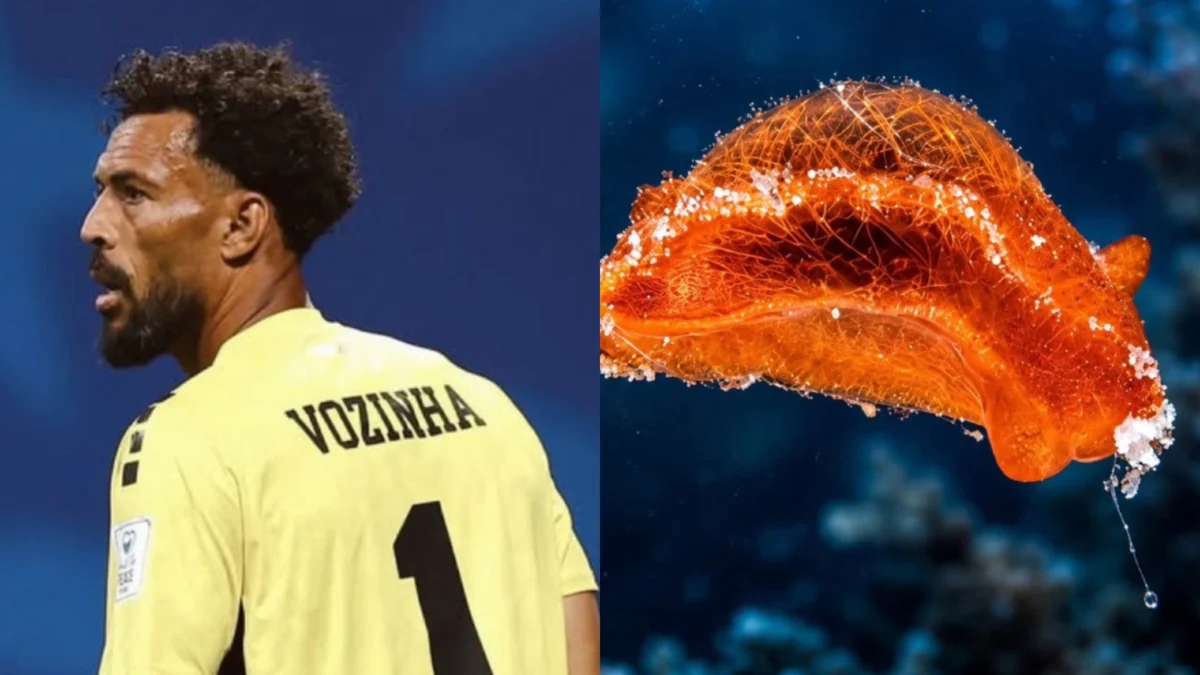
In a remarkable convergence of marine biology and international football, the discovery of a new species of nudibranch—a vibrant, shell-less sea snail—has been immortalized with a name that pays tribute to one of the most unexpected breakout stars of the 2026 World Cup. Spanish biologist Jesus Ortea, a renowned expert in marine malacology, has officially named the newly discovered Aldisa vozinha after the Cape Verdean goalkeeper whose heroics captured the imagination of the global sporting community.
The naming serves as a permanent scientific record of a tournament that defied expectations, marking the intersection of taxonomic discovery and the emotional intensity of the World Cup. For Ortea, a man who has built a career around both the microscopic wonders of the ocean and the macroscopic drama of the football pitch, the decision was a natural synthesis of his two great passions.
Main Facts: The Discovery of Aldisa vozinha
The species, a strikingly small, vivid red sea snail, was identified by Ortea during his recent fieldwork in the Caribbean. The creature belongs to the genus Aldisa, a group of dorid nudibranchs known for their distinct coloration and textured mantles. However, what sets Aldisa vozinha apart from its relatives is not just its morphological uniqueness, but the cultural context of its naming.
Ortea, who has been a frequent visitor to the waters surrounding the Cape Verde archipelago, has long maintained a professional and personal affinity for the nation. His academic work in the region, which earned him the prestigious Medal of Merit in 2023, has provided him with an intimate knowledge of the biodiversity of the island nation. When the opportunity arose to classify this new species, the timing of the World Cup—and the specific performance of the Cape Verdean national team—offered the perfect inspiration.
The scientific description, published in a formal report on ResearchGate, details the anatomical features of the snail, noting that its brilliant red hue is a direct reference to the "La Roja" kit of the Spanish national team, against whom Cape Verde’s goalkeeper, Vozinha, delivered an iconic, clean-sheet performance.
Chronology: A Tournament of Surprises
The story of Aldisa vozinha began long before the first whistle of the 2026 World Cup, but its public unveiling is inextricably linked to the tournament’s timeline.
- 2023: Spanish biologist Jesus Ortea is awarded the Medal of Merit by the Cape Verdean government, solidifying his bond with the island nation.
- Early 2026: Ortea conducts a series of marine surveys in the Caribbean, where he collects specimens of an unidentified species of the Aldisa genus.
- June 2026: The World Cup kicks off. Cape Verde enters the tournament as underdogs, drawing a group stage match against the powerhouse Spanish national team.
- The Match: In a defensive masterclass, 40-year-old goalkeeper Vozinha frustrates the Spanish attack, resulting in a 0-0 draw that elevates his status to cult-hero level.
- July 2026: Following the tournament, the taxonomic classification of the new species is finalized. Ortea officially names it Aldisa vozinha.
- July 12, 2026: The discovery gains international traction as the story highlights how the "giant-killing" performance of a goalkeeper can ripple into the scientific community.
Supporting Data: The Science Behind the Name
In his research paper, Historias de la Bioadversidad, Ortea provides a rigorous breakdown of why this species warrants a unique designation. Taxonomists often face the challenge of naming species that share characteristics with previously documented organisms. Aldisa vozinha was distinguished through a combination of genetic sequencing and meticulous observation of its physical traits.
The "red" coloration, which Ortea explicitly cites as a tribute to the match against Spain, is biologically significant as a warning signal—a phenomenon known as aposematism. In the wild, such vibrant colors often warn predators that the organism is toxic or unpalatable. In the world of football, the "red" of the Spanish jersey represented a wall that could not be breached.
Ortea’s previous work includes naming species after football icons like the late Spanish striker Quini and Costa Rican shot-stopper Keylor Navas. This pattern suggests that for Ortea, the act of naming is not merely a bureaucratic task but a way of anchoring scientific advancement in the cultural zeitgeist of his era.
"We have chosen the name vozinha in honor of Vozinha," Ortea wrote in his report. "Who played a prominent role in his country’s World Cup debut against The Reds. The coloration of the species is intended as a tribute to that achievement."
Official Responses and Public Sentiment
The reaction to the news has been overwhelmingly positive, particularly within the Cape Verdean diaspora and the global football community. The 40-year-old goalkeeper, who has become one of the most followed athletes on social media following the tournament, has yet to issue a formal statement on his mollusk namesake, but the scientific community has praised the gesture as a creative approach to public engagement with biology.
For many, this serves as a reminder that science does not exist in a vacuum. By linking a rare, deep-sea discovery to a globally broadcast sporting event, Ortea has successfully drawn public attention to the importance of biodiversity and marine conservation.
Social media platforms have been abuzz with "Vozinha" memes, shifting from his saves on the pitch to his "scientific" immortality on the seabed. Fans of the sport have expressed amusement at the notion that a small, red snail will likely outlive the memory of the tournament itself, permanently cataloged in the annals of natural history.
Implications: The Legacy of the 2026 World Cup
The naming of Aldisa vozinha carries several long-term implications for both sports history and biological taxonomy:
1. The Humanization of Taxonomy
Traditionally, scientific naming conventions are dry, Latinized, and focused on physical descriptors or geographical locations. By opting for a name that captures a contemporary cultural moment, Ortea is part of a growing movement of scientists who believe that naming can be a tool for storytelling. This humanizes the process, making it more accessible to the general public.
2. Promoting Marine Conservation through Sport
The 2026 World Cup was a spectacle of global unity, but it was also a massive environmental footprint. By injecting marine science into the discourse, the naming of Aldisa vozinha encourages fans to look beyond the stadium and consider the health of the oceans where such creatures reside. It creates a bridge between the entertainment of football and the urgency of environmental stewardship.
3. A New Benchmark for "Immortalization"
While professional athletes are often honored with statues, stadium stands, or retired jersey numbers, the honor of having a biological species named after one is unique. It elevates the athlete from a local hero to a permanent fixture in the biological record. As the world continues to explore the depths of the Caribbean, Aldisa vozinha serves as a benchmark for how we choose to honor those who provide us with moments of extraordinary performance.
4. Future Collaborations
The success of this naming convention may encourage future researchers to explore similar crossovers. As we move forward, the "Vozinha Effect" could become a standard for how scientists communicate their findings, ensuring that the excitement of global events like the World Cup is used as a vehicle to promote public interest in the lesser-known, yet equally heroic, creatures of the natural world.
Conclusion
The story of Aldisa vozinha is more than just a footnote in a scientific journal; it is a testament to the enduring impact of sport on the human imagination. While Cape Verde eventually exited the World Cup in a heartbreaking 3-2 defeat to Argentina, the legacy of their goalkeeper, Vozinha, has been secured in a way few athletes could ever dream of.
In the quiet, dark depths of the Caribbean, a small, vibrant red snail now carries the name of a man who dared to stand against the best in the world. It is a fitting tribute to a player who, for a few short weeks in the summer of 2026, made the impossible look routine. As we reflect on the tournament, we are reminded that whether on the pitch or in the lab, the pursuit of greatness—and the recognition of it—is a universal language.