For the vast majority of consumers, buying a new PC is a bundled experience. You walk into a retailer or click "buy" on a website, and the machine arrives with Microsoft Windows 11 pre-installed, licensed, and ready to go. While this "plug-and-play" convenience is a selling point for the casual user, it has long been a point of contention for power users, privacy advocates, and, most notably, the open-source community.
For those who intend to wipe their machine the moment it arrives to install a Linux distribution or another free operating system, paying for a Windows license—often bundled into the retail price of the hardware—feels like an unnecessary tax. A growing movement, spearheaded by the Italian Linux Society and the Free Software Foundation Europe (FSFE), is now pushing back against this practice through a project known as Refund4Freedom.
The Core Conflict: Forced Bundling and Consumer Choice
At the heart of the Refund4Freedom initiative is a fundamental question of consumer autonomy: Should a manufacturer be allowed to mandate the inclusion of specific software in a hardware purchase?
The Refund4Freedom platform argues that the current market model is fundamentally unfair. When a consumer purchases a laptop, they are essentially forced to pay a "hidden" fee for an operating system they may have no intention of using. The group’s stance is clear: "Consumers should be able to buy laptops without any specific operating system, and should not have to pay the license price if they don’t want to."
This is not merely a matter of a few dollars. It is an issue of principle regarding digital sovereignty. By forcing users to pay for proprietary software, manufacturers are effectively subsidizing Microsoft’s ecosystem through the hardware market, limiting the visibility of alternative operating systems and making it more difficult for hardware to be sold as "software-agnostic."
The Three Pillars of the Refund4Freedom Demand
To address this, the project has established a tripartite set of demands for manufacturers and vendors:
- Non-Imposition: Manufacturers should not force consumers to pay for software they do not want. Hardware should be treated as a blank canvas.
- Transparency: Pricing should be granular. A consumer should be able to see the price of a device with Windows versus the price of the same hardware without it.
- Frictionless Recourse: If a user finds themselves with a pre-installed OS they did not want, there should be a clear, documented, and easy-to-navigate path to obtaining a refund for that specific license.
A Brief Chronology of the "Windows Tax" Dispute
The debate over the "Windows Tax" is far from new. It has been a persistent theme in the tech industry for decades, tracing back to the early days of Windows 95 and 98 when the dominance of Microsoft’s OS was cemented by its near-total ubiquity on OEM machines.
- The Late 90s/Early 2000s: This period saw the first major organized efforts by Linux users to demand refunds for pre-installed Windows licenses. These early attempts were largely ad-hoc, involving individual users sending registered letters to major manufacturers like Dell and HP, often resulting in prolonged legal battles or outright refusals.
- The 2010s: As the Linux community grew and distributions like Ubuntu, Fedora, and Linux Mint became more user-friendly, the friction between hardware manufacturers and "power users" intensified. Some manufacturers, such as System76 and Purism, began emerging to fill the void, selling laptops specifically designed for Linux.
- 2020 to Present: The launch of Windows 11, with its controversial hardware requirements (such as TPM 2.0), reignited the debate. Many users, frustrated by the forced migration or the telemetry embedded in modern Windows, began looking for an exit. The Refund4Freedom project emerged during this period as a consolidated, organized effort to provide legal frameworks and procedural guidance for those seeking to recoup their costs across the European market.
The Disparity in Manufacturer Cooperation
As the Refund4Freedom website highlights, "not all manufacturers and vendors are equal." The ease with which a consumer can claim a refund varies wildly, and often depends on local consumer protection laws rather than a global company policy.
The "Helpful" Manufacturers
Some companies have developed, whether begrudgingly or proactively, specific procedures for handling these requests.
- Acer and Lenovo: Both brands have been cited as having clearer, more accessible reimbursement procedures. While not always advertised on the front page of their websites, their support channels are generally more equipped to process these specific requests than their competitors.
- Asus: Asus operates what could be described as a "hidden" reimbursement procedure. In certain jurisdictions, particularly in Italy, users have successfully navigated the process, though it often requires navigating through specific local support branches.
The "Non-Responsive" Manufacturers
On the other end of the spectrum are companies that provide effectively zero support for this practice.
- Dell and HP: Despite being two of the largest PC manufacturers in the world, the Refund4Freedom project notes that these companies generally do not have a defined, public-facing reimbursement procedure. For a consumer buying a Dell or HP machine, attempting to claim a refund for Windows is often a bureaucratic nightmare, frequently involving endless loops of customer service redirects and eventual denials.
How to Pursue a Refund: A Strategic Guide
For those determined to reclaim their license fees, the process is far from a simple "click-to-refund" button. It requires a methodical, evidence-based approach. The Refund4Freedom project suggests the following protocol:
1. Document Everything
Before you even think about wiping the drive, you must capture the state of the machine. The moment you power on the PC for the first time, take photographs of the End User License Agreement (EULA) and any contract clauses that mention the OS. These documents are your leverage. If you format the drive or erase the recovery partition before documenting the license agreement, you may be forfeiting your right to a refund.
2. Communicate Formally
Do not rely on live chat or telephone calls, which leave no paper trail. Use official email channels or physical registered mail. State clearly that you are refusing the EULA, which is typically presented upon first boot. By refusing the agreement, you are legally entitled to a refund for the software license that you have not accepted.
3. Use Legal Templates
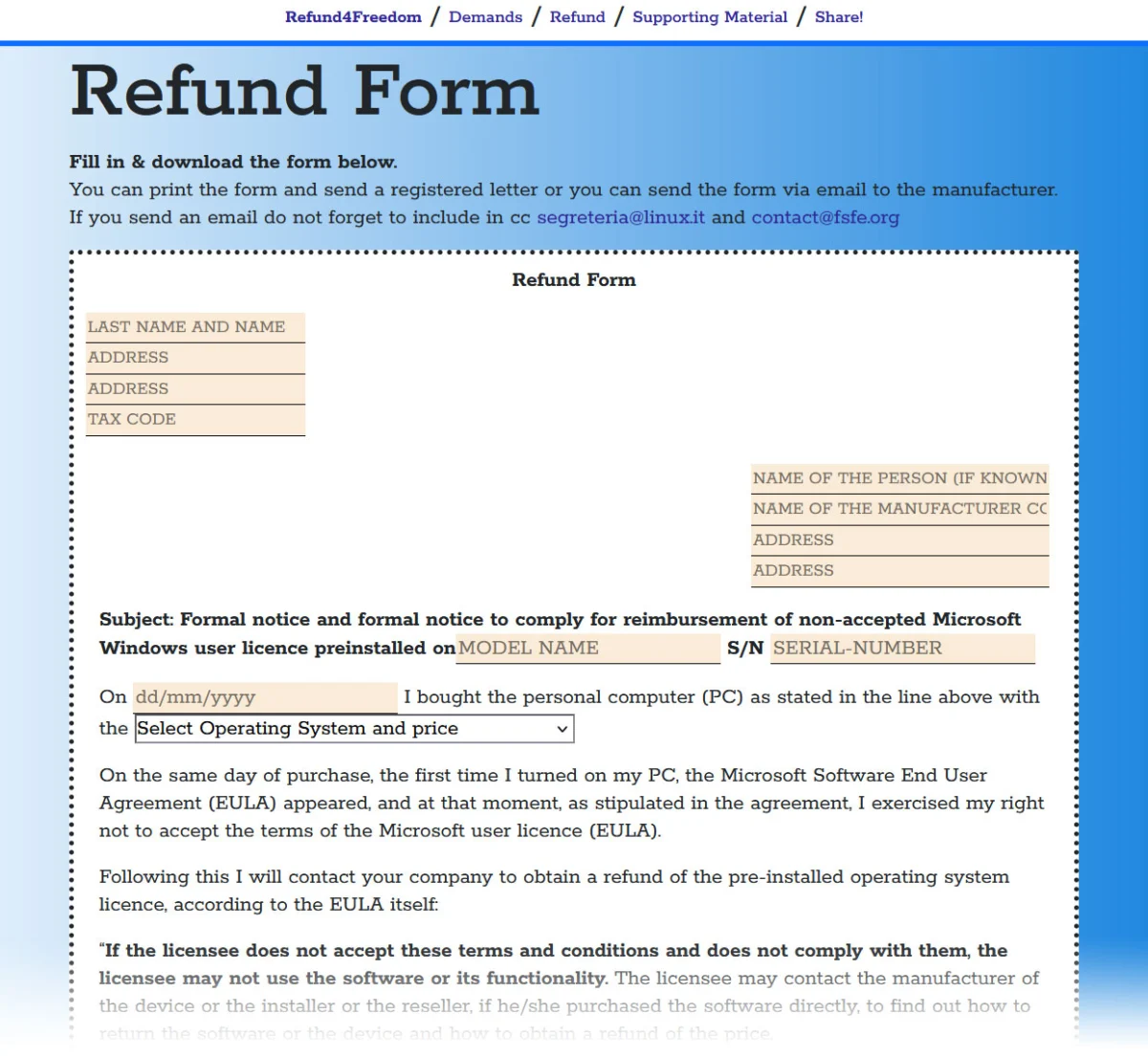
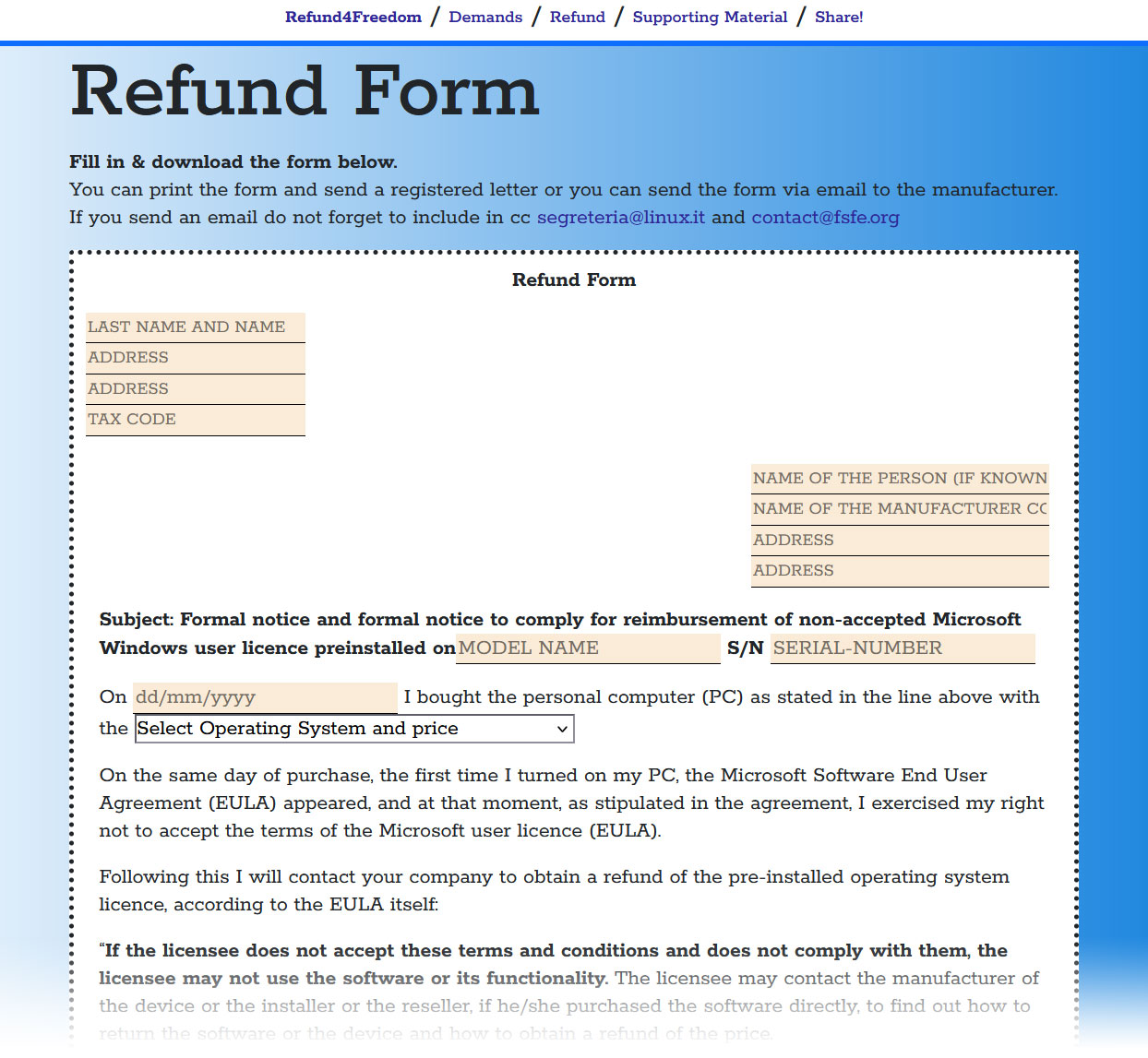
The Refund4Freedom site provides pre-made forms for this purpose. However, users should be aware that these are often tailored to specific regional laws (such as the Italian AGCM rulings). If you are outside of Italy, you may need to consult with local consumer protection agencies or legal experts to adapt the language to your specific jurisdiction. As the site suggests, you can even use modern LLMs to help draft letters citing local consumer protection laws, though you should always verify the legal standing of the arguments presented.
4. Report Your Findings
Regardless of whether you succeed, the movement encourages users to report their experiences to local consumer protection authorities. The more data these agencies have regarding consumer dissatisfaction with forced software bundling, the more likely it is that future regulations might mandate "naked" hardware options at the point of sale.
The Financial Reality
What kind of return can a user expect? The amount varies. While the actual value of a Windows Home license is often estimated between $50 and $100, the amount you get back may be affected by the manufacturer’s internal accounting.
Reports from the field suggest that a typical refund hovers around the $60 mark. However, in some cases, if a user has to engage in a formal, legalistic dispute, the total amount recovered might include reimbursement for legal or administrative fees, as seen in some successful Italian cases where users reclaimed upwards of €150.
Implications for the Future of PC Hardware
The existence of the Refund4Freedom project serves as a barometer for a shift in the computing industry. As Microsoft continues to integrate cloud-based services and mandatory accounts into Windows 11 and 12, a segment of the population will continue to look for alternatives.
If hardware manufacturers continue to refuse to decouple their hardware from Windows, they risk alienating a growing demographic of technically literate, privacy-conscious, and open-source-oriented consumers. Conversely, there is a clear market opportunity for manufacturers who decide to lean into this demand. By offering "Linux-ready" hardware—or simply providing a transparent, no-OS option at a lower price point—brands could differentiate themselves in an otherwise saturated and commoditized market.
Ultimately, the fight for a Windows refund is about more than just $60. It is a protest against a "one-size-fits-all" model of computing that treats the user as a subscriber rather than an owner. Until manufacturers recognize that the right to choose an operating system is as fundamental as the right to choose a processor or a graphics card, the movement for digital autonomy will only continue to grow.