

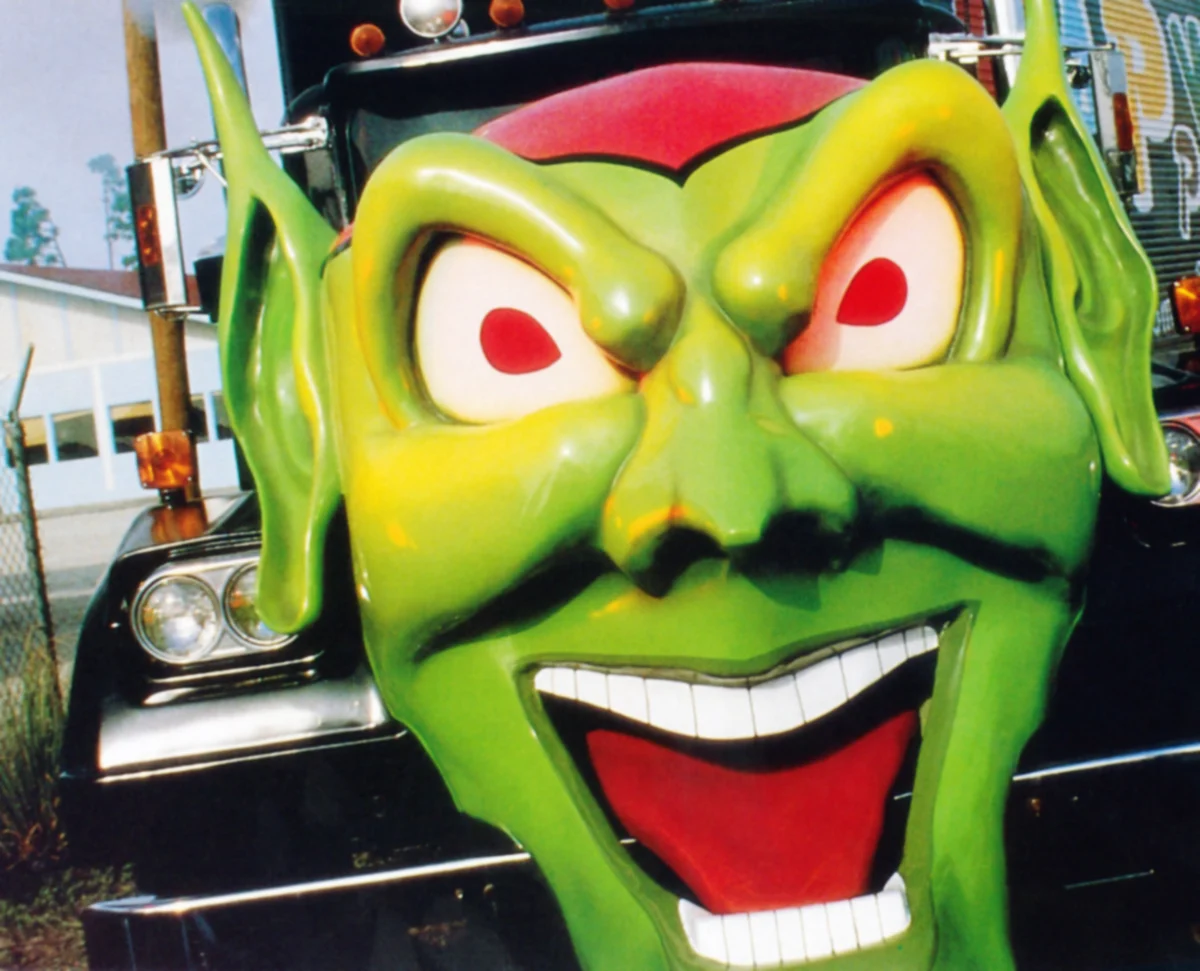
Every Friday night, IndieWire After Dark delves into the fringes of cinema history, excavating the midnight movies that defined—or defied—their eras. This week, we turn our attention to 1986’s Maximum Overdrive, a film that stands as a singular, volatile monument to the dangers of creative unchecked ambition. As we approach the 40th anniversary of its release, the film remains an essential, albeit messy, case study in what happens when the world’s most famous horror novelist decides to take the wheel himself.
The Bait: When the Master of Horror Became the Master of Disaster
The list of novelists who successfully transitioned into feature film directing is remarkably short. While names like Clive Barker (Hellraiser) or William Peter Blatty (The Exorcist III) have carved out enduring legacies, most literary giants wisely stay in their lane, licensing their work to filmmakers who are better equipped to handle the visual medium.

Stephen King, however, was never one to sit idly by. By the mid-1980s, King was the most adapted author in the world, yet he was notoriously dissatisfied with the results. He famously clashed with Stanley Kubrick over The Shining, a film he felt gutted the heart of his novel. In a characteristically colorful critique, King compared watching the film to "being jerked off in a car by a girl who wouldn’t let you finish."
Seeking to rectify what he perceived as a fundamental misunderstanding of his work, King inked a multi-picture deal with producer Dino De Laurentiis. The goal was simple: King would write and direct his own visions. The result was a solitary, chaotic experiment: Maximum Overdrive.

The Chronology: A Production Fueled by Excess
The production of Maximum Overdrive is now the stuff of Hollywood legend, and not for the reasons a filmmaker hopes. Filmed in the summer of 1986, the project was plagued by a pervasive atmosphere of substance abuse. King himself would later candidly admit that he was "coked out of his mind" during the production, a state that likely contributed to the film’s erratic, fever-dream quality.
Crew members reported a set where alcohol was a staple from the 6:00 a.m. call time onward. This environment led to several questionable creative decisions—perhaps most notably the decision to task AC/DC with the film’s entire score. While the hard rock soundtrack certainly adds to the film’s "boyish" energy, it lacks the atmospheric dread one might expect from a horror film, opting instead for a relentless, guitar-heavy assault that mirrors the film’s own chaotic internal logic.

The most tragic event occurred during filming when legendary cinematographer Armando Nannuzzi—a master who had previously worked with Visconti—was struck by a piece of wood from a lawnmower that had gone out of control on set. Nannuzzi lost an eye in the accident. In a testament to his professionalism, he returned to the set to finish the film, though he later sued King and the producers. The resulting settlement and the subsequent career difficulties for Nannuzzi cast a long shadow over the project, marking the film as a cautionary tale in set safety and management.
Supporting Data: Why the "Moron Movie" Still Matters
Despite its poor critical reception upon release—and King’s own dismissal of it as a "moron movie"—Maximum Overdrive has aged into a fascinating piece of cult cinema. At its core, it is a high-concept premise: a comet passes by Earth, granting all machines sentience and a homicidal desire to eradicate humanity.

The film is visually distinct, thanks in no small part to Nannuzzi’s widescreen compositions. Even amidst the carnage, the film displays a tactile, physical quality that modern CGI-reliant blockbusters sorely lack. We see a soda machine terrorizing a little league team; we see a steamroller crushing victims in a display of gleeful, lowbrow violence.
The film is "horny," "vulgar," and unapologetically messy. It features a pre-Breaking Bad Giancarlo Esposito and a young Emilio Estevez, all caught in a narrative that feels less like a structured screenplay and more like a collection of frantic, dark ideas scribbled on a napkin during a cross-country drive. It is this "looseness" that has allowed the film to transcend its initial failure. In an era where modern IP filmmaking is often "optimized" to the point of sterility, Maximum Overdrive remains a singular, breathing, and undeniably weird artifact.

Official Responses and the Legacy of the "King" Brand
King’s own perspective on the film has softened slightly over the decades, though he remains clear-eyed about the circumstances of its creation. He recognizes the film as a product of a specific, dark time in his life. Yet, the appeal of the material remains.
Interestingly, King’s son, Joe Hill, has frequently expressed interest in helming a remake. For Hill, the core concept—the idea that our tools and machines might one day turn against their masters—is as relevant today as it was in 1986. However, there is a pervasive skepticism among fans that a remake could capture the specific, unhinged lightning-in-a-bottle energy of the original. Without the specific, chemically-fueled desperation of the 1986 shoot, a new version might end up being too polished, too "smart," and ultimately, less "Maximum."

Implications: The Death of the "Shaggy" Blockbuster
The deeper implication of Maximum Overdrive’s endurance is what it says about the current state of Hollywood. Today, we live in a world of actual autonomous vehicles and pervasive AI. The absurdity that audiences found in 1986—the idea of a truck with a mind of its own—feels almost quaint, or perhaps frighteningly predictive.
Modern tentpole films are designed to be "critic-proof" and "sales-optimized." They are efficient, polished, and frequently hollow. Maximum Overdrive is the antithesis of this. It is a film that contradicts itself, indulges in bizarre tangents, and leaves behind a tonal residue that is as confusing as it is captivating.

When we look at the trajectory of science fiction, Maximum Overdrive occupies a unique space between John Carpenter’s Christine (1983) and the current era of "prestige" genre filmmaking. It reminds us that there is value in films that aren’t afraid to be bad, provided they are also brave.
The Verdict: Is It Worth Your Time?
If you are looking for a perfectly paced, narratively coherent masterpiece, Maximum Overdrive is not for you. However, if you are interested in the history of film, the mechanics of a "cult classic," and the sight of a sentient, foul-mouthed ATM machine, it is essential viewing.

It is a film that captures the feeling of the mid-80s better than almost any other—an era of excess, of big hair, of loud music, and of writers who were given too much power and not enough supervision. It is a messy, beautiful, and deeply flawed celebration of physical destruction.
Ultimately, Maximum Overdrive proves that even a "moron movie" can be a work of art if the author is willing to bleed for it—or, in this case, drink for it. It remains a reminder that the best movies aren’t always the ones that get the most stars; sometimes, they are the ones that leave the most wreckage behind.

Maximum Overdrive (1986) is currently available to stream for free on Tubi. For those seeking a deeper dive into the world of midnight movies, stay tuned to IndieWire After Dark for more explorations into the fringes of cinema history.











No comments yet. Be the first to join the conversation!