Azzam Bilal Chamdy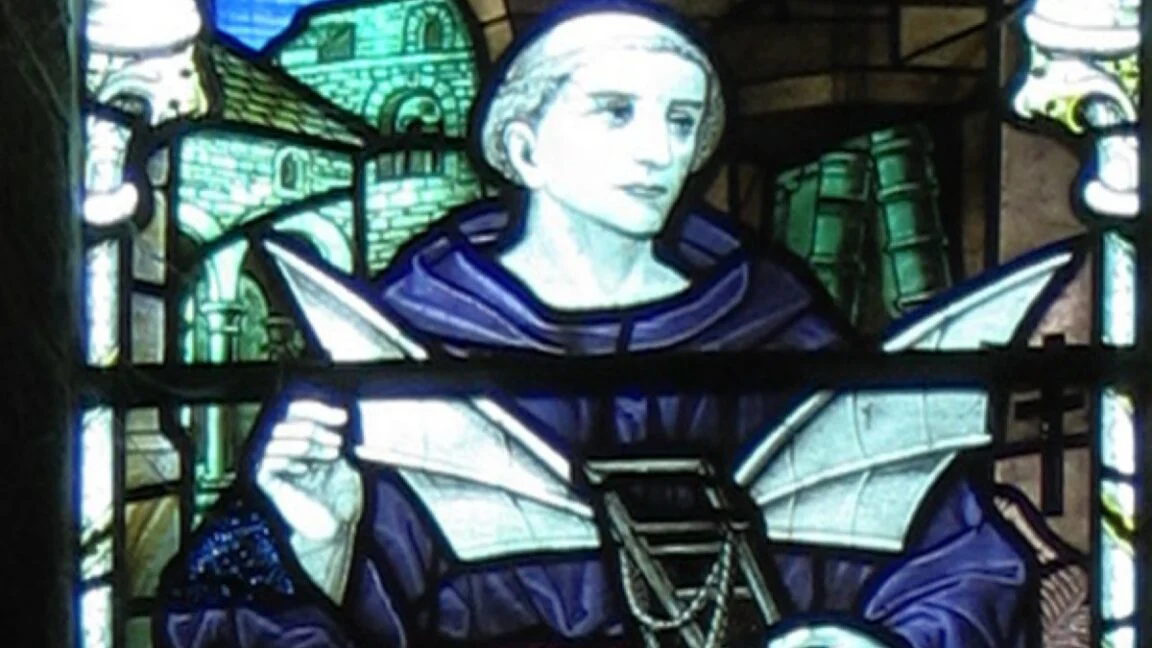
In the annals of human ambition, few stories possess the haunting, tactile imagery of Eilmer of Malmesbury. Centuries before Leonardo da Vinci sketched his ornithopter or the Wright brothers conquered the dunes of Kitty Hawk, a Benedictine monk stood atop the precipice of a Wiltshire abbey, staring into the abyss with the audacious belief that he could master the winds. Clad in a contraption of willow wood and linen, Eilmer launched himself into the unknown, effectively becoming one of history’s first documented, if ill-fated, test pilots.
For nearly a millennium, the story of this "Flying Monk" has drifted between the realms of hagiography and historical curiosity. However, recent academic scrutiny, fueled by fresh interpretations of medieval texts and astronomical records, is forcing historians to reconsider not only the date of Eilmer’s flight but the very nature of his scientific endeavor.
The Main Facts: A Leap of Faith
The primary account of Eilmer’s life and his daring flight stems from the 12th-century historian William of Malmesbury, writing around 1125. According to William, Eilmer was a man of insatiable curiosity and scholarly ambition. Driven by the myth of Daedalus and Icarus, Eilmer fashioned crude wings, fastening them to his hands and feet.
The jump took place from the tower of Malmesbury Abbey—a structure rising approximately 150 feet above the surrounding landscape. As Eilmer leaped, he didn’t plummet like a stone. Instead, he caught an updraft. Accounts suggest he glided for roughly 600 feet, successfully clearing the abbey’s city walls before the volatile wind currents of the valley near the River Avon caused a catastrophic loss of control. The subsequent crash landing left Eilmer with two shattered legs, crippling him for life. Despite the physical toll, his legacy endured; today, Malmesbury Abbey features a stained-glass window dedicated to his memory, immortalizing the monk who dared to challenge gravity.
Chronology: Pinning Down the Unseen
Determining exactly when this event occurred has proven to be a labyrinthine task for historians. The difficulty lies in the scarcity of contemporary records and the reliance on oral traditions transcribed long after the fact.
The 1066 Connection
William of Malmesbury provides a crucial, if ambiguous, temporal anchor: the appearance of Halley’s Comet in 1066. In his writing, William notes that when Eilmer was an old man, he witnessed the celestial phenomenon and remarked, “It is long since I saw you.”
For decades, historians interpreted this to mean that Eilmer had witnessed the previous perihelion of the comet in 989. If one assumes Eilmer was at least five years old in 989—the age at which a child might reasonably remember such a singular event—he would have been born no later than 984. This timeline places him in his early twenties around 1000–1010, the period William describes as Eilmer’s "first youth," when he allegedly undertook his flight.
The Revisionist Perspective
However, the historical timeline is currently undergoing a rigorous re-examination. James Aitcheson, a researcher at the University of Leicester, has challenged the traditional 989/1066 narrative. In a paper published in the journal Notes and Queries, Aitcheson argues that the monk’s encounter with a comet in his youth might not have been Halley’s at all.
Aitcheson posits that Eilmer could have been observing the comet of 1018. If this hypothesis holds, it would fundamentally shift the monk’s birth date significantly forward. Under this revised chronology, Eilmer would have been a younger man during the 1020s or 1040s, placing his flight attempt much later in the 11th century. This shift complicates the traditional narrative, suggesting that the "Flying Monk" may have been part of a later, perhaps more technologically advanced, intellectual movement than previously imagined.
Supporting Data: The Science of Medieval Flight
While Eilmer’s wings were undeniably crude, the physics behind his flight cannot be entirely dismissed as folklore. The flight distance of 600 feet—roughly the length of two American football fields—is remarkably consistent with a controlled, albeit unstable, glide.
Modern aeronautical enthusiasts have often analyzed the structural limitations of the period. Willow wood is lightweight and possesses a degree of flexibility, making it an ideal material for a primitive airframe. The use of cloth, likely waxed or treated to increase lift, suggests a rudimentary understanding of aerodynamics, or at the very least, a keen observation of avian flight.
The primary hurdle for Eilmer was not the initial launch, but the lack of an empennage (tail assembly). Without a mechanism to control pitch and yaw, Eilmer was entirely at the mercy of the wind. When he hit the turbulent air over the valley, his inability to adjust his wing configuration led to the inevitable crash. Yet, the fact that he survived the fall is a testament to the limited lift his device provided; he was gliding, not falling.
Official Responses and Academic Debate
The academic community remains divided on the interpretation of William of Malmesbury’s writings. Some, like the researchers at Leiden University, have been instrumental in debunking the casual association of historical figures with specific astronomical events. They argue that the 11th-century chroniclers often used celestial events as literary devices to provide a sense of gravitas to their subjects, rather than as precise chronological markers.
"The danger in historical analysis is the desire to build a perfect bridge between our modern records and their ancient diaries," says one academic source. "William of Malmesbury was writing for an audience that valued moral lessons over flight telemetry. We must treat his text as a product of its time—a mixture of observation and hagiography."
Conversely, proponents of the flight’s historical accuracy emphasize that the detail about the broken legs provides a "truth-claim" that is rare in medieval miracle stories. Typically, if a monk were to attempt flight in a medieval text, the story would end in either miraculous success or divine punishment. The inclusion of a painful, non-fatal injury grounded in a specific geographical location (the valley by the Avon) suggests that William was recording an event he believed to be factual.
Implications: The Legacy of Eilmer
Why does Eilmer of Malmesbury continue to captivate the modern imagination? The implications of his story extend far beyond the history of aviation. Eilmer represents the intersection of faith and the nascent scientific method. In an era where the heavens were often viewed through the lens of theology, Eilmer was looking at the sky and seeing a domain to be explored.
Cultural Impact
The stained-glass window in Malmesbury Abbey serves as a reminder that the community—and the Church—eventually embraced Eilmer’s curiosity rather than condemning it as hubris. His legacy has become a symbol of the English spirit: a blend of eccentric brilliance and pragmatic bravery.
Lessons for Future Historians
The ongoing debate regarding Eilmer’s birth and flight dates highlights the necessity of interdisciplinary research. By combining astronomical data (cometary orbits), philology (the study of William of Malmesbury’s specific word choices), and materials science (the feasibility of willow-and-cloth flight), scholars are moving closer to a holistic understanding of the medieval mind.
As we continue to analyze the life of Eilmer, we are forced to confront our own biases regarding the "Dark Ages." The narrative of a stagnant, unscientific medieval world is increasingly untenable. Eilmer was not a man of the dark; he was a man who looked up, saw the light, and dared to follow it. Whether he flew in 1005 or 1035, the reality remains that for a brief, breathless moment over the river Avon, a monk from Malmesbury was the first human to experience the exhilaration of sustained flight.
In the final assessment, Eilmer’s crash was not a failure of intellect, but a necessary step in the long, arduous process of human discovery. He was the first to find the limits of the air, and for that, he remains an essential figure in the history of human progress—a man who, for 600 feet, held the sky in his hands.


 Suro Senen
 Jia Lissa