

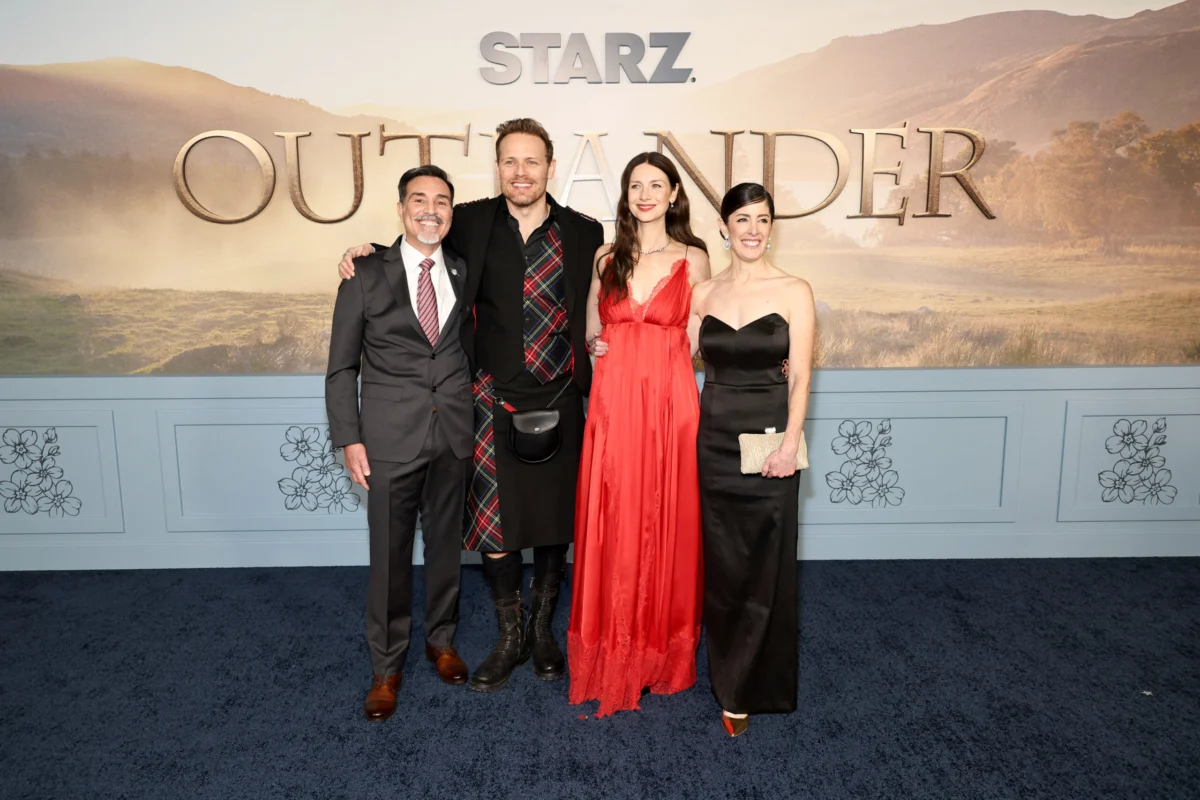
Editor’s note: The following article contains significant spoilers for the series finale of “Outlander.”
After a decade of traversing time, surviving historical upheavals, and enduring the perils of the 18th century, the epic journey of Claire and Jamie Fraser has reached its final destination. Since its premiere in 2014, Starz’s "Outlander" has transcended the typical boundaries of period drama to become a global cultural phenomenon. As the credits rolled on the 101st episode, bringing an eight-season run to a close, the air in Los Angeles was thick with both the nostalgia of a farewell and the satisfaction of a story brought full circle.
Showrunner Matthew B. Roberts, who has navigated the series through its most turbulent narrative waters, recently sat down with IndieWire to unpack the complexities of the finale, address the spirited feedback from the show’s notoriously dedicated fanbase, and reflect on the serendipitous "magic" that defined the show’s production from its first day in Scotland to its last.
A Legacy of Passion and Feedback
For a showrunner, the "Outlander" community represents a unique challenge. Known for their encyclopedic knowledge of Diana Gabaldon’s novels and their unwavering devotion to the characters of Claire and Jamie, the fanbase does not hesitate to voice their approval—or their dissent.
"Like any showrunner, I have to hear the good feedback and the bad feedback," Roberts noted. "Fans of this show are known for their passion. If they feel there’s been a misstep, I’m going to hear about it." Following the series finale, which aired just 24 hours prior to our conversation, the reception has been largely celebratory. However, the path to this conclusion was not without its hurdles, particularly concerning the pacing of the final season.
Navigating Narrative Shifts: The Faith Conundrum
One of the most controversial creative choices in recent seasons was the radical deviation from the source material regarding the fate of Claire and Jamie’s daughter, Faith. In the novels, Faith’s death is a cornerstone of Claire’s trauma in the 18th century. However, the television series delivered a narrative bombshell at the end of Season 7, suggesting that their daughter had actually survived.

This retcon sparked intense debate among readers and viewers alike. Roberts admitted that the execution of this storyline was hampered by logistical realities. "We didn’t know in Season 7 that there was going to be a Season 8," he explained. This uncertainty forced the writing team to balance long-term character arcs with the immediate pressure of an unknown endpoint.
When the final season was confirmed, it arrived with a truncated order of only 10 episodes—a frustratingly small canvas upon which to paint the conclusion of Diana Gabaldon’s massive novel, Go Tell the Bees That I’m Gone. "I would have loved two more episodes," Roberts confessed. "Not only did we get a Season 8, but then we got two fewer episodes to tell this story, and that’s quite a chunk of space." The resulting compression meant that some narrative beats, which would have provided more clarity regarding the characters’ motivations, were left on the cutting room floor. Speculation has already begun among fans regarding whether these missing pieces might one day be addressed in a potential standalone film, though nothing has been officially confirmed.
The Balancing Act: Screen Time and Character Agency
A recurring critique throughout the final season was the perceived reduction in screen time for Caitríona Balfe’s Claire Fraser. Addressing this directly, Roberts emphasized that the issue was purely mathematical rather than intentional.
"If I write for Claire, I have to take away from Jamie’s story, and if I write for Jamie, I take away from Claire’s story," he explained. The challenge of adapting a sprawling, hefty literary work into a 10-hour television season meant that compromises were inevitable. "We certainly didn’t go, ‘Hey, let’s diminish Claire in these episodes.’ It was a time thing."
Despite these constraints, the series remained, at its core, a testament to the partnership between Balfe and Sam Heughan. The most celebrated episodes of the final season were those that allowed the lead couple to share the frame, reminding the audience that the heartbeat of "Outlander" has always been the radical equality and profound love between the two protagonists.
The Ambiguity of the End: A Final Breath
The final moments of the series saw Jamie and Claire, apparently deceased on a mountain, suddenly open their eyes and draw a collective breath. It was a haunting, ethereal conclusion that left the audience debating the literal versus the spiritual nature of their survival.

When pressed for an explanation, Roberts remained steadfastly protective of the ambiguity. "I don’t want to interpret what happens to them," he said. "We show that they open their eyes, we show that they take a breath. That’s there on screen; that’s not ambiguous in any way."
Roberts revealed that he intentionally kept the cast and even the episode director, Emer Conroy, in the dark regarding his personal interpretation of the final scene. "I don’t want to say because I don’t want to affect the audience that sees it." Even Balfe and Heughan, the stars who lived these characters for over a decade, watched the final edit for the first time just one day before the public.
Behind the Scenes: Bloopers and Bonds
Beyond the heavy lifting of the script, the camaraderie behind the scenes has been a cornerstone of the show’s longevity. Roberts shared a lighthearted anecdote about a disastrous—yet memorable—readthrough. Following a celebratory whisky tasting, the cast and producers attempted to power through a script session, resulting in a scene that would be a dream for any blooper-reel collector.
"According to Sam, Caitríona’s legs were on the ceiling of their car the next morning," Roberts laughed, recounting the aftermath of their revelry. It is this genuine affection between the core team—Balfe, Heughan, Roberts, and executive producer Maril Davis—that has anchored the show through eight years of filming.
A Bookended Journey: The Magic of Scotland
Perhaps the most poignant moment of the production occurred during the filming of the finale near the iconic "Outlander" stones. For Roberts, the experience was a spiritual bookend to the series.
"The light was just perfect. We toasted and everybody had a drink. It was really a magical moment, and I’ll never forget that," he recalled. He drew a parallel to the pilot episode, where Caitríona Balfe stood by the stones as the Scottish wind caught her hair—a moment that appeared to be the work of a wind machine but was, in fact, entirely natural.

"When we first started, Caitríona and Maril had that day. Scotland was giving her that perfect moment. And at the end, Sam and I had it. Scotland was like, ‘I’ll give you some magic.’"
Implications: A Lasting Cultural Impact
As the show transitions from a live-airing juggernaut to a permanent fixture in the streaming library of Starz, the legacy of "Outlander" seems secure. It has redefined the historical romance genre for television, proving that a show centered on a mature, nuanced, and equal partnership can sustain high-stakes drama for over a decade.
Roberts’ final reflection at the Paley Center captures the sentiment shared by the entire production team: "It’s an amazing feeling when somebody comes up to you and says, ‘I love Outlander and it changed my life.’ That’s the most rewarding thing anybody could say."
While the screen may have gone black on the lives of Jamie and Claire, the impact of their journey—and the "magic" of the world they inhabited—will continue to resonate with fans for generations to come.
All eight seasons of "Outlander" are available to stream on Starz.









No comments yet. Be the first to join the conversation!