After decades of development hell, failed film attempts, and the persistent reputation of being "unfilmable," William Gibson’s seminal 1984 cyberpunk masterpiece Neuromancer is finally materializing on screen. Apple TV+, currently carving a formidable reputation as the premier home for high-concept, critically acclaimed science fiction, has released the first official teaser for its highly anticipated adaptation. While the footage is brief and intentionally obfuscated, it marks a monumental step for the genre that effectively birthed modern digital culture.
Main Facts: A Digital Glitch in Reality
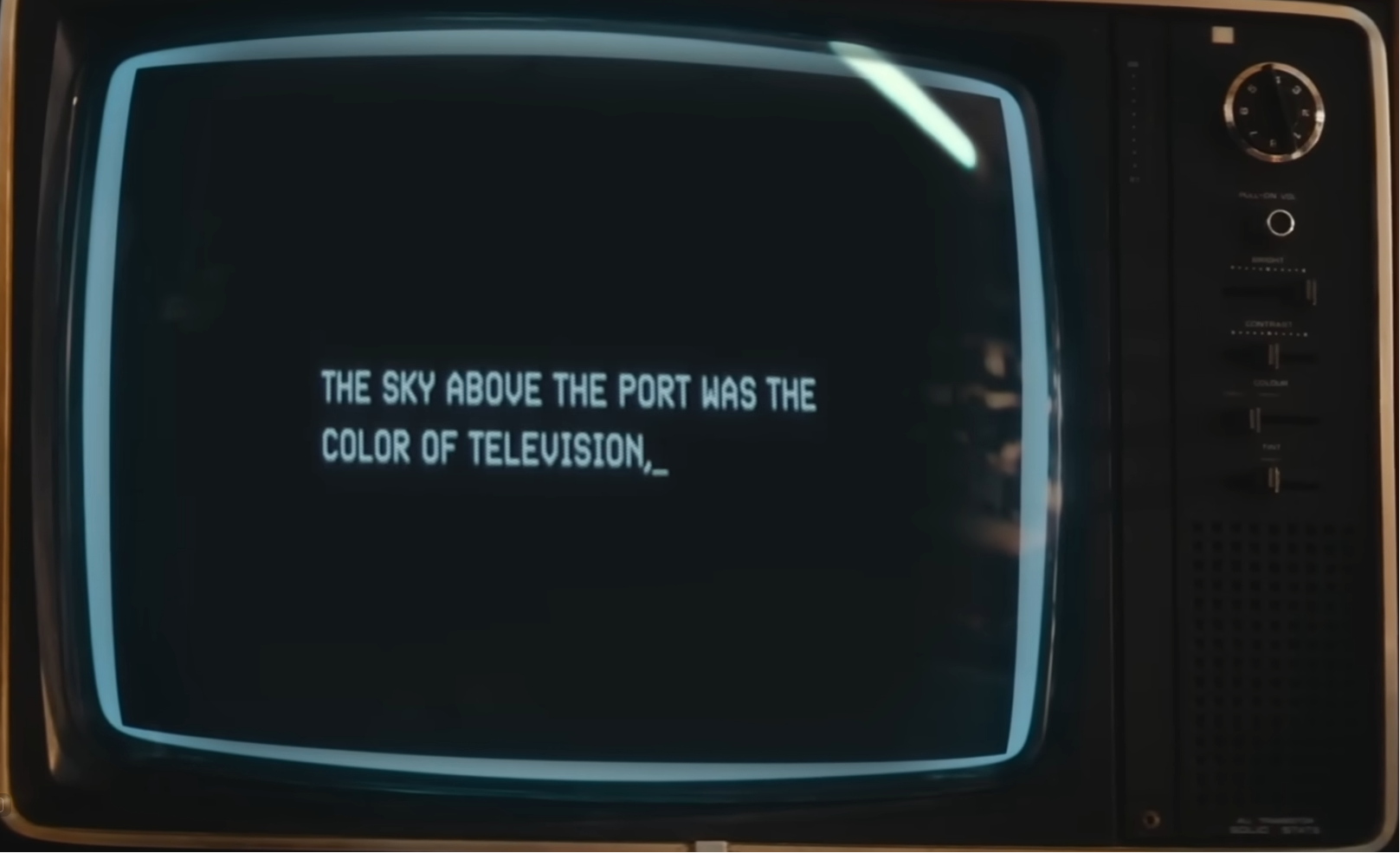
The teaser released by Apple TV+ is a study in minimalist marketing. Eschewing the traditional "hype reel" approach, the preview focuses on a grainy, retro-style computer monitor flickering with the most iconic opening line in the history of science fiction: "The sky above the port was the color of television, tuned to a dead channel."
The footage then cuts to a fractured, low-resolution glimpse of an interior space—likely a Japanese boarding capsule or a grimy sprawl-side apartment—before fading to black. Accompanying this visual is a brief, tantalizing message: "42 years ago, William Gibson introduced the world to Neuromancer. Now, the next chapter is loading."
The production features a star-studded cast, with Callum Turner stepping into the role of Henry Dorsett Case, the disgraced hacker at the center of the narrative. He is joined by Briana Middleton as the razor-fingered assassin Molly Millions, Mark Strong as the mysterious handler Armitage, and Clémence Poésy as the enigmatic Lady 3Jane. Behind the scenes, the series is steered by co-creators Graham Roland (Dark Winds) and J.D. Dillard (Sweetheart), with Dillard slated to direct the pilot. Crucially, William Gibson himself is serving as an executive producer and creative consultant, providing a level of authorial oversight that fans hope will preserve the soul of his complex, neon-soaked vision.
Chronology: From Page to Pixels
The road to bringing Neuromancer to the screen is a saga that spans four decades. Published in 1984, the novel didn’t just win the "triple crown" of science fiction (the Hugo, Nebula, and Philip K. Dick Awards); it effectively invented the concept of "cyberspace" and codified the aesthetics of the cyberpunk subgenre.
- 1984: William Gibson publishes Neuromancer, introducing the world to the Sprawl, the Matrix, and the concept of the console cowboy.
- 1990s–2000s: Various directors, including Chris Cunningham and Joseph Kahn, attempted to adapt the novel for the big screen. The complexity of the narrative, the abstract nature of the "cyberspace" sequences, and the specific, gritty tech aesthetic made it a financial and creative nightmare for studio executives.
- 2010s: The project lingered in development at various production houses, with the rise of prestige television eventually making the Sprawl trilogy a more viable candidate for a series format rather than a two-hour film.
- 2024: Apple TV+ officially announces the series, with production beginning in earnest.
- 2026 (Projected): Industry insiders and current post-production reports suggest a late 2026 release window, positioning the show as one of the most significant cultural events of that year.
Supporting Data: The Anatomy of a World
The teaser confirms a core design philosophy: the preservation of "rough, retro tech." While modern sci-fi often leans toward the sleek, sterile aesthetic of Minority Report or the high-gloss sheen of Star Trek, Neuromancer demands something different. The world of the Sprawl is one of scavenged parts, CRT monitors, clunky interfaces, and hardware that feels tactile and heavy.
This decision to lean into the "crude" nature of the technology is not just an aesthetic choice; it is a narrative requirement. The grit of Gibson’s world—the idea that the future is just as dirty, broken, and commodified as the present—is the bedrock of the cyberpunk genre. By choosing to honor this, the showrunners are signaling a commitment to the "High Tech, Low Life" ethos that defined the novel.
Furthermore, the involvement of William Gibson as an executive producer provides a critical data point for fan confidence. In previous years, Gibson has been famously protective of his IP, often citing the difficulty of translating the internal monologue and the sheer density of the book’s jargon to a visual medium. His presence in the writers’ room suggests that the "next chapter" rhetoric in the teaser might imply a more expansive narrative strategy—one that potentially integrates elements from the subsequent books in the Sprawl trilogy, Count Zero and Mona Lisa Overdrive, rather than limiting the story to the original 1984 novel.
Official Responses and Implications
The phrase "the next chapter is loading" has sparked intense debate among the literary and film communities. While the official synopsis released by Apple—"A hacker and an assassin are thrust into a web of high-stakes crime as they take aim at a corporate dynasty"—aligns closely with the events of the novel, the implication of a "next chapter" suggests that the show is designed as a multi-season franchise.
For Apple TV+, this is a high-stakes gamble. The platform has successfully launched Foundation and Silo, both of which proved that complex, dense sci-fi can find a massive audience if handled with sufficient budget and respect for the source material. However, Neuromancer is a different beast. It is the "grandfather" of the genre; any deviation from the established lore will be scrutinized with microscopic intensity by a fan base that has been waiting for this for nearly half a century.
The casting choices also imply a desire to ground the story in human emotion, which is the necessary antidote to the cold, clinical nature of cyberspace. Callum Turner’s portrayal of Case will be the anchor for the audience. As a character defined by his cynicism and his addiction to the digital high, his arc is one of the most compelling in literary sci-fi. If the chemistry between Turner and Briana Middleton’s Molly works, the series will have the emotional scaffolding required to support its high-concept world-building.
The Cultural Significance of the "Unfilmable"
Why has Neuromancer been labeled "unfilmable" for so long? The primary obstacle has always been the Matrix. Gibson’s descriptions of cyberspace—the "consensual hallucination" of data—are abstract, poetic, and internal. Translating that into a visual medium without relying on the tired visual shorthand of "green code raining down" (a trope popularized, ironically, by The Matrix, which was heavily influenced by Gibson) is a monumental creative challenge.
Apple TV+’s decision to keep the visual identity of the show under wraps is a tactical masterstroke. By showing only a "dead channel" on a screen, they are teasing the audience’s own imagination, forcing them to visualize the Sprawl before the show actually forces a specific interpretation upon them.
Ultimately, Neuromancer is not just an adaptation; it is a test case for the future of adult-oriented science fiction on streaming platforms. If it succeeds, it could set a new benchmark for how we adapt dense, intellectual property. If it fails, it will serve as a cautionary tale for those who attempt to digitize the analog soul of the 80s. With the production currently in post-production, the clock is ticking. The world is watching the port, waiting for the television to finally tune into something more than a dead channel. The "next chapter" is indeed loading, and for the first time in history, the future of the Sprawl feels closer than ever.