
 Siti Muinah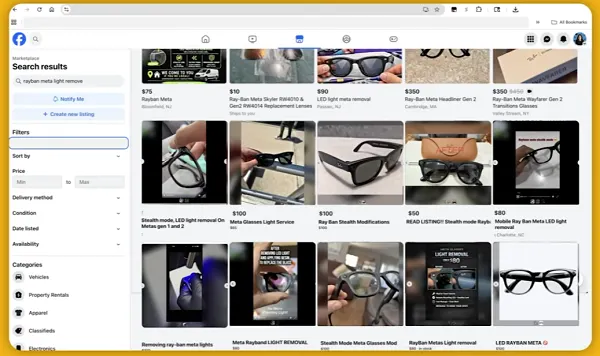
In an era where the boundaries between physical reality and digital capture are increasingly blurred, Meta’s smart glasses have become a focal point of intense ethical and technological debate. As the tech giant pushes to integrate artificial intelligence into the everyday lives of its users, it finds itself embroiled in a high-stakes struggle against a burgeoning black market of hardware hackers. At the heart of this conflict is the device’s recording indicator—a small LED light designed to signal to the public when they are being recorded. Meta has now announced a robust software update intended to render the device useless if this safety mechanism is tampered with, yet critics argue that the company’s own future product roadmap may contradict its stated commitment to privacy.
The Rise of the "Stealth Mode" Black Market
The recent crackdown by Meta was prompted by a disturbing trend uncovered by tech journalist Joanna Stern. In an investigation for her YouTube channel, New Things, Stern revealed that a cottage industry had sprouted on platforms like Facebook Marketplace, where third-party providers were offering services to physically remove or disable the recording LED on Meta’s second-generation smart glasses.
These "stealth mode" modifications were being advertised as a way for users to capture footage without alerting those around them. With prices for these illicit services reaching up to $100, the trend highlighted a clear consumer demand for covert recording capabilities. By drilling out or masking the light, users could transform a consumer-grade wearable into a surveillance tool, raising significant alarms regarding non-consensual filming, harassment, and the fundamental right to privacy in public spaces.
Chronology: From Consumer Tech to Covert Surveillance
The escalation of this issue has been swift, tracking alongside the increasing adoption of Meta’s wearable hardware:
- The Launch: Meta’s second-generation smart glasses arrive with built-in cameras and a mandate for transparency: a physical LED light that activates whenever the shutter is pressed.
- The Emergence of Tampering: Early in 2026, reports surfaced on social media and niche tech forums regarding the ease with which the hardware could be modified to bypass the LED indicator.
- The "New Things" Exposé: In mid-2026, Joanna Stern’s investigation brought mainstream attention to the issue, documenting specific ads on Facebook Marketplace that promised "stealth" functionality for a fee.
- The Corporate Pivot: Recognizing the existential threat this posed to the product’s public image and regulatory standing, Meta began developing a fail-safe system.
- The Enforcement Update: Meta officially announced that the latest software update for its glasses includes a hardware-detection feature that triggers an automatic shutdown of the camera if the LED is obscured or destroyed.
Official Responses and Technical Countermeasures
Meta’s response to the tampering crisis has been two-pronged: technological intervention and aggressive policy enforcement. According to the company, the second-generation glasses are now equipped with sensors capable of detecting if the capture LED has been blocked or physically compromised.
"Beginning with our second generation of glasses, the camera is automatically disabled if we detect that the capture LED has been blocked," a Meta spokesperson stated. "No photos or videos can be taken until we detect that the light is unblocked." Furthermore, if the system determines the LED has been destroyed, the device will remain in a permanent state of lockout. Meta has positioned this as a landmark move, noting, "No other kind of camera has done this, and we’re proud to lead the industry forward."
Beyond the software updates, Meta is turning its legal and administrative firepower on those facilitating the modifications. The company has pledged to:
- Actively monitor and remove all Marketplace listings and social media posts advertising LED removal services.
- Ban accounts associated with the promotion or execution of such hardware modifications.
- Pursue legal action against third-party businesses that specialize in tampering services, regardless of whether these operations take place on or off Meta-owned platforms.
The Ethical Implications of "Always-On" AI
While Meta frames its latest update as a triumph for user safety, the narrative is complicated by reports regarding the company’s internal development roadmap. According to a recent report by the Financial Times, Meta is currently testing a prototype for a future iteration of smart glasses that would function in a state of near-continuous capture.

The prospect of "always-on" smart glasses—devices that record audio and capture photos every few seconds to help users "recall their day"—presents a radically different set of privacy concerns. If the device is constantly collecting data, the traditional concept of an "indicator light" becomes functionally obsolete. It is difficult to imagine a world where an LED remains illuminated for sixteen hours a day, or where such a light would be meaningful to the public in a world of constant, ambient recording.
Critics suggest that Meta’s crackdown on third-party "stealth mode" modifications may be less about protecting privacy and more about maintaining market control. By banning unauthorized modifications, Meta ensures that it remains the sole arbiter of what constitutes "appropriate" recording. If the company’s future vision involves the company itself bypassing the social contract of the "recording light" in favor of continuous data collection, the irony is not lost on observers.
Corporate Ethos and the "Move Fast and Break Things" Legacy
This situation serves as a microcosm of Meta’s broader corporate philosophy. The company has long operated under the "move fast and break things" ethos—a mantra that prioritizes rapid product deployment and iterative growth over the meticulous anticipation of long-term societal consequences.
The current conflict over LED lights illustrates the inevitable friction that occurs when hardware intended for consumer convenience hits the reality of social privacy. When the company pushes products that challenge social norms, it often finds itself scrambling to implement safety guardrails only after the public or malicious actors have identified the potential for abuse.
Meta’s pivot from allowing the glasses to exist as they were to imposing strict, software-locked limitations on hardware integrity reflects a company trying to reconcile its ambitions with the mounting pressure from regulators and the public. As the glasses become more capable—and more invasive—the question remains: can technological "fail-safes" ever truly compensate for the loss of individual privacy in the public square?
Conclusion: A Precarious Future
As Meta continues to expand its footprint in the wearable technology market, the tension between innovation and accountability will only intensify. The company has proven that it can, and will, deploy defensive measures to protect the integrity of its devices. However, the move toward "always-on" AI-assisted hardware suggests that the definition of "privacy" is being redefined by the very companies that stand to profit from the data captured by these lenses.
For now, the LED light remains a symbol of transparency, a small digital beacon meant to preserve the sanctity of human interaction. Whether that beacon can withstand the pressure of a company eager to see everything, and a public increasingly comfortable with the idea of being watched, remains to be seen. One thing is certain: as Meta moves forward, it will need to do more than just update software; it will need to convince a skeptical public that its pursuit of a new digital reality does not come at the cost of the old one.


 Azzam Bilal Chamdy
 Sagoh
Sagoh





