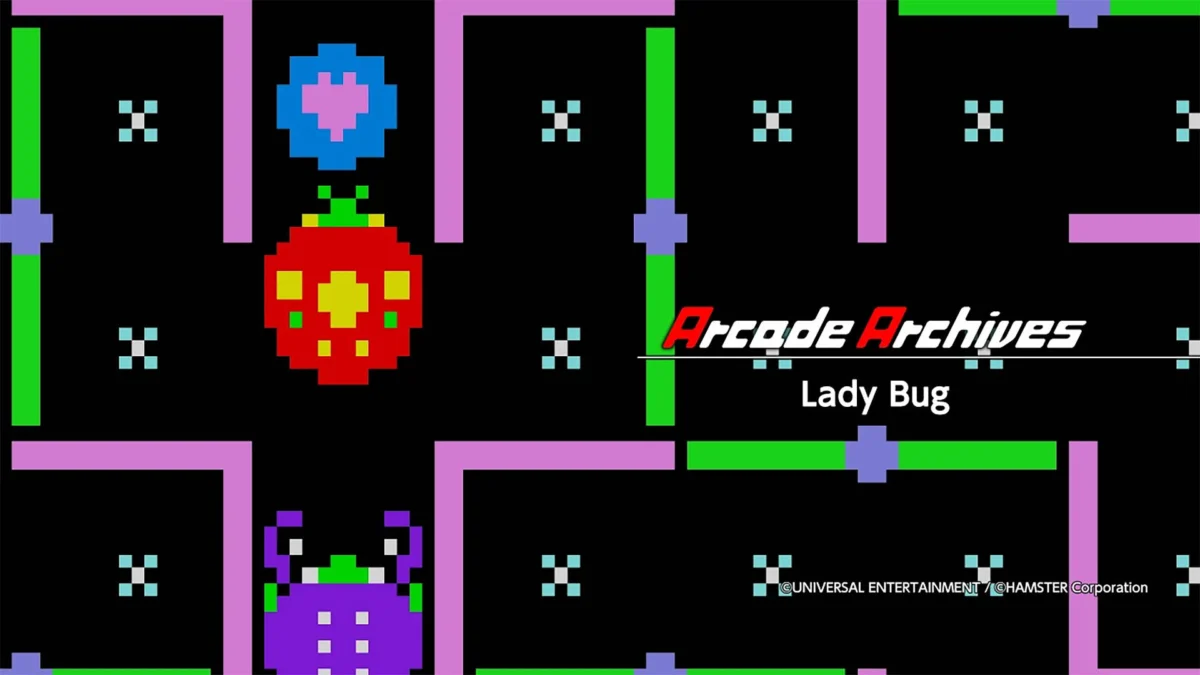
In a move that underscores the enduring appeal of the golden age of arcades, Hamster Corporation has officially announced the latest addition to its esteemed Arcade Archives catalog. The title in question is the 1981 classic Lady Bug, a strategic maze-chaser developed by Universal. This release marks a significant milestone for retro gaming enthusiasts, as it represents the first time the title has been officially ported to modern hardware, bridging a gap that has spanned over four decades.
The re-release will be available across a broad spectrum of platforms, utilizing both the standard Arcade Archives line and the newer Arcade Archives 2 initiative. With a scheduled launch date of June 2nd, the title aims to bring the frantic, puzzle-heavy gameplay of the early 80s to a new generation of players on the PlayStation 5, Xbox Series X|S, Nintendo Switch, and the newly integrated Switch 2.
The Core Facts: A Strategic Maze-Chase Reborn
At its heart, Lady Bug is a game of precision and tactical movement. While often compared to its contemporaries like Pac-Man, Lady Bug differentiated itself in the early 1980s by emphasizing environmental manipulation over pure reflex-based navigation.
Players assume control of the titular ladybug, tasked with navigating a complex, ever-changing maze. The objective is deceptively simple: collect all the dots scattered across the screen while avoiding a relentless pursuit by enemy insects. However, the game’s unique hook lies in its "revolving doors." Unlike other maze games of the era where the environment is static, the maze in Lady Bug features gates that rotate as the player passes through them. This mechanic allows for strategic path-blocking, enabling players to trap enemies or create safe corridors for themselves.
The release is tiered to cater to different hardware generations. The standard Arcade Archives version, available for the PlayStation 4 and Nintendo Switch, is priced at $14.99. Meanwhile, the Arcade Archives 2 version—optimized for the PlayStation 5, Xbox Series X|S, and the Nintendo Switch 2—will retail for $16.99. In a consumer-friendly move, Hamster Corporation is offering an upgrade path for existing owners of the first iteration, allowing them to bridge the gap to the updated AA2 version for a nominal fee of $2.99.
Chronology: From Universal’s Lab to Modern Emulation
To understand the significance of this release, one must look back at the landscape of 1981. During this era, the arcade market was dominated by the success of Namco’s Pac-Man. Developers were racing to capitalize on the "maze-game" craze, but Universal stood out by adding layers of complexity that turned simple navigation into a game of chess.
- 1981: The Arcade Debut: Lady Bug hit arcades as a fresh alternative to the established giants. It was praised for its vibrant color palette and the innovative use of gates.
- 1982-1985: The Console Struggles: The game saw limited home console ports during the initial video game boom, most notably on the ColecoVision. However, these versions were often hampered by the limitations of the hardware of the time, failing to capture the fluidity of the arcade original.
- The "Lost" Years: For nearly forty years, Lady Bug remained largely inaccessible outside of original arcade cabinets and niche emulation projects. It never received the mainstream re-release treatment that other titles like Galaga or Frogger enjoyed.
- 2026: The Hamster Corporation Restoration: Hamster Corporation, through its Arcade Archives project, has dedicated itself to the "digital preservation" of these titles. By securing the rights to Lady Bug and applying their proprietary emulation technology, they are finally providing a definitive, legally accessible version of the game that runs at perfect arcade fidelity.
Supporting Data: Why ‘Lady Bug’ Remains Relevant
The enduring legacy of Lady Bug is not merely nostalgic; it is rooted in its mechanical depth. When analyzing the game’s design, several factors explain why it remains a "cult classic" among arcade historians:
- Dynamic Difficulty Scaling: Unlike many games of the early 80s that relied solely on increasing enemy speed, Lady Bug increases the complexity of the maze layouts. The strategic requirement to manage the revolving doors becomes exponentially harder as the game progresses.
- Bonus Systems: The game introduced a robust bonus system where players could collect letters (like ‘S’, ‘P’, ‘E’, ‘C’, ‘I’, ‘A’, ‘L’) or hearts. Completing these sequences provided massive score multipliers, adding a layer of risk-reward gaming that was ahead of its time.
- Enemy AI: The enemies in Lady Bug do not just chase the player; they are programmed with specific patrol behaviors that interact with the revolving doors. This makes the game feel more like an interactive puzzle than a simple chase.
According to industry analysts, the "retro-renaissance" currently being driven by publishers like Hamster Corporation is a response to the growing desire for "short-burst" gaming. In an era dominated by 100-hour open-world RPGs, the high-score-chasing nature of Lady Bug provides a refreshing, low-barrier entry point for modern gamers.

Official Responses and Preservation Philosophy
Hamster Corporation has long been the silent guardian of arcade history. Their philosophy is simple: reproduction over reimagination. By avoiding the temptation to "remaster" or "modernize" the graphics with high-definition filters, they maintain the integrity of the original experience.
In recent internal statements regarding the Arcade Archives initiative, representatives from the company emphasized the importance of input latency. "The feel of an arcade game is in the responsiveness," noted a spokesperson for the project. "When we bring a game like Lady Bug to the PlayStation 5 or Switch 2, we are not just porting code; we are ensuring that the sub-frame timing of the original arcade hardware is matched. This is why our titles are the gold standard for speedrunners and purists."
The inclusion of the Arcade Archives 2 label signifies an evolution in this preservation effort. By moving to platforms like the PS5 and Switch 2, Hamster is leveraging the higher-end processing power to ensure that even with modern upscaling, there is zero frame-dropping, keeping the classic experience perfectly preserved for the next decade of hardware.
Implications: The Future of Digital Preservation
The decision to release Lady Bug on the latest generation of consoles—specifically the Switch 2 and PS5—signals a shift in how legacy content is viewed by major stakeholders. It is no longer considered "abandonware" to be forgotten; it is a catalog of intellectual property that retains value through the lens of digital preservation.
The Economic Impact
The tiered pricing model ($14.99 vs. $16.99) suggests that Hamster Corporation is carefully gauging the consumer appetite for legacy content. If the AA2 model proves successful, it may incentivize other publishers (such as Konami, Capcom, or Taito) to accelerate their own archival efforts.
The Cultural Impact
The re-release of such a title allows for a new dialogue between generations. Grandparents who stood at the arcade machines in 1981 can now share the experience with their grandchildren on the same screen. This continuity of play is the ultimate goal of the Arcade Archives project. By keeping the barrier to entry low and the quality high, Hamster is ensuring that the "alphabet" of gaming history remains readable.
Final Thoughts: A Call to the Arcade
As we approach the June 2nd release, the excitement surrounding Lady Bug is a testament to the fact that good design is timeless. Whether you are a fan of the frantic maze-chasing of the 80s or a modern gamer looking to sharpen your reflexes with a classic, Lady Bug serves as a masterclass in gameplay efficiency.
The game is more than just a piece of software; it is a historical artifact that has been meticulously cleaned, polished, and presented for the modern age. As players once again navigate those revolving doors and hunt for that elusive ‘SPECIAL’ bonus, they are not just playing a game—they are participating in the ongoing story of video game history. Hamster Corporation has ensured that, for the first time in over forty years, the ladybug is back, and she is better than ever.