

As the digital landscape undergoes a seismic shift from traditional search engine result pages (SERPs) to generative AI-powered responses, content creators and marketers are facing a new imperative: Answer Engine Optimization (AEO). A recent deep dive by LinkedIn consultant Brooke Weller has illuminated the mechanics of how content—specifically LinkedIn articles—is being ingested, processed, and cited by Large Language Models (LLMs). With LinkedIn now emerging as a primary source for AI-generated answers, understanding the intersection of human expertise and machine intelligence is no longer optional; it is a prerequisite for brand survival.
The New Frontier: Why LinkedIn is an AI Goldmine
For years, SEO professionals focused on ranking for keywords on Google. Today, the goal is shifting toward being "cited" by AI chatbots. LinkedIn has quietly become one of the most reliable data repositories for LLMs. This is not accidental. The platform’s unique structure—professional, verified, and often dense with industry-specific nuance—provides the high-signal, low-noise data that AI models crave.
LinkedIn has strategically structured its content delivery to align with the semantic retrieval methods used by chatbots. By organizing information into coherent, article-based formats, the platform allows AI to extract precise, factual, and expert-backed answers. As users increasingly turn to tools like ChatGPT, Claude, and Perplexity for quick insights, they are bypassing traditional links in favor of direct, synthesized responses. Consequently, if your content isn’t built to be "readable" by an AI, your brand effectively ceases to exist in this new ecosystem.
Chronology: The Evolution of Search
To understand the current urgency, we must look at the progression of search technology:
- Pre-2015: Keyword Density Era. Content was optimized for crawlers, often at the expense of readability.
- 2015–2022: Semantic and Intent-Based SEO. Search engines like Google began prioritizing "intent" and natural language, leading to the rise of Featured Snippets.
- 2023–Present: The Generative Era. The focus has shifted from "ranking" to "retrieval." AI models synthesize information from multiple sources to provide a single, authoritative answer. This is the era of Generative Engine Optimization (GEO) and Answer Engine Optimization (AEO).
The realization that LinkedIn is a top-tier source for these models marks a critical juncture. Professionals who previously viewed LinkedIn articles as mere "thought leadership" now recognize them as data-training inputs that directly impact visibility in AI-driven search environments.
The Structural Anatomy of AI-Friendly Content
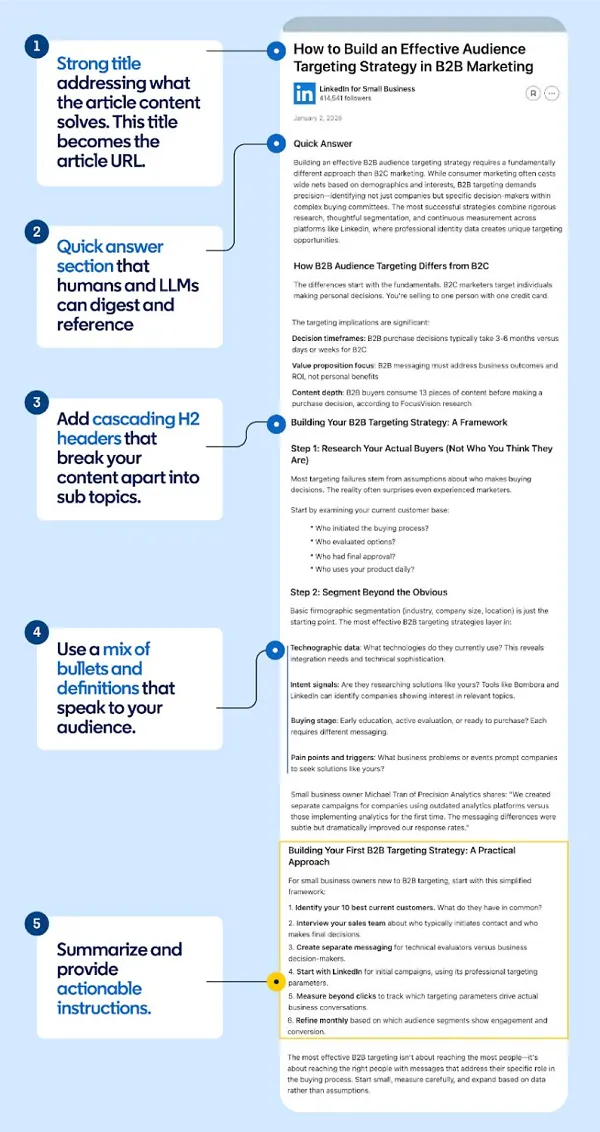
Brooke Weller’s recent insights emphasize that the structure of your content is the most significant factor in whether an AI "chooses" to cite you. Based on current best practices for AEO, here is how content should be formatted to maximize AI discovery:
1. The Power of Definitive Statements
AI models are designed to be helpful, which means they prioritize content that answers a "Who, What, Where, or Why" question directly. Avoid flowery, ambiguous language in your opening paragraphs. Use "The answer is…" or "The primary benefit of X is…" structure to provide clear entry points for AI crawlers.
2. Hierarchical Heading Structures
Just as human readers scan for H2 and H3 tags to understand an article’s flow, LLMs use these tags to index sub-topics. If your headings are witty but vague, you lose. Use descriptive, keyword-rich headings that summarize the content beneath them.
3. Bulleted and Numbered Lists
AI models have a structural preference for data that is already organized. Lists provide a clean, logical format that is easily parsed and summarized. Incorporating listicles into long-form content increases the likelihood that your points will be pulled directly into a chatbot’s response.
4. Contextualizing Expertise
LinkedIn’s strength lies in the verified nature of its users. Content should be framed with professional authority. Providing context—such as "As a consultant in the X industry for Y years"—helps the AI assign "authority" to your content, which is a key metric for ranking in AI responses.
Supporting Data: The Shift in User Behavior
The necessity of AEO is backed by a rapid change in consumer habits. According to recent market analysis, a significant percentage of search queries are now being directed toward generative interfaces. While traditional search traffic remains significant, the "Zero-Click" search—where the user gets their answer directly on the results page—has accelerated.

Data suggests that when users ask a query regarding professional development, industry trends, or business strategy, chatbots are increasingly turning to LinkedIn articles. This is because LinkedIn provides "first-party" professional knowledge that is often fresher and more specific than general web content. For businesses, this means that a single, well-optimized LinkedIn article can generate more brand awareness through AI citation than a dozen poorly optimized blog posts on a private domain.
Official Responses and Industry Sentiment
While LinkedIn has not released a comprehensive "AI Optimization Manual," their internal adjustments suggest a clear commitment to this path. By making content more crawlable and indexing it in a way that respects the semantic requirements of LLMs, the platform has essentially turned every member into a potential data provider for the AI revolution.
Industry experts are reacting with a mix of caution and excitement. The consensus among SEO professionals is that AEO does not replace traditional SEO, but rather serves as its evolution. "We aren’t just writing for people anymore," says one analyst. "We are writing for an audience of one: the algorithm that is going to summarize our work for a million other people."
Implications for Content Strategy
What does this mean for the future of your marketing plan? The implications are far-reaching:
The Death of "Fluff"
AI models are efficient. They strip away filler words to find the core message. Content that is long for the sake of length will be penalized by being ignored by AI, and eventually by human readers who are getting their summaries from bots. Precision is the new length.
The Rise of "Answer-First" Writing
Traditional journalism often builds to a climax at the end. AI-optimized content must follow the "inverted pyramid" model: provide the answer first, then provide the supporting details, and conclude with context or implications. This ensures that the AI’s summary is accurate and represents your brand correctly.
The Importance of Brand Consistency
Because AI models synthesize data from multiple sources, your brand needs to be consistent across all your channels. If your LinkedIn article contradicts your whitepaper, the AI may flag the inconsistency, or worse, ignore both. A unified brand voice is essential for establishing "truth" in the eyes of an AI.
Investing in Originality
AI is a mirror; it reflects the data it is fed. If your content is derivative, the AI will synthesize it into a generic, low-value answer. However, if your content contains original data, unique case studies, or proprietary insights, the AI will prioritize it because it is the only source of that specific value. Originality is your best defense against being commoditized.
Conclusion: Preparing for the Future
The evolution of search is not a temporary trend; it is a fundamental shift in how human beings interact with information. As AEO and GEO become standard practice, brands that adapt their structural approach to content will find themselves with a distinct advantage.
By following the guidelines highlighted by experts like Brooke Weller—focusing on clarity, structure, and authoritative intent—you are not just optimizing for a chatbot; you are clarifying your own brand messaging. The future belongs to those who can speak the language of both humans and machines, ensuring that when the world asks a question, your brand provides the answer.
As we move forward, the goal remains the same: to be visible, to be useful, and to be the authority. The tools have changed, but the mission of quality content remains unchanged. It is time to treat every LinkedIn post and every article as a building block for your brand’s AI identity.












No comments yet. Be the first to join the conversation!