

Most client-agency relationships begin not with a handshake of mutual excitement, but with a guarded, skeptical assessment. Clients rarely walk into a new partnership with a clean slate; they arrive carrying the baggage of previous agency failures—the broken promises of “long-game” strategies, the irrelevant follower-growth graphs presented as revenue, and the agonizing three-day wait for a response to a simple question.
For the agency, this skepticism is a hurdle that appears the moment the contract is signed, often long before the first piece of content goes live. As evidenced by ongoing discussions on platforms like Reddit, clients are increasingly demanding ironclad ROI guarantees. Even agencies that produce stellar results find themselves trapped in a cycle of justifying their existence, proving that in the modern digital landscape, technical excellence is no longer enough to ensure retention. The agencies that thrive are not necessarily those with the highest conversion numbers, but those that have mastered the art of the ROI conversation.
The Anatomy of Initial Skepticism
The mistrust clients feel is rarely a personal indictment of the agency’s talent. Instead, it is a byproduct of three systemic issues that plague the marketing industry.
First, the weight of past experience. Many clients have been "burned" by agencies that promised rapid growth and vanished when performance lagged. This history acts as a lens through which they view every report and communication gap. Second, the Profit & Loss (P&L) asymmetry. A monthly retainer is a hard, visible line item on a balance sheet, while the value generated by social media often feels abstract and intangible. For finance-minded stakeholders, this creates an uncomfortable gap between cost and return.

Finally, the attribution crisis. Modern customer journeys are non-linear. A buyer might discover a product via an Instagram Reel, engage with content for weeks, and eventually convert through a direct Google search. In most standard analytics setups, Google gets the credit, and the social media agency is left looking like an expense rather than a revenue driver.
What Clients Really Mean When They Ask for ROI
When a client asks for "ROI," they are rarely asking for a more complex formula. They are expressing a need for trust. They want to know that their partner is as invested in the business’s survival as they are.
To navigate this, agencies must differentiate between three distinct types of conversations:
- The Tactical "What is Happening" (Monthly): This is not a data dump. It is evidence of critical thinking. A report that identifies a 12% drop in engagement and explains exactly what was changed to correct it builds far more confidence than a report that simply lists the numbers.
- The Strategic "Are We Moving Toward the Goal" (Quarterly): This connects social activity to business outcomes—traffic to sign-ups, sign-ups to pipeline. A client who sees a directional trend, even a slow one, is a client who stays.
- The Foundational "What is This Building" (6-Month Intervals): Here, you report on compounding indicators: content library growth, audience quality, and branded search trends. Month three is not the time to judge ROI; it is the time to evaluate if the strategy is pointed in the right direction.
The Measurement Ecosystem: Why the Odds are Stacked
Before entering any conversation, agencies must recognize that the measurement landscape is often designed to undervalue social efforts.
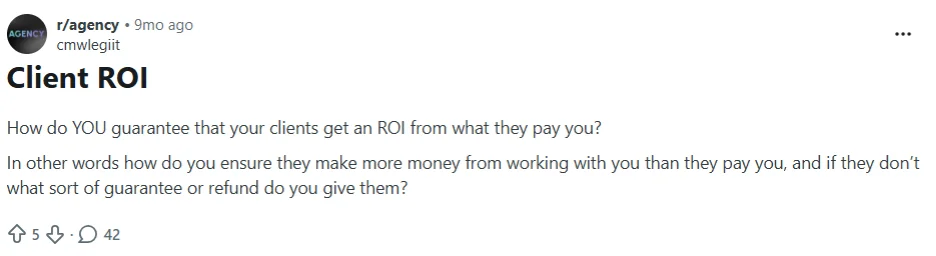
The industry benchmark for a healthy return is 4:1—four dollars returned for every dollar invested. Anything below 2:1 is essentially breaking even once overhead is accounted for. However, research from organizations like Fospha and Sellforte suggests that "last-click" attribution models significantly undervalue paid and organic social. In some cases, Meta or TikTok ads show a 17x to 20x higher ROAS (Return on Ad Spend) when using Marketing Mix Modeling compared to standard last-click tracking.
Furthermore, there is the phenomenon of "Dark Social." Approximately 71% of content sharing occurs in private channels—WhatsApp, Slack, and private DMs—which remain invisible to traditional analytics. Finally, the "time-to-impact" gap is a major point of friction. While paid ads can show results in two weeks, organic social requires a six-to-twelve-month runway. Clients who cancel at month three are effectively quitting right before the "hockey stick" growth curve begins.
Building the Case: The "Measurement Contract"
Agencies that wait for clients to question their value are already on the defensive. The most successful agencies establish a written measurement contract during the onboarding phase.
Before a single post is scheduled, agencies should secure sign-off on:
- Success Milestones: What does success look like at months three, six, and twelve?
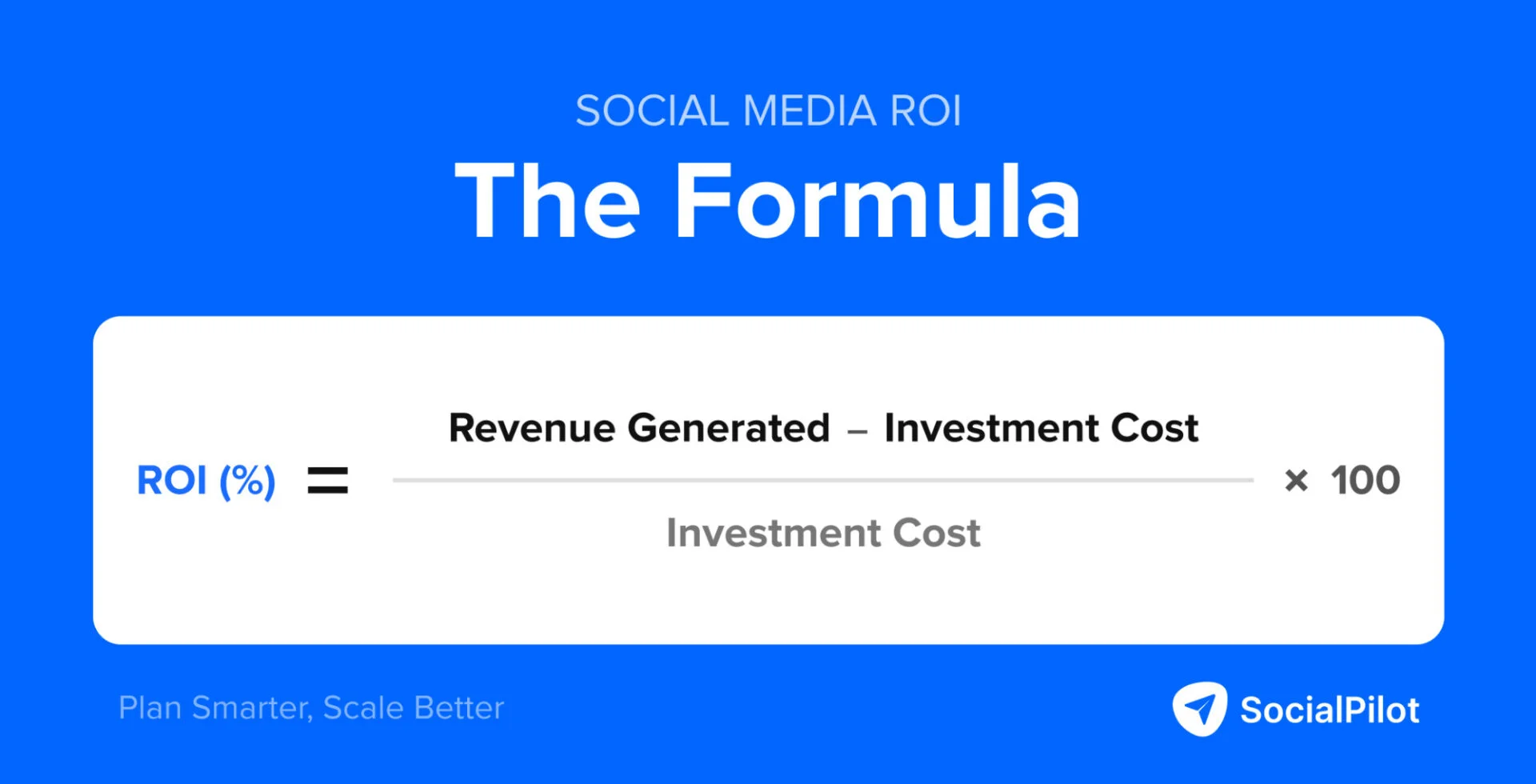
- The Attribution Chain: Acknowledging where data is imperfect. A simple, honest statement like, "No tool does attribution perfectly for organic social. Here is what we track, here is what we infer, and here is how we will report the difference," goes a long way in establishing credibility.
Framing Data for Different Stakeholders
A single report format cannot serve every stakeholder. You must tailor the narrative to the person sitting across the table:
- The CFO: They fear budget waste. Lead with the hard numbers. Show the cost-per-acquisition and the specific path from social to closed deal.
- The Founder: They fear losing competitive ground. Focus on brand equity, audience loyalty, and how the agency’s work positions the brand against competitors.
- The Marketing Director: They fear being embarrassed by underperformance. Show how social contributes to the wider marketing pipeline and supports other channels.
- Operations/Procurement: They fear a lack of accountability. Lead with the process—the milestone tracking and the documented measurement contract.
The Five-Part Report Structure
To survive a skeptical client, your reporting structure should follow a narrative arc rather than a data table:
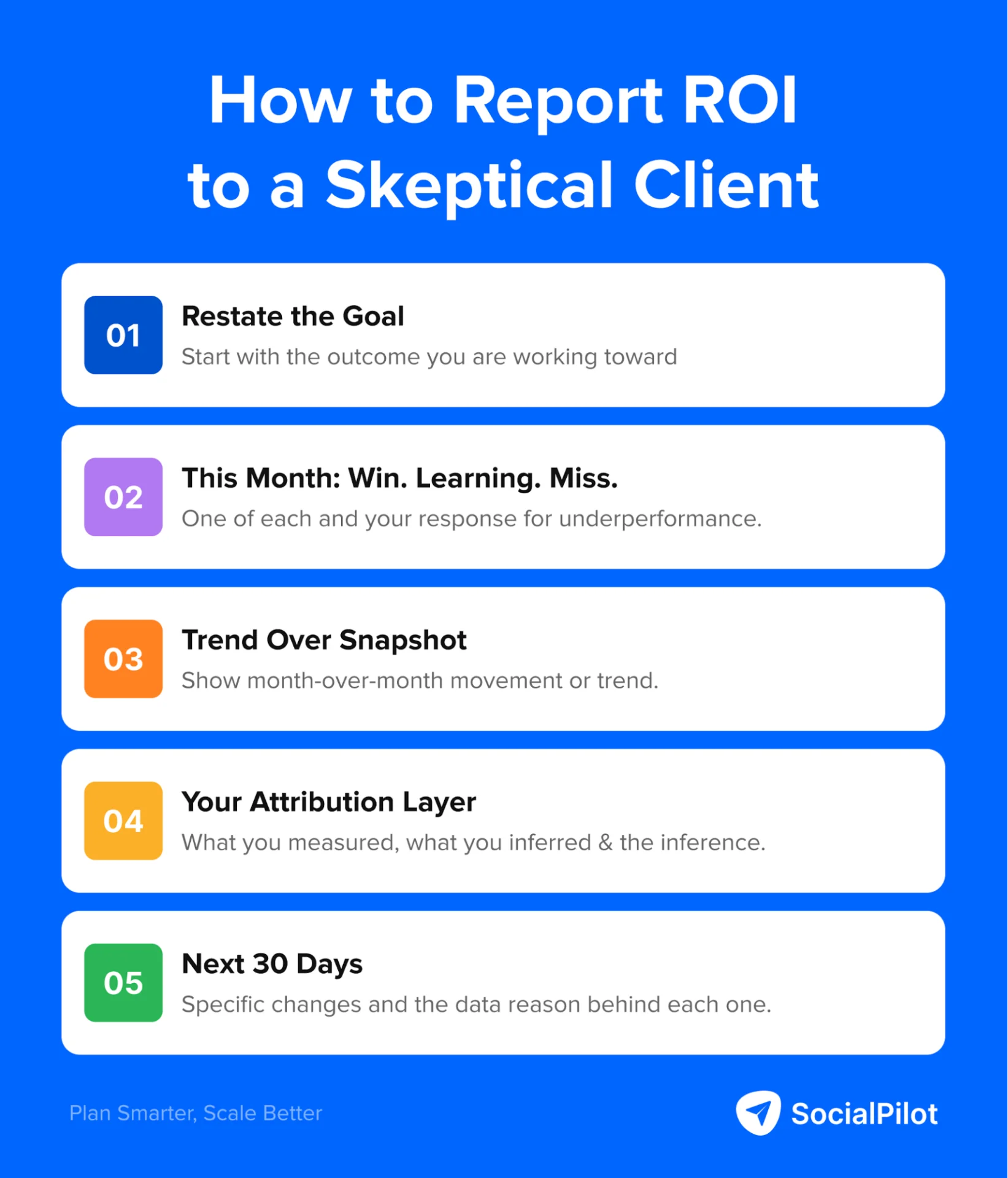
- Restate the Business Goal: Every report opens with the agreed-upon objective. This anchors the conversation in the client’s own mission.
- Win, Learning, Miss: A transparent assessment of what worked, what didn’t, and why. This positions the agency as a strategic partner, not a vendor.
- Trend Before Snapshot: Never present a single month’s metric in isolation. Always show a three-month trend. Growth is a story; a static number is just a data point.
- The Attribution Layer: A section explicitly detailing what is being tracked, what is inferred, and where the "dark social" gaps are. This honesty turns a question about "validity" into a productive discussion about strategy.
- The Next 30 Days: A list of specific actions and the data-driven rationale behind them.
Handling the 5 Most Common Objections
Even with the perfect report, objections will arise. Here is how to handle them:
- "I don’t see any ROI": Acknowledge the disconnect immediately. "The metrics we’ve been using aren’t connecting to revenue, and that’s on us. Let’s reset the primary metric to something that matters to your P&L."
- "Our competitor is doing better": Focus on quality, not vanity metrics. "They have high engagement, but is it converting? Let’s look at who is actually taking action on our content."
- "Nothing has changed in three months": Normalize the curve. "Month three is where organic social feels most expensive. We are now at the point where the data tells us exactly what to double down on."
- "The last agency said the same thing": Differentiate via documentation. "I’m not asking you to take my word for it. Let’s look at the measurement contract we signed in month one."
- "Can you guarantee results?": Define the risk. "No ethical agency guarantees organic results. The real risk isn’t the strategy—it’s stopping before the compounding effect takes hold."
The Retainer Rescue Framework
If you suspect a client is close to cancelling, follow the "Retainer Rescue" protocol. In Week 1, diagnose the gap between expectations and reality. In Week 2, reset the measurement contract and agree on a single, clear success metric. In Week 3, increase communication frequency to show active management. In Week 4, review the progress against the new goal.
Conclusion: Preparation is the Ultimate Strategy
The most costly outcome in agency management is not poor performance, but strong, invisible results. When agencies fail to communicate the value of their work, they are effectively invisible to the client’s bottom line.
By implementing structured, automated reporting and establishing clear measurement contracts, agencies can move from a state of constant justification to one of strategic partnership. In a world where client skepticism is the default, the agency that prepares for the ROI conversation is the one that earns the right to grow alongside its clients. Use these frameworks not just to report data, but to guide the narrative—because in the eyes of a client, the story you tell about the data is often just as important as the data itself.












No comments yet. Be the first to join the conversation!