Raul Delapena Setiawan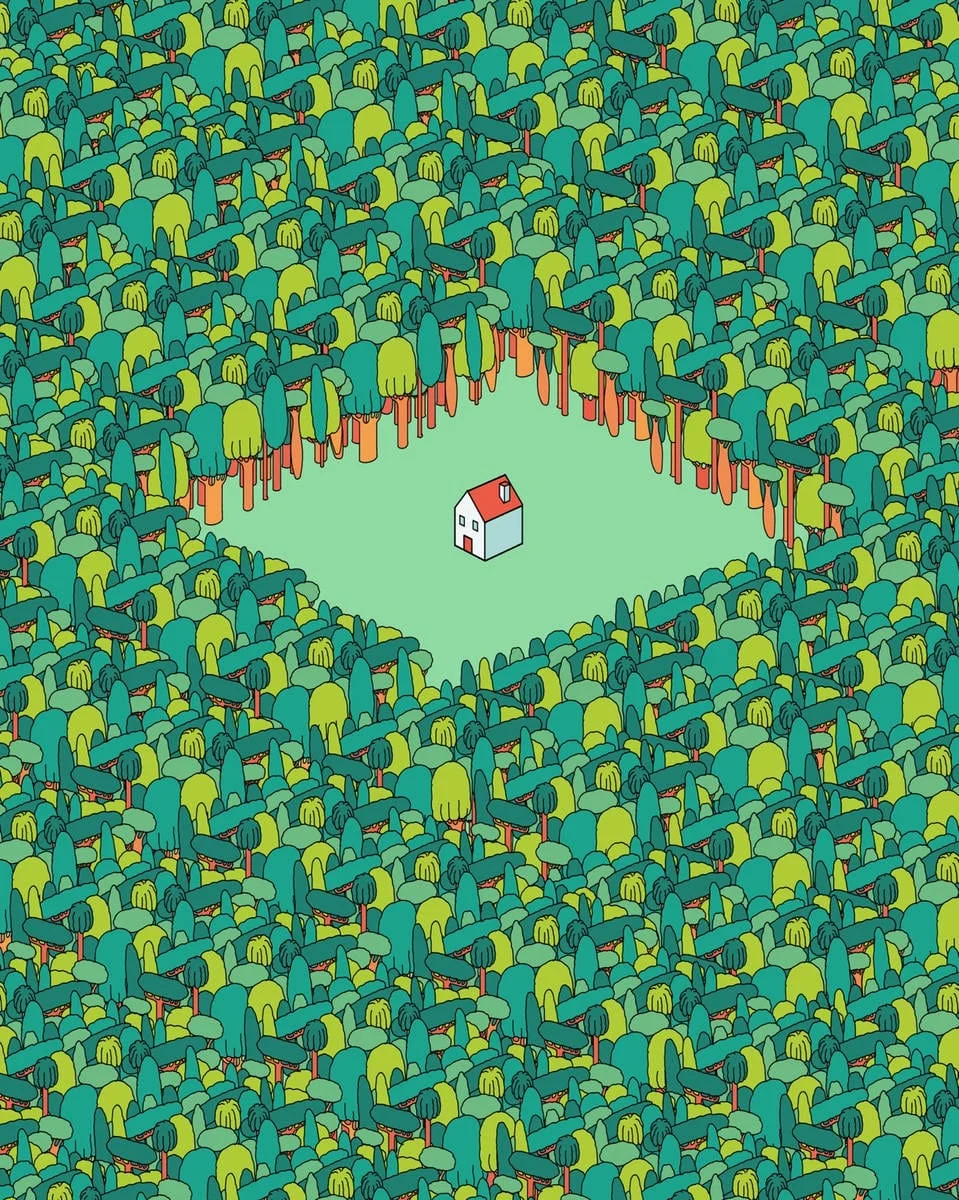
In the lexicon of modern visual culture, few pairings of words evoke such a visceral sensory conflict as "soda" and "sour." The former promises the effervescent, saccharine comfort of familiarity; the latter suggests a sharp, defensive recoil—a citrus-infused warning. This intentional dissonance serves as the conceptual bedrock for Sour Soda Studio, an anonymous artistic project that has quietly emerged as one of the most poignant, albeit unsettling, visual commentaries on the Anthropocene. Drawing upon two decades of deep-rooted illustration expertise, the artist behind the studio has crafted a body of work that functions as a dark mirror, reflecting the absurdity of humanity’s fraught relationship with the natural world.
Main Facts: A Visual Language of Disconnect
Sour Soda Studio operates not through didactic manifestos, but through the evocative power of the surreal. The works, characterized by vibrant palettes and clean, vector-based aesthetics, depict a reality where human dominance over the environment is exposed as a fragile, often dangerous, fantasy.

The studio’s portfolio—comprising titles such as Plastic Wind, The Siren’s Catch, and Fire Season—presents a world that is simultaneously familiar and nightmarish. In these illustrations, the laws of nature and the hubris of man collide. Clouds mimic the skeletal structures of trees; tiny human figures cling to botanicals suspended within fragile, soapy bubbles; and, in a particularly biting commentary on environmental apathy, festival-goers dance in oblivious, rhythmic circles around a polar bear, ignoring the beast as it mauls a member of their group on a rapidly shrinking ice floe.
This is not merely surrealism for the sake of aesthetic curiosity; it is a calculated "visual side-eye" aimed at the societal disconnect surrounding the climate crisis. The studio’s imagery acts as a conduit for the anxieties of the 21st century, translating complex, often paralyzing ecological grief into digestible, albeit stinging, vignettes of dark humor.

Chronology: The Evolution of a "Visual Alphabet"
The genesis of Sour Soda Studio was not sparked by a sudden career pivot or a political awakening, but rather an organic, slow-burning evolution. The artist, who maintains a veil of anonymity to keep the focus squarely on the work, describes the project as a quest for a new, more effective voice.
- Formative Years (Early 2000s–2010s): The artist spent two decades honing a professional illustration style, mastering the technical aspects of form, light, and composition. This period was characterized by traditional workflows, primarily tinkering with concepts on paper and refining them through rigorous study.
- The Transitional Phase (2020s): As the global discourse around climate change shifted from peripheral concern to existential crisis, the artist felt a growing need to address these issues. The transition to the iPad as a primary medium allowed for a more fluid, experimental approach to vector-based art.
- The Emergence of the "Visual Alphabet": Through constant iteration, the artist began to develop a recurring set of motifs—simple, flat colors, transitional landscapes, and suspended figures. This "visual alphabet" allows the studio to build complex narratives within a minimalist framework.
- The Launch of Sour Soda Studio: Formally established to house this specific body of work, the studio began sharing its output online, quickly garnering attention for its ability to marry the whimsical with the deeply disturbing.
Supporting Data: The Anatomy of the Anthropocene
To understand the weight behind Sour Soda Studio’s work, one must acknowledge the data that informs its narratives. The Anthropocene is defined by the significant impact of human activity on the Earth’s geology and ecosystems. The studio translates this scientific reality into visual metaphors:

- Consumption and Waste: In The Siren’s Catch, the artist depicts mermaids—creatures of myth and ocean mystery—being harvested like commercial tuna and canned for consumption. This imagery directly mirrors the unsustainable practices of industrial fishing and the pervasive nature of plastic pollution, where even the most "magical" aspects of our world are commodified.
- Deforestation and Fire: The piece Fire Season features a lumberjack hacking away at a tree that is already engulfed in flames. This is a literalization of climate feedback loops, where human activity (deforestation) exacerbates the very conditions (drought and fire) that are destroying the resource being harvested.
- Urban Encroachment: Clearing shows a single, isolated house sitting within a geometric square of cleared land, surrounded by an endless, encroaching forest. It is a striking representation of the human desire to impose grid-like order onto the chaotic, sprawling complexity of the natural wilderness.
Official Responses and Artistic Philosophy
When asked about the intent behind the work, the artist remains characteristically humble and enigmatic. The lack of a "manifesto" is, in itself, a statement. The artist argues that the images are meant to be open-ended, serving as "images that can be poetic, decorative, narrative, or something harder to name."
By refusing to categorize the work as strictly "political" or "environmental," the artist allows the viewer to engage with the uncomfortable reality of the imagery without feeling lectured. "It came from something simpler," the artist notes. "The need to say different things with a different voice." This voice is one of observation—a detached, ironic witness to the slow-motion collision between human convenience and planetary health.

The studio’s choice to remain unnamed further reinforces this philosophy. The art is not about the creator’s ego; it is about the "visual alphabet" and how that language resonates with an audience currently living through the very events depicted in the art.
Implications: The Power of Dark Humor
The true strength of Sour Soda Studio lies in its use of dark humor as a coping mechanism and a diagnostic tool. In a world saturated with alarming climate data and apocalyptic news cycles, the human psyche often resorts to apathy or denial to survive.

By framing these issues through a lens that is both vibrant and absurd, the artist lowers the viewer’s defensive barriers. When we see a crocodile making off with a pool cleaner’s arm, we laugh—and then, in the subsequent beat, we realize the encroachment of the wild into our manicured, synthetic lives. When we see a stork delivering a baby in a sack over a dying forest, we are forced to reconcile our desire for growth and expansion with the reality of the world we are inheriting for the next generation.
The Future of the Project
As Sour Soda Studio continues to grow, its influence on contemporary illustration is becoming increasingly clear. It represents a shift toward a "climate-conscious surrealism"—a genre that acknowledges we no longer live in a natural world, but in a world of our own making, for better or for worse.

The studio serves as a reminder that art does not need to offer solutions to be effective. Sometimes, the most important contribution an artist can make is to hold up a mirror, show us the absurdity of our own actions, and force us to sit with the bitter, bubbly, and lingering aftertaste of the progress we have pursued at any cost.
For those interested in tracing the ongoing evolution of this visual discourse, the studio maintains an active presence on Behance, where the collection continues to expand, one stinging illustration at a time. Through this digital archive, the artist continues to document the fading borders between the human and the wild, ensuring that even if we ignore the warnings, we cannot escape the art.

 Suro Senen
 Laily UPN