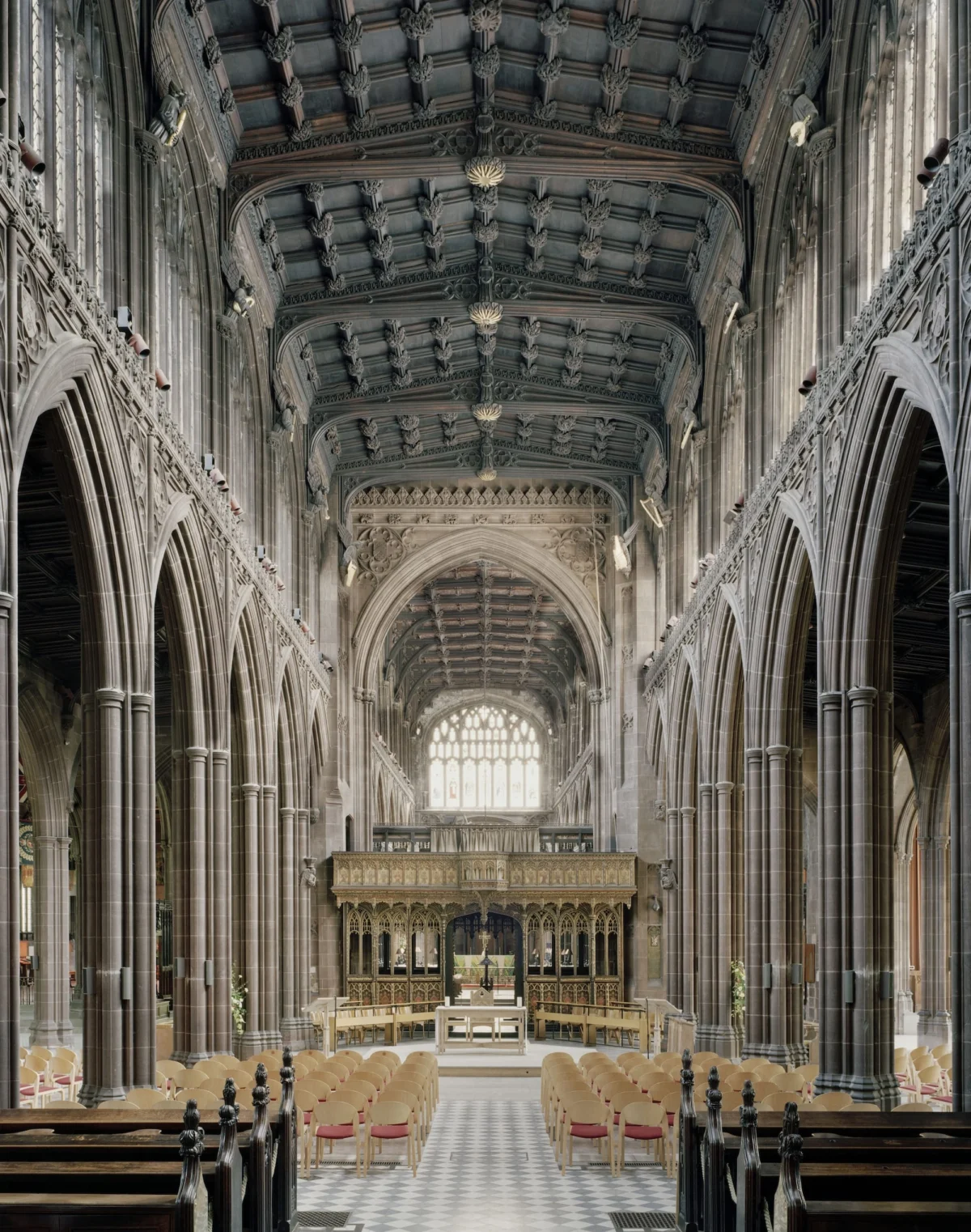
The late British photographer Peter Marlow (1952–2016) occupied a singular space in the annals of twentieth-century visual history. As a two-time president of the legendary Magnum Photos collective, Marlow was widely revered for his incisive, journalistic eye, which captured the volatile intersections of global politics and the raw realities of life in conflict zones. Yet, his most enduring contribution may well be the quiet, meditative project he conducted far from the front lines: a comprehensive, multi-year survey of all 42 Anglican cathedrals in England.
This summer, a poignant exhibition of The English Cathedral opens at London’s Southwark Cathedral, running from July 21 through August 31. The showcase offers a rare opportunity to engage with Marlow’s photographic mastery—a body of work that strips away the clutter of modern ecclesiastical life to reveal the austere, skeletal beauty of these ancient architectural monoliths.
The Master’s Eye: A Legacy of Contrast
To understand the significance of Marlow’s cathedral series, one must first appreciate the breadth of his career. Before turning his lens toward the stillness of stone, Marlow spent decades documenting the tumult of the human condition. His seminal work, Liverpool: Looking Out to Sea (completed between the late 1980s and early 1990s), serves as a haunting portrait of an industrial powerhouse in the throes of economic collapse. As the historic docks of Liverpool withered, rendering the city’s traditional maritime industry obsolete, Marlow was there to capture the resilience and melancholy of a displaced working class.
This background in reportage provided the foundation for his later, more contemplative work. Marlow did not treat the cathedrals as mere historical monuments; he treated them as living entities. By applying the same rigorous, observational discipline he used in war zones to the quietude of the nave, he bridged the gap between the chaotic external world and the internal search for spiritual stillness.

Chronology of the Project: Capturing the Ethereal
The execution of The English Cathedral was a feat of logistics and patience. Spanning several years, the project required Marlow to travel the length and breadth of England, meticulously coordinating visits to coincide with the shifting tides of natural light.
- The Early Years (2008–2009): Marlow began his survey, focusing on the logistical challenges of photographing buildings that were constructed long before the advent of artificial lighting. He sought to replicate the experience of a medieval visitor, relying solely on the interplay between daylight and stone.
- The Peak of Production (2010–2012): This period saw the bulk of the photography. During these years, Marlow visited the majority of the 42 cathedrals, often arriving at dawn or lingering until dusk to catch the precise moment when the light would hit the altar or filter through the rosette-covered wooden ceilings.
- Curation and Refinement (2013–2016): Following his active photography, Marlow spent his final years curating the collection, ensuring the sequencing reflected the architectural lineage of the Anglican tradition.
- Posthumous Recognition (2016–Present): Following his passing in 2016, his work has been celebrated through various exhibitions and publications, cementing his reputation as a master of architectural documentary photography.
Supporting Data: Architectural Lineage and the Anglican Tradition
The Anglican tradition, which traces its roots back to the English Reformation of the 16th century, is inextricably linked to the cathedrals Marlow photographed. However, these structures serve as a physical record that predates the Reformation by centuries.
The Architecture of the Sacred
The cathedrals in Marlow’s project represent the evolution of English architecture from the Norman period through the High Gothic. The data regarding these sites is staggering:
- Geographic Reach: The 42 sites cover the entire breadth of the Church of England, from the northern reaches of the country to the southern coast.
- Construction Timelines: Many of the cathedrals, including Southwark—which dates back to the 11th century—possess foundations that predate the Norman Conquest.
- Design Elements: Marlow’s focus was primarily on the nave. His compositions emphasize the verticality of Gothic arches, the geometric precision of vaulted ceilings, and the subtle, often overlooked transitions between the altar and the apses.
By stripping away the pews, the congregants, and the modern electrical lighting, Marlow allowed the structural geometry to speak for itself. The "supporting data" of his work is, in effect, the light itself—a variable that changed with every cathedral, providing a unique atmospheric signature for each location.

Official Responses and Curatorial Intent
The upcoming exhibition at Southwark Cathedral is not merely a display of photographs; it is a homecoming for the project. As the oldest Gothic church in London, Southwark Cathedral serves as the perfect host for a body of work that explores the intersection of faith and architectural permanence.
In an official statement regarding the exhibition, the cathedral’s leadership highlighted the symbiotic relationship between Marlow’s art and the space itself. "Marlow’s work invites the viewer to look up," a representative noted. "He captures the buildings in a state of grace—undisturbed by the noise of the 21st century. By removing the artifice of electricity, he returns the cathedral to its original purpose: to be a vessel for light."
Art historians have praised the project for its refusal to romanticize. Unlike traditional architectural photography, which often relies on wide-angle distortion to make spaces appear grander, Marlow’s images are restrained. He maintains a human scale, framing the cathedrals as spaces that, while immense, were designed for the individual soul.
Implications: The Cathedral in the Modern Age
The implications of The English Cathedral extend far beyond the realm of art history. At a time when physical spaces for communal reflection are becoming increasingly rare, Marlow’s work challenges us to consider the value of "monumental time."

The Erosion of Silence
We live in an era characterized by hyper-connectivity and the relentless illumination of our environments. Marlow’s insistence on using natural light serves as a quiet protest against this constant brightness. His photos remind us that for centuries, the human experience was defined by the rising and setting of the sun. The cathedrals were built to harness this cycle, turning the passage of time into a religious experience.
Architectural Preservation
The project also draws attention to the ongoing struggle to preserve these massive stone structures. As the economic realities of the 21st century put pressure on the Church of England, the maintenance of such vast, ancient buildings becomes an increasing burden. Marlow’s photographs serve as a visual manifesto for their importance; they remind the public that these cathedrals are not just buildings, but repositories of national memory.
A New Way of Seeing
Finally, the enduring legacy of this project is the way it changes the viewer’s perception of space. After viewing Marlow’s work, one cannot walk into a cathedral—or any historical space—without looking at the light. He teaches us to observe the "negative space" of a room, the way dust motes dance in a shaft of sun, and how the weight of stone can feel ethereal under the right conditions.
Conclusion
Peter Marlow’s The English Cathedral is more than a photography project; it is a meditation on mortality and the enduring power of human creation. By documenting the 42 cathedrals of England, Marlow ensured that even as the world around these structures changes, their essence remains captured in silver and light.

As visitors gather at Southwark Cathedral this summer, they will be entering a space that has witnessed nearly a millennium of history. Standing in the shadow of its Gothic arches, they will be viewing the world through the eyes of a man who understood that while our lives are fleeting, the structures we leave behind—and the light that dances upon them—possess a grace that is, quite literally, timeless.
The exhibition is a vital pilgrimage for those who appreciate the intersection of history, faith, and the high art of the lens. It serves as a reminder that even in the most secular of times, the need for sacred space remains an essential part of the human journey.