

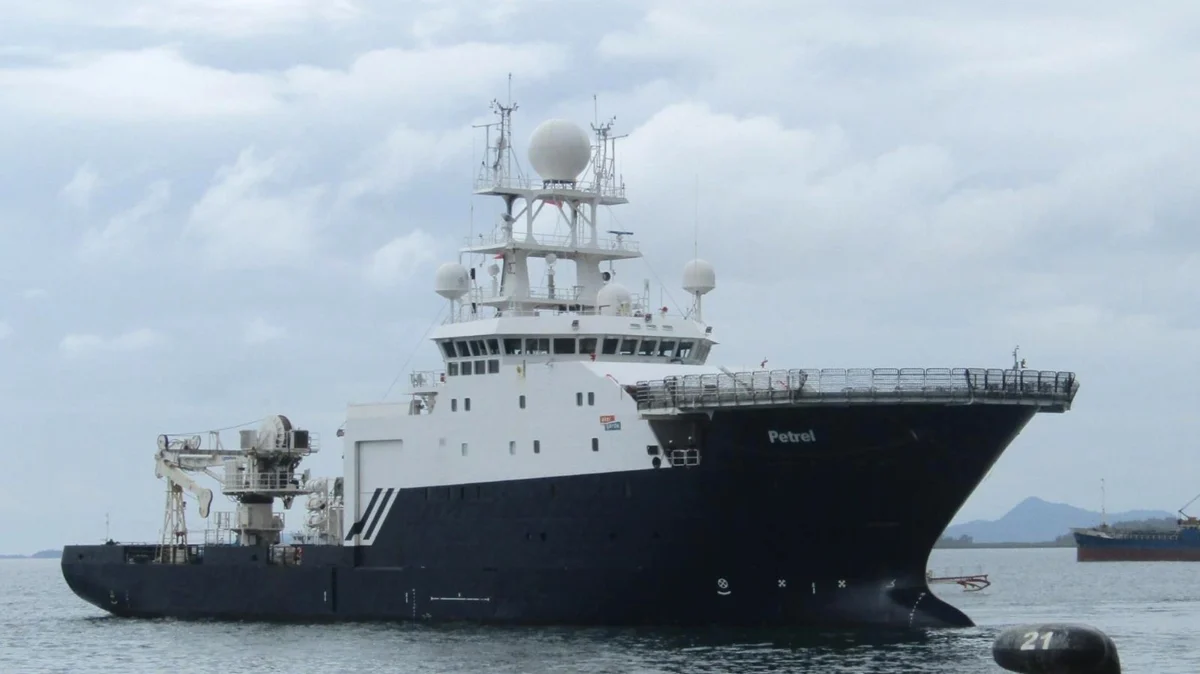
In the silent, crushing depths of the Pacific, the vessel once known as the RV Petrel built a legacy of resurrection. It was a ship that whispered to the ghosts of the Second World War, finding the iron tombs of sailors lost for nearly a century. Today, that narrative has shifted. As of 2025, the vessel has shed its civilian identity to begin a new, high-stakes chapter as the MV Sarah Lynn, now serving under the banner of the United States Navy.
This transition marks a rare and fascinating intersection between private-sector historical preservation and national defense. By trading its searchlight for the strategic requirements of modern maritime operations, the Sarah Lynn has evolved from a seeker of history into a guardian of the contemporary undersea domain.
The Legacy of the RV Petrel: A Vessel Designed for Discovery
To understand the strategic value of the Sarah Lynn, one must first look at the unique DNA of its predecessor. Originally built as a platform for oil and gas exploration, the ship was acquired by the late Microsoft co-founder and philanthropist Paul Allen. Under Allen’s vision, the vessel was transformed into the world’s most sophisticated private research ship, specifically engineered to operate in the most challenging deep-sea environments on Earth.
The Petrel was not merely a boat; it was an integrated system of systems. It boasted a suite of advanced multi-beam echosounders capable of mapping the seafloor with near-photographic clarity. Furthermore, it carried an array of autonomous underwater vehicles (AUVs) and a powerful, work-class remotely operated vehicle (ROV) capable of diving to depths exceeding 19,000 feet.
For years, these tools were turned toward the pursuit of the "lost fleet" of the Pacific. Unlike traditional salvage operations, the Petrel’s mission was one of quiet documentation and commemoration. By locating wrecks like the USS Indianapolis—which had eluded searchers for 72 years—the crew provided families with the first tangible evidence of their loved ones’ final moments. The ship successfully identified the USS Juneau, the Japanese carrier Akagi, and the USS Wasp, among dozens of others. These missions were characterized by a deep reverence for the "war graves" they uncovered, setting a new gold standard for how deep-sea archaeology should be conducted.
A Chronology of Transformation
The shift from the Petrel to the Sarah Lynn did not happen overnight. The timeline of this transition reflects the broader shift in how the U.S. Navy views the undersea domain.
- 2016–2020: The Golden Age of Discovery. Under the stewardship of Vulcan Inc., the RV Petrel conducts a series of high-profile expeditions, locating the USS Indianapolis (2017), the USS Lexington (2018), and the USS Hornet (2019).
- 2020–2022: Pandemic and Operational Pause. The COVID-19 pandemic forces the cessation of civilian expeditions. The vessel is docked and maintained, leading to speculation about its long-term future in the wake of Paul Allen’s passing.
- 2023: Acquisition. Recognizing the vessel’s unmatched sensor suite and deep-water endurance, the U.S. government moves to acquire the platform. The acquisition highlights a strategic need for vessels capable of operating independently in "contested" or "unknown" maritime zones.
- 2024: Refit and Rebranding. The ship undergoes a comprehensive refit to transition from archaeological research to military-grade survey and domain awareness. It is officially christened the MV Sarah Lynn.
- 2025: Operational Status. The vessel enters service with the U.S. Navy, beginning its role in supporting modern maritime operations.
The Technical Edge: Why the Navy Needed the Sarah Lynn
The U.S. Navy’s acquisition of the Sarah Lynn is a testament to the fact that, in the 21st century, the ocean floor has become the new frontier for national security. The vessel’s technical specifications remain top-tier, making it a "turn-key" asset for the military.
Advanced Sonar and Mapping Capabilities
Modern naval warfare relies heavily on "bathymetry"—the study of underwater depth and topography. The Sarah Lynn’s multi-beam sonar arrays allow it to map vast swaths of the ocean floor at high resolution. This is critical for submarine navigation, detecting undersea anomalies, and monitoring the integrity of undersea infrastructure, such as fiber-optic data cables and energy pipelines.
Deep-Water Endurance
One of the primary challenges in modern oceanography is the cost and logistics of deep-sea operations. Most naval vessels are optimized for surface combat or logistics, not for long-duration stays in the abyss. The Sarah Lynn features a specialized hull and dynamic positioning systems that allow it to hover precisely over a site for days or weeks at a time, regardless of surface conditions.
Autonomous and Remotely Operated Systems
The vessel’s AUVs and ROVs are effectively an extension of the Navy’s intelligence, surveillance, and reconnaissance (ISR) capabilities. While the ship once used these tools to photograph the rusted hull of a carrier, they can now be used to inspect modern underwater infrastructure or investigate suspicious objects on the seafloor without exposing human divers to extreme pressures.
Official Responses and Strategic Rationale
While the Department of the Navy has been characteristically tight-lipped regarding specific mission profiles, senior officials have signaled that the Sarah Lynn serves a broader goal: "Maritime Domain Awareness" (MDA).
"The ability to monitor the undersea environment is no longer just a scientific endeavor; it is a strategic imperative," says a spokesperson for the Naval Sea Systems Command. "The Sarah Lynn allows us to leverage a platform that has already proven its ability to operate in the most unforgiving environments on the planet. By repurposing this vessel, we are filling a critical gap in our deep-water survey capabilities."
Defense analysts argue that the vessel’s primary focus will likely involve the protection of undersea infrastructure. With the rise of hybrid warfare—where adversaries may target the data cables that underpin the global economy—the ability to maintain a persistent, high-resolution presence on the seabed has become a priority for the Pentagon.
Implications: The Future of Deep-Sea Operations
The transition of the Sarah Lynn serves as a symbolic marker for the future of maritime power. The ocean, once considered a vast, unreachable buffer, is now a crowded space filled with sensors, cables, and strategic assets.
Bridging the Gap Between Science and Defense
The Sarah Lynn represents a "dual-use" model that is likely to become more common. By utilizing platforms that were originally designed for civilian exploration, the Navy can bypass the long development cycles required for new, custom-built research vessels. This "buy-and-adapt" strategy is a cost-effective way to modernize the fleet.
The New "Great Game" on the Seafloor
For years, the Petrel explored the ruins of the last great global conflict. Now, the Sarah Lynn will be tasked with preventing the next one. Its mission is no longer to honor the fallen, but to ensure that the critical infrastructure of the modern world remains secure. The vessel’s history—as a ship that looked into the abyss and found the remains of history—is now its greatest strength. It brings a unique institutional knowledge of the seafloor that is, for all intents and purposes, irreplaceable.
A Legacy of Exploration
Despite the change in mission, the spirit of the ship remains consistent. Whether the objective is finding a lost aircraft carrier or mapping a critical communications line, the Sarah Lynn remains a pioneer. It is a vessel designed for the unknown, built for the impossible, and now tasked with the most vital work in the modern Navy: keeping the depths of the ocean transparent, understood, and secure.
As the Sarah Lynn sails into its new role, it carries with it the ghosts of the Petrel. It is a reminder that the ocean is not just a place of history, but a place of constant, evolving strategic significance. The vessel has proven that it can handle the pressure of the deep; now, it must prove that it can handle the pressure of global security.











