

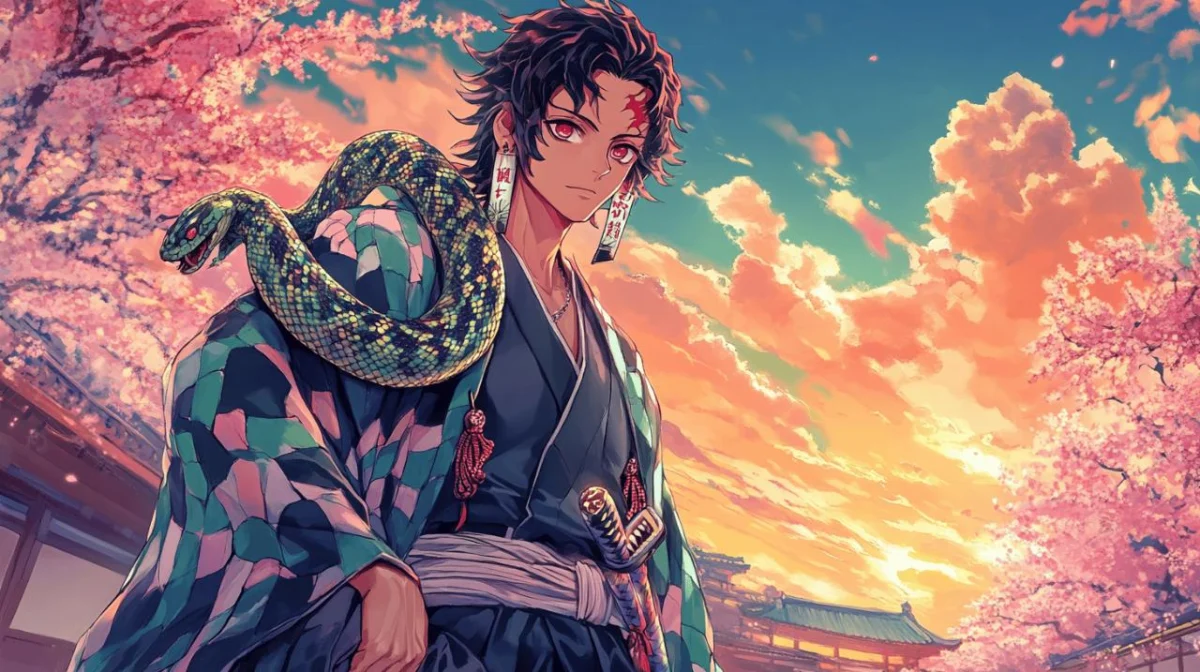
In the pantheon of the Demon Slayer Corps, few figures command as much intrigue, controversy, and silent admiration as Obanai Iguro, the Serpent Hashira. Often characterized by his caustic wit, unwavering discipline, and a physical appearance that mirrors the trauma of his origins, Iguro stands as a testament to the resilience of the human spirit. His journey—from the dark, suffocating basements of a criminal clan to the frontlines of the final war against Muzan Kibutsuji—is a narrative of redemption, hidden love, and ultimate sacrifice.
Main Facts: The Anatomy of a Hashira
Obanai Iguro is not merely a master swordsman; he is a tactical anomaly. At 21 years of age, he reached the pinnacle of the Demon Slayer Corps, wielding the "Serpent Breathing" style—a derivative of Water Breathing that mimics the fluid, unpredictable, and lethal strikes of a viper.
Standing at a modest 162 cm and weighing 53 kg, Iguro defies the conventional trope of the hulking warrior. Instead, his combat efficacy relies on extreme agility, psychological warfare, and a symbiotic partnership with his white snake companion, Kaburamaru. His most distinct physical traits—a bandaged face concealing a mouth mutilated by his own kin and a partially blind right eye—are the living scars of a life dictated by cruelty. His Nichirin blade, a curved, violet-tinted masterpiece, matches the serpentine elegance of his combat style, capable of striking from impossible angles.
Chronological Evolution: From Captivity to Valor
The Shadow of the Serpent Clan
Iguro’s origins are rooted in a grotesque tradition. Born into a family of thieves that worshipped a demon serpent, he was the first male born in 370 years. His arrival was met not with joy, but with the expectation that he would eventually be fed to the clan’s deity. Kept in a gilded cage, his only solace was the white snake, Kaburamaru, who would later become his constant companion. The trauma of his youth culminated in a horrific act of violence: the demon forced his family to slit his cheeks into a permanent, snake-like smile. His subsequent escape was not just a flight from captivity, but a rejection of the demonic corruption that defined his bloodline.
Rise within the Corps
Rescued by Shinjuro Rengoku, the former Flame Hashira, Iguro channeled his rage into the rigorous training of the Corps. His development of the Serpent Breathing style was a response to his lack of raw physical strength compared to peers like Gyomei Himejima. By mastering the art of swordplay amidst tight, obstacle-filled environments, he developed a precision that allowed him to strike through narrow gaps in a demon’s defenses.
The Infinity Castle and the Dawn of Reckoning
During the final arc, the true breadth of Iguro’s power was unveiled. Facing Muzan Kibutsuji, the progenitor of all demons, Iguro pushed his body beyond its limits. He became one of the few to manifest the "Demon Slayer Mark" mid-battle, achieving a state of hyper-focus that allowed him to see the "Transparent World." His ability to anticipate Muzan’s movements, aided by Kaburamaru’s visual input, proved to be a decisive factor in preventing the total annihilation of the remaining Hashira.
Supporting Data: Tactical Prowess and Combat Metrics
To understand Iguro’s lethality, one must look at his unique tactical profile. His combat efficacy is built upon three pillars:
- Synergistic Combat (Kaburamaru): Unlike other slayers who fight alone, Iguro uses his serpent as a sensory extension. Kaburamaru can detect minute shifts in air pressure and muscle tension, relaying this to Iguro, who then compensates for his blindness in his right eye.
- The Red Nichirin Blade: During the final battle, Iguro forced his blade to turn a bright crimson, a feat achieved by clutching his sword with immense force and clashing it against another blade. This "Red Blade" state is critical in slowing down the rapid regeneration of upper-rank demons and Muzan himself.
- Agility and Geometry: His sword techniques—such as "First Form: Winding Serpent Slash"—are designed to bypass armor and bone. By weaving his blade through complex arcs, he creates a "strike zone" that is almost impossible for an opponent to parry completely.
The Human Element: The Bond with Mitsuri Kanroji
The relationship between Obanai Iguro and Mitsuri Kanroji, the Love Hashira, provides the emotional core of his arc. In a world defined by the imminent threat of death, their connection was a quiet, enduring rebellion against despair.
Iguro’s initial aloofness was not a product of arrogance, but of deep-seated self-loathing. He believed his bloodline was "polluted" and that he was unworthy of happiness. Mitsuri’s genuine, bubbly, and accepting nature acted as a catalyst for his change. Their correspondence, often conducted through letters and shared meals, served as a tether to his humanity. The tragedy of their mutual demise in the final battle—where they confessed their love as the sun rose—transformed their story from one of duty into one of the most poignant romances in modern shonen history.
Official Perspectives and Thematic Implications
The legacy of the Serpent Hashira is heavily debated within the lore of the series. To the lower-ranking slayers, he was an intimidating, harsh mentor; to the Hashira, he was a pillar of unyielding commitment.
The Burden of Responsibility
Iguro’s character embodies the "burden of the past." He spent his entire life trying to "cleanse" his lineage through the slaughter of demons. His final act—sacrificing himself to ensure Tanjiro Kamado could finish the fight—was the ultimate manifestation of his ideology: that the sins of the ancestors should not dictate the fate of the future.
Implications for the Demon Slayer Corps
Iguro’s death, alongside that of the other Hashira, marked the end of an era. His tactical contributions, specifically the integration of non-human sensory assistance (Kaburamaru) and the mastery of the Transparent World, became blueprints for the next generation of slayers. His story forces the audience to confront the question of whether a person can ever truly escape their origins, or if we are merely the sum of our choices in the face of inevitable tragedy.
Conclusion: An Eternal Legacy
Obanai Iguro remains one of the most complex characters in the Demon Slayer saga. He represents the duality of the hunter—a man who was once the prey, and a warrior who was defined by his capacity for tenderness in a world of brutality.
His contribution to the defeat of Muzan Kibutsuji was not just physical, but symbolic. By protecting the future in the form of Tanjiro and confessing his love to Mitsuri, he finally shed the constraints of his clan’s dark history. While his life was cut short, his impact on the Demon Slayer Corps—and the hearts of the audience—is permanent. He stands as a reminder that even those born into darkness can choose to become the light that guides others to the dawn. In the silent, winding strikes of the Serpent Breathing, one finds the echo of a man who fought not just to kill, but to finally be free.











No comments yet. Be the first to join the conversation!