

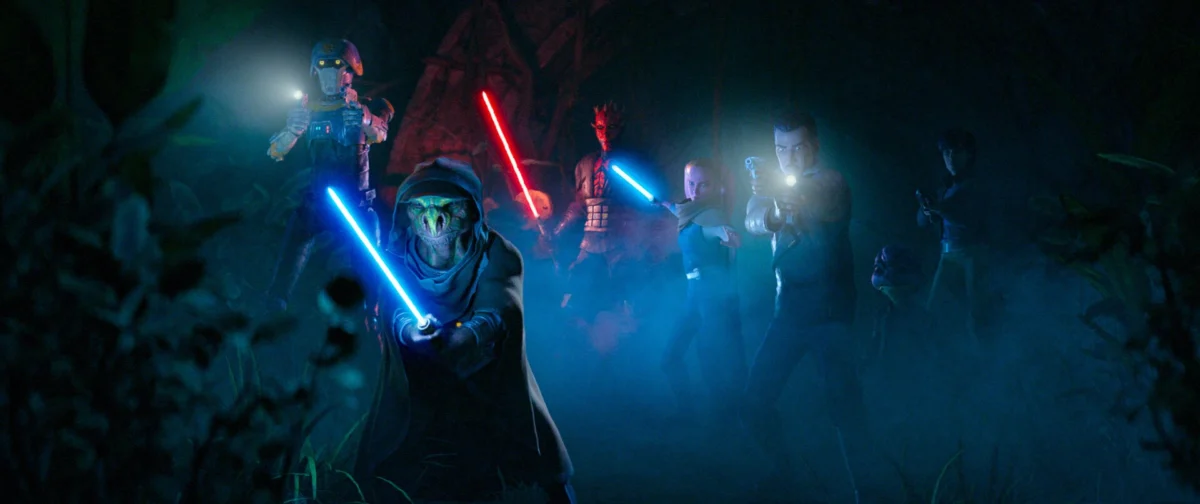
The Star Wars galaxy has long been defined by the struggle between light and darkness, but rarely has that conflict felt as visceral, intimate, and terrifying as it does in the season finale of Star Wars: Maul — Shadow Lord. As the first season draws to its harrowing conclusion, the creative team—led by Lucasfilm’s Chief Creative Officer Dave Filoni, Supervising Director Brad Rau, and Head Writer Matthew Michnovetz—has delivered a two-episode climax that pivots from a character-driven drama to an exercise in pure, unadulterated horror.
By introducing the most iconic villain in cinematic history, Darth Vader, into the narrative, the production team has fundamentally altered the trajectory of the series. The following report explores the meticulous craftsmanship, creative philosophy, and narrative implications behind the finale that has left fans reeling.
The Arrival of a Silent Terror: Main Facts
The finale centers on the planet Janix, where the enigmatic and often morally grey Maul finds himself hunted not by the Jedi, but by the ultimate instrument of the Emperor’s will. In a departure from typical Star Wars confrontations, the creative team made a bold, deliberate choice: Darth Vader does not speak.
For Filoni, the silence of the Dark Lord was essential. "There’s no new information we need," Filoni explains. "Vader, through his presence, through his ability, through his terror, shows those aspects." By removing dialogue, the team elevated Vader to the status of a slasher-movie icon, drawing deliberate parallels to Michael Myers or Jason Voorhees. This choice forces the audience and the characters to confront the reality that Vader is not a negotiator; he is a force of nature, a "perfected" version of the evil that Maul himself only mimics.
A Chronology of Chaos: The Making of the Finale
The road to the finale was paved with months of technical and narrative planning. The production utilized a rigorous "pre-visualization" (previs) phase, where every movement, camera angle, and lens choice was mapped out to ensure the weight of Vader’s presence was felt in every frame.
The Planning Stages
- Pre-Production: Rau and Michnovetz collaborated with Art Director Andre Kirk to refine the series’ unique, painterly animation style. The goal was to ensure the lighting and texture of Vader’s suit—specifically the scuffs on his helmet—felt grounded and real.
- The Handoff: The finale required seamless coordination between episode 9 director Steward Lee and episode 10 director Nate Villanueva. The team conducted "supervisory summits" to ensure consistency in character motion, cape physics, and the specific, rhythmic breathing patterns that define the Sith Lord.
- The Choreography: Taking inspiration from the fluid, high-stakes combat of Crouching Tiger, Hidden Dragon, the team meticulously planned every saber strike. For the character of Devon Izara, the choreography had to reflect a student caught between two conflicting philosophies: the nuanced, manipulative shadow-training of Maul and the more traditional, disciplined path she once knew.
The Anatomy of a Sith: Design and Performance
A significant challenge for the animation team was translating the physical presence of the original Darth Vader performer, David Prowse, into a digital medium.
"We wanted his silhouette to be more horrific than we’ve seen in animation previously," says Brad Rau. The team scoured archival footage of Prowse, studying his movements from his days in the wrestling ring and his stunt work in The Empire Strikes Back. By incorporating the actor’s specific posture and gait—the way he carries his shoulders and the heavy, deliberate placement of his feet—the animators created a version of Vader that feels both nostalgic and hauntingly new.
Director of Lighting, Cinematography, and Visual Effects Joel Aron played a critical role in this, working closely with the team to define how light interacts with Vader’s armor. This was not merely an aesthetic choice; it was a narrative one. By controlling the reflection and the "scuffiness" of the helmet, the team ensured that Vader appeared as an ancient, battle-hardened relic of the Republic’s fall.
Official Responses and Creative Philosophy
The creative leadership behind Maul — Shadow Lord views this finale not just as an action set-piece, but as a deep psychological study of its protagonist.
"The challenge with using Darth Vader here is to show Maul the horror of what you can become when you have power and evil come together in a more perfected version than what Maul is," Filoni notes. For Filoni, who famously directed Vader’s appearance in Star Wars Rebels, this was an opportunity to highlight the contrast between Maul’s "broken, scrambling" villainy and the cold, calculated efficiency of the Emperor’s apprentice.
Head Writer Matthew Michnovetz emphasizes the impact on the supporting cast, particularly the Padawan Devon Izara. "She’s caught between the devil on her shoulder and the angel," he says, noting that Devon’s development is the emotional core of the finale. Her transition from a captive to an active participant in Maul’s machinations is framed as a tragic descent—one that forces her to choose a path of survival that ultimately alienates her from her Jedi roots.
The Ripple Effect: Narrative Implications
The finale concludes on a note of profound vulnerability for the series’ lead. Maul, a character defined by his desire for control, is left exposed and fearful. This vulnerability is the key to the show’s next chapter.
Key Implications for Season 2:
- The Secret of Betrayal: Devon Izara is now in possession of a dangerous truth: her new mentor, Maul, has a history of betraying those he claims to protect. The lingering question is how long she can remain in the dark, and what she will do once the truth surfaces.
- The Rise of Crimson Dawn: With the syndicate largely decimated by the events of the finale, Maul must find new, more ruthless ways to consolidate power. The "Age of Maul" is no longer just a tagline; it is a desperate attempt to build an empire from the ashes of his failed plans.
- The New Apprentice: The final sequence, where Devon makes the conscious decision to follow the Shadow Lord, serves as a dark mirror to traditional Star Wars heroics. She is not being coerced; she is choosing a path of rage. This shift in agency suggests that Season 2 will explore the consequences of "terrible lessons" taught by a master who is himself a victim of his own circumstances.
Conclusion: A New Standard for Animated Horror
Star Wars: Maul — Shadow Lord has successfully expanded the boundaries of the franchise’s animated output. By leaning into the horror genre and treating its central antagonist as a force of nature rather than a mere obstacle, the production team has elevated the stakes for all involved.
As the credits roll on the Season 1 finale, the audience is left with a sense of dread and anticipation. Maul, stripped of his syndicate and faced with the terrifying reality of Vader’s superiority, is a changed man. And Devon Izara, the girl caught in the middle of a war between two versions of the dark side, stands at the precipice of a new, darker reality. With the foundation laid for a second season, one thing is certain: the shadow of the Sith has only just begun to lengthen.
All episodes of Star Wars: Maul — Shadow Lord are currently available for streaming on Disney+, inviting viewers to witness the transformation of a galaxy, and the characters within it, forever.











No comments yet. Be the first to join the conversation!