

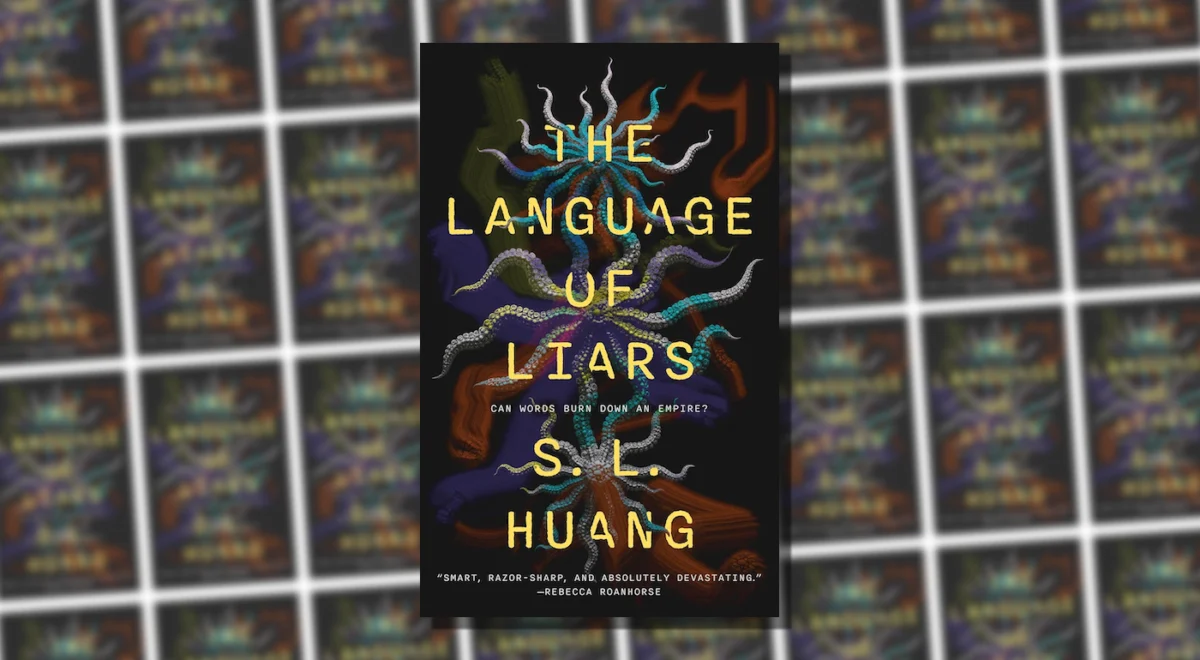
In the landscape of modern speculative fiction, the novella has experienced a renaissance, providing a fertile ground for high-concept world-building and moral experimentation. S.L. Huang’s latest contribution to the Tordotcom library, The Language of Liars, attempts to bridge the gap between hard-science fiction linguistics and a harrowing exploration of collective human—or, rather, non-human—moral failure. While the work succeeds in its intellectual ambition to map the "embodied experience" of an alien protagonist, it invites a rigorous interrogation regarding the boundaries of narrative plausibility.
The Premise: Ambition and Linguistic Isolation
The story follows Ro, an aspiring Senior Linguist from the Ponto species, whose primary ambition is to achieve the "jump"—a process of consciousness transfer into the body of a Star Eater. The Star Eaters are the galaxy’s most enigmatic species, revered as the sole masters of harvesting meridian, the vital resource underpinning the galactic economy.
Ro’s journey is framed by the classic trope of the outsider. Viewed by his superiors as flighty and unfocused, Ro is desperate to validate his worth to his home planet of Orro. His desire to learn the complex, exclusionary language of the Star Eaters is not merely academic; it is an act of patriotic duty. However, upon successfully inhabiting a Star Eater, Ro is confronted with a chilling reality: the Star Eater culture is not merely reserved or professional; it is profoundly alien and disconnected from the warm, communal existence Ro is accustomed to as a Ponto.
Chronology of a Failed Discovery
The narrative structure of The Language of Liars is intentionally fragmented, utilizing archival transcripts and excerpts at the start of each chapter. This design choice serves as both a narrative bridge and a tool for exposition, detailing the socio-political status of the Star Eaters within the galactic conglomerate.
The chronology of Ro’s realization is linear and claustrophobic. Initially, the reader is led to believe that Ro is a pioneer, a lone infiltrator tasked with gathering secrets. As the narrative progresses, the tension shifts from the struggle of learning an impossible syntax to the mounting terror of exposure. Ro finds himself navigating a society that is not only indifferent to him but, as he slowly uncovers, fundamentally hollow. The culmination of this trajectory is the "Big Reveal"—a moment that is intended to function as a thematic gut-punch, but which simultaneously acts as the primary point of failure for the novella’s internal logic.
Supporting Data: The Anatomy of a World-Building Crisis
Huang’s world-building is undeniably impressive, particularly given the constraints of the novella format. She treats linguistics as a living, breathing mechanism of power, detailing how slang, pronoun usage, and phonology can signal status and intent across interplanetary boundaries. The reader is presented with a "stress-testable" world; one feels that if they were to lean against the architecture of the narrative, it would hold firm.
Yet, it is precisely this high level of detail that creates the book’s greatest friction. To support the central revelation—that the Star Eaters are not a functioning species but are instead entirely occupied, replaced by various alien species siphoning meridian—the narrative requires the reader to suspend disbelief regarding a massive, multi-generational conspiracy.

Key Analytical Tensions:
- The Mechanism of Exchange: The process of "jumping" into a Star Eater body is established early as a high-stakes, specialized operation. If this process is widely available to multiple species, the logistics of a universal, decades-long occupation of an entire species suggest a level of inter-species cooperation that contradicts the xenophobic, competitive nature of the galactic conglomerate depicted in the text.
- The Problem of Attrition: The biological reality of the Star Eaters is ignored. If every Star Eater is, in fact, an alien in a stolen suit, how is the biological lifecycle of the species managed? Does the "occupier" always vacate the body before the Star Eater reaches natural end-of-life? The probability of such a perfect, seamless replacement cycle across thousands of individuals is statistically improbable.
- The Failure of Silence: The most glaring issue is the sociological impossibility of the secret. Science and academic research are, by definition, collaborative and conversational. The idea that researchers across different planets could study the "Star Eater language" and never once compare notes, or that a lone researcher wouldn’t accidentally reveal their true nature through a slip of the tongue or a personal connection, ignores the fundamental human (or sentient) instinct to communicate and gossip.
Official Responses and Thematic Implications
The thematic core of The Language of Liars is a powerful, if flawed, allegory. Huang is exploring the "banality of evil"—how individual, seemingly well-intentioned choices made by thousands of people can, when aggregated, result in an unrecoverable, systemic atrocity. The book suggests that by viewing ourselves as "doing our best for our own," we can justify the erasure of another’s personhood.
Critics have noted that while this allegory is profound, it creates a "thematic vs. logical" dissonance. The book works beautifully as a philosophical essay on the nature of complicity, but it falters as a piece of science fiction. The "gut-punch" of the ending relies on the reader accepting that everyone kept their mouths shut. In a world where nerds, researchers, and political actors are constantly exchanging data, the total suppression of truth for decades is perhaps the most fantastical element of the entire book.
Implications for the Future of SFF
Despite the logistical failures of the plot, The Language of Liars remains a testament to the health and vitality of the novella as a literary form. In an era where publishing is increasingly dominated by algorithms and content designed for mass-market consumption, Huang’s work stands out as an artifact of ambition.
The novella highlights a recurring struggle in contemporary SFF: the balance between the "big idea" and the "lived experience." Huang is a writer who refuses to play it safe. Her commitment to exploring the "person-ness" of non-human entities is, in itself, a significant contribution to the genre. Even when the world-building mechanics buckle under the weight of the story’s moral thesis, the sheer audacity of the attempt is commendable.
The book serves as a reminder that science fiction is at its best when it dares to fail in the pursuit of something meaningful. While The Language of Liars may not be the flawless execution one might hope for, it is an essential read for those interested in the evolution of the genre. It asks difficult questions about the nature of truth and the ease with which we can lie to ourselves in the name of the "greater good." Whether or not one accepts the plausibility of the ending, the conversation it provokes is a necessary one—perhaps, in the end, that is all that any author can hope to achieve.












No comments yet. Be the first to join the conversation!