

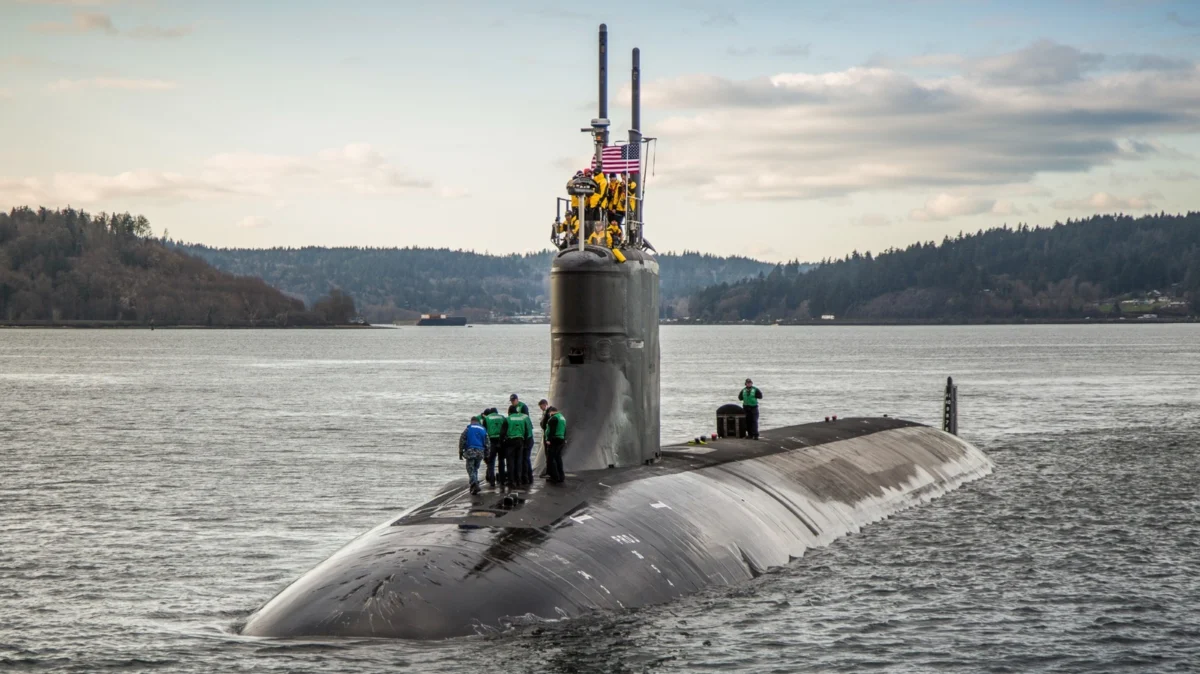
The United States Navy stands as the world’s preeminent maritime force, projecting power through a sophisticated network of surface combatants and a formidable undersea fleet. Central to this undersea dominance are the nuclear-powered fast-attack submarines, a category defined by stealth, speed, and lethality. Among these, the Seawolf-class represents perhaps the most ambitious, expensive, and technically impressive chapter in American naval engineering. Conceived as the ultimate predator of the deep during the twilight of the Cold War, the Seawolf-class remains a testament to what is possible when cost is no object—and a cautionary tale regarding the realities of post-Cold War defense budgeting.
Main Facts: The Apex Predator of the Abyss
The Seawolf-class was designed with a singular, terrifying mission: to hunt and destroy the Soviet Union’s most advanced ballistic missile and attack submarines in the deep, open waters of the North Atlantic and the Arctic. Commissioned starting in 1997, the class was intended to be the successor to the Los Angeles-class boats, which were beginning to show their age against rapidly quieting Soviet designs.
The class is defined by three specific hulls: the USS Seawolf (SSN-21), the USS Connecticut (SSN-22), and the USS Jimmy Carter (SSN-23). These vessels are not merely submarines; they are technological marvels. Featuring an advanced hull design and an incredibly quiet propulsion system, they are capable of reaching submerged speeds of approximately 40 miles per hour—making them the fastest military submarines currently in service. Furthermore, their acoustic signature is so low that they are often described as being virtually undetectable in the vast expanse of the ocean.
Armed to the teeth, a Seawolf-class submarine can carry up to 50 ordnance items, including UGM-109 Tomahawk cruise missiles, Mark 48 heavyweight torpedoes, and Harpoon anti-ship missiles. This arsenal, paired with a sophisticated suite of sonar and fire-control systems, allows these vessels to dominate any theater they enter, whether in intelligence gathering, clandestine operations, or traditional anti-submarine warfare.
Chronology: From Cold War Ambition to Fiscal Realism
The Design Genesis (1983–1990)
The project began in 1983, a period when the Reagan administration was heavily investing in military modernization to challenge Soviet technological parity. The Navy envisioned a massive fleet of 29 Seawolf-class boats. The goal was to ensure that the U.S. would maintain a decisive advantage in the "cat-and-mouse" game of Cold War undersea warfare.
The Post-Cold War Reality Check (1991–1997)
As the Soviet Union collapsed in 1991, the geopolitical landscape shifted overnight. The primary reason for the Seawolf’s existence—the need to stalk Soviet Akula and Sierra-class submarines in deep-water environments—vanished. Simultaneously, the U.S. government faced intense pressure to reap a "peace dividend." By the time the USS Seawolf was commissioned in 1997, the program had become a political liability. The astronomical cost per unit made it impossible for the Department of Defense to justify building the remaining 26 planned boats. Congress ultimately terminated the program after only three hulls were completed.
The Operational Era (1997–2025)
Over the last three decades, these submarines have served as the "special forces" of the submarine fleet. While the Los Angeles-class and later the Virginia-class handled routine patrol duties, the Seawolf-class was reserved for high-stakes missions. The USS Jimmy Carter, in particular, underwent significant modifications—an extension of 100 feet—to accommodate specialized mission equipment, cementing its role as the Navy’s premier platform for clandestine surveillance and underwater intelligence gathering.
Supporting Data: Engineering and Cost Analysis
The cost of the Seawolf program is legendary in defense circles. At approximately $3.5 billion per boat in 1990s currency—equivalent to roughly $7.65 billion today—the Seawolf-class holds the record as the most expensive submarine program in U.S. history.
Comparative Specifications
| Feature | Seawolf-class (SSN-21/22) | USS Jimmy Carter (SSN-23) | Virginia-class (Block V) |
|---|---|---|---|
| Length | 353 feet | 453 feet | 377 feet |
| Submerged Displacement | 9,137 tons | 12,151 tons | 7,800 tons |
| Top Speed | ~40 mph | ~40 mph | ~30+ mph |
| Primary Role | Deep-ocean dominance | Intelligence/Clandestine | Multi-mission/Littoral |
The disparity in cost between the Seawolf and the current workhorse, the Virginia-class, illustrates a pivot in naval strategy. The Virginia-class, while still costing roughly $3.2 billion per unit, was designed for "littoral" (coastal) operations as well as deep-water engagement, providing a more versatile platform that the Navy could afford to produce in large numbers. As of late 2025, the Navy maintains a robust fleet of over two dozen Virginia-class submarines, which have largely superseded the operational necessity of the Seawolfs.
Official Responses and Strategic Policy
The U.S. Navy has officially signaled the beginning of the end for the Seawolf-class. In alignment with long-term force structure planning, the Navy has scheduled the retirement of the USS Connecticut for 2031, with the USS Seawolf and USS Jimmy Carter slated to follow in the years thereafter.
Naval leadership has emphasized that while the Seawolf-class provided unparalleled capability during its prime, the maintenance requirements for such aging, non-standardized vessels are becoming unsustainable. Keeping the unique systems of the Seawolf-class operational requires specialized training and a dedicated logistical tail that competes with the resources needed for the newer Virginia-class and the forthcoming Columbia-class ballistic missile submarines.
"The Seawolfs were built for a specific threat environment that no longer exists in the same capacity," a retired naval analyst noted. "They served their purpose as a bridge between the analog era of the Cold War and the digital, networked warfare of the 21st century. Retiring them is not a failure; it is a recognition of the evolution of the fleet."
Implications: The Legacy of the Silent Predator
The impending retirement of the Seawolf-class marks a significant transition in U.S. naval history. The program serves as a case study in the tension between technological perfection and fiscal reality. By pushing the boundaries of acoustics and speed, the Seawolf-class forced potential adversaries to invest heavily in their own undersea detection capabilities, essentially raising the bar for global submarine warfare.
However, the legacy of the Seawolf is also found in the lessons learned during its construction and deployment. The shift toward the Virginia-class indicates a move toward modular, scalable, and affordable naval power. The Navy now prioritizes platforms that can be upgraded with new software and sensors throughout their lifespan, rather than "gold-plated" platforms that are difficult to iterate upon.
As the Connecticut, Seawolf, and Jimmy Carter prepare to head into the sunset, they do so with a reputation that remains untarnished. They are remembered as the "F-22 Raptors of the sea"—stealthy, lethal, and fundamentally unmatched in their primary mission of undersea dominance. While their numbers were few, their impact on the design of the modern submarine force is indelible. As the U.S. Navy moves toward a future dominated by autonomous underwater vehicles (AUVs) and hyper-connected fleet networks, the Seawolf-class will be remembered as the last of the "super-subs," representing an era where the pinnacle of military power was defined by the sheer, silent force of a single, world-class vessel.












No comments yet. Be the first to join the conversation!