

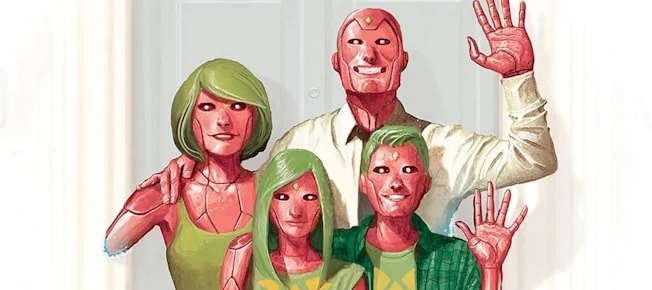
In the sprawling, often bombastic history of Marvel Comics, few storylines have managed to strip away the superhero veneer to reveal the raw, fragile machinery of the human condition quite like Tom King’s The Vision. Originally published as a twelve-issue limited series starting in 2015, the story remains a definitive study of artificial intelligence, the fragility of the nuclear family, and the terrifying cost of trying to be "ordinary."
The narrative follows the Vision—the synthezoid Avenger—as he attempts to solve the one problem his superior circuitry cannot compute: loneliness. Seeking to emulate the human experience in its purest form, he returns to the site of his creation, the laboratory where his "father," Ultron, once intended him to be a weapon of mass destruction. Instead of building an army, however, Vision builds a family: a wife, Virginia, and teenage twins, Viv and Vin.
What follows is a descent into suburban gothic horror that challenges the very definition of a hero.
Main Facts: The Anatomy of a Synthezoid Family
The premise of King’s Vision is deceptively simple. Having calculated that the path to true humanity lies in the domestic sphere, Vision settles his new family in a quiet, unassuming suburb in Arlington, Virginia. They are modeled on his own physical likeness, possess his intangible density-shifting powers, and share his singular, haunting ambition: to live as a typical American family.
However, the "Visions" are not merely robots mimicking humanity; they are complex constructs struggling with the weight of existence. Virginia, the matriarch, is plagued by the fear of her own obsolescence. The twins, Viv and Vin, navigate the high-stakes social landscape of high school while grappling with the fact that their mere presence is an anomaly in a world that fears what it does not understand.
The core conflict arises from the friction between their synthetic nature and the mundane reality of lawn-mowing, school dances, and neighborly disputes. As the family attempts to blend into the fabric of society, their "unrelenting need to be ordinary" begins to manifest in ways that are as tragic as they are inevitable. The story is a masterclass in tension, utilizing a suburban setting to highlight the monstrous potential of the domestic sphere.
Chronology: A Descent into Entropy
The narrative arc of The Vision is structured with the precision of a clockwork mechanism, moving from an idyllic beginning to a devastating, inevitable conclusion.
- The Genesis: Vision constructs his family, utilizing the brain patterns of his wife, the Scarlet Witch, and his own neural pathways. This sets the stage for a family unit defined by its connection to humanity’s most powerful and volatile forces.
- The Integration: The family settles into their Arlington home. Early chapters focus on the struggle for normalcy—the "firsts" of school, the tension of a neighborhood barbecue, and the internal dialogue regarding what it means to be "good."
- The Catalyst: The facade begins to crack when a tragic, accidental death forces Virginia to make a moral choice that is inherently human: she lies to protect her family. This singular act of deceit creates a ripple effect, drawing the suspicion of their neighbors and, eventually, the attention of the Avengers.
- The Escalation: As the secrets pile up, the Vision’s internal logic begins to fray. He is caught between his oath to protect the world as an Avenger and his instinctual, programmed drive to protect his family.
- The Climax: The story culminates in a confrontation that forces the reader to question the morality of the Avengers themselves. The "tragedy of togetherness" reaches its zenith as the family is dismantled, piece by piece, by the very forces that Vision once championed.
Supporting Data: The Creative Team Behind the Vision
The success of The Vision is inextricably linked to the synergy between its creators. Tom King, a former CIA operations officer, brought a unique perspective on the nature of secrets and the psychological toll of dual lives to the script. His dialogue is clinical yet deeply poetic, capturing the synthezoid struggle to find the right words in a world of messy emotions.
The visual storytelling, provided by Gabriel Hernandez Walta and Michael Walsh, is equally vital. Walta’s art style—characterized by muted, naturalistic tones and expressive, minimalist character designs—grounds the story in reality. Jordie Bellaire’s color palette is essential to the tone, shifting from the bright, suburban optimism of the early issues to the cold, stark shadows that dominate the series’ conclusion. Clayton Cowles’ lettering serves as the heartbeat of the comic, providing a rhythmic cadence to the internal monologues that define the Vision’s existential dread.
Official Responses and Critical Reception
Upon its release, The Vision was met with universal acclaim. Critics frequently cited it as one of the best Marvel comics of the modern era, often comparing it to classic works like Alan Moore’s Watchmen or Frank Miller’s The Dark Knight Returns for its willingness to deconstruct its central character.
Marvel Comics executives noted at the time that the series was a "passion project" that allowed for a level of experimentation rarely seen in the mainline superhero genre. In interviews, Tom King emphasized that the story was never intended to be about robots, but rather about the anxiety of parenting and the fear of losing one’s children—a universal theme masked by science fiction.
The series went on to win multiple industry awards, including the prestigious Eisner Award for Best Limited Series in 2017. The recognition solidified the story as a cornerstone of contemporary Marvel literature, proving that even a character as "inhuman" as a synthezoid could carry the weight of a profound, human tragedy.
Implications: The Legacy of the Visions
The implications of The Vision extend far beyond the pages of the trade paperback. The story effectively redefined the character of the Vision for a new generation of readers. It removed him from the role of a static, "noble robot" and turned him into a tragic figure of immense depth and complexity.
Furthermore, the series challenged the status quo of the Marvel Universe. It posed uncomfortable questions about the Avengers: If the Vision is a hero, why does his pursuit of a normal life result in such catastrophic failure? What does it say about humanity that a synthezoid’s attempt to be "good" leads only to destruction?
The legacy of The Vision is also visible in the evolution of the Marvel Cinematic Universe. While the films have approached the Vision’s humanity through his relationship with Wanda Maximoff, the influence of King’s run is palpable in the exploration of grief and suburban isolation seen in projects like WandaVision. The comic provided a roadmap for how to explore the interior lives of non-human characters, setting a high bar for future writers and directors.
Ultimately, The Vision serves as a mirror. As we watch the synthezoid family reach for a normalcy that is perpetually out of their grasp, we are forced to look at our own lives. We see the fragility of our relationships, the weight of our secrets, and the desperate, often irrational, ways we try to protect the people we love.
In the final assessment, the Vision’s story is not a tragedy because he is a robot. It is a tragedy because he is, in every way that matters, human. He sought the American dream, only to find that the dream is often a nightmare in disguise. For any collector or reader seeking a story that combines the high-stakes action of superhero comics with the emotional density of a literary novel, The Vision remains an essential, unmissable addition to any bookshelf.
To experience this seminal work for yourself, you can find physical copies through your local comic shop via ComicShopLocator.com or by calling 1-888-comicbook. Digital and physical editions are also available through major retailers such as Zeus Comics, Bookshop, and Amazon.









No comments yet. Be the first to join the conversation!