

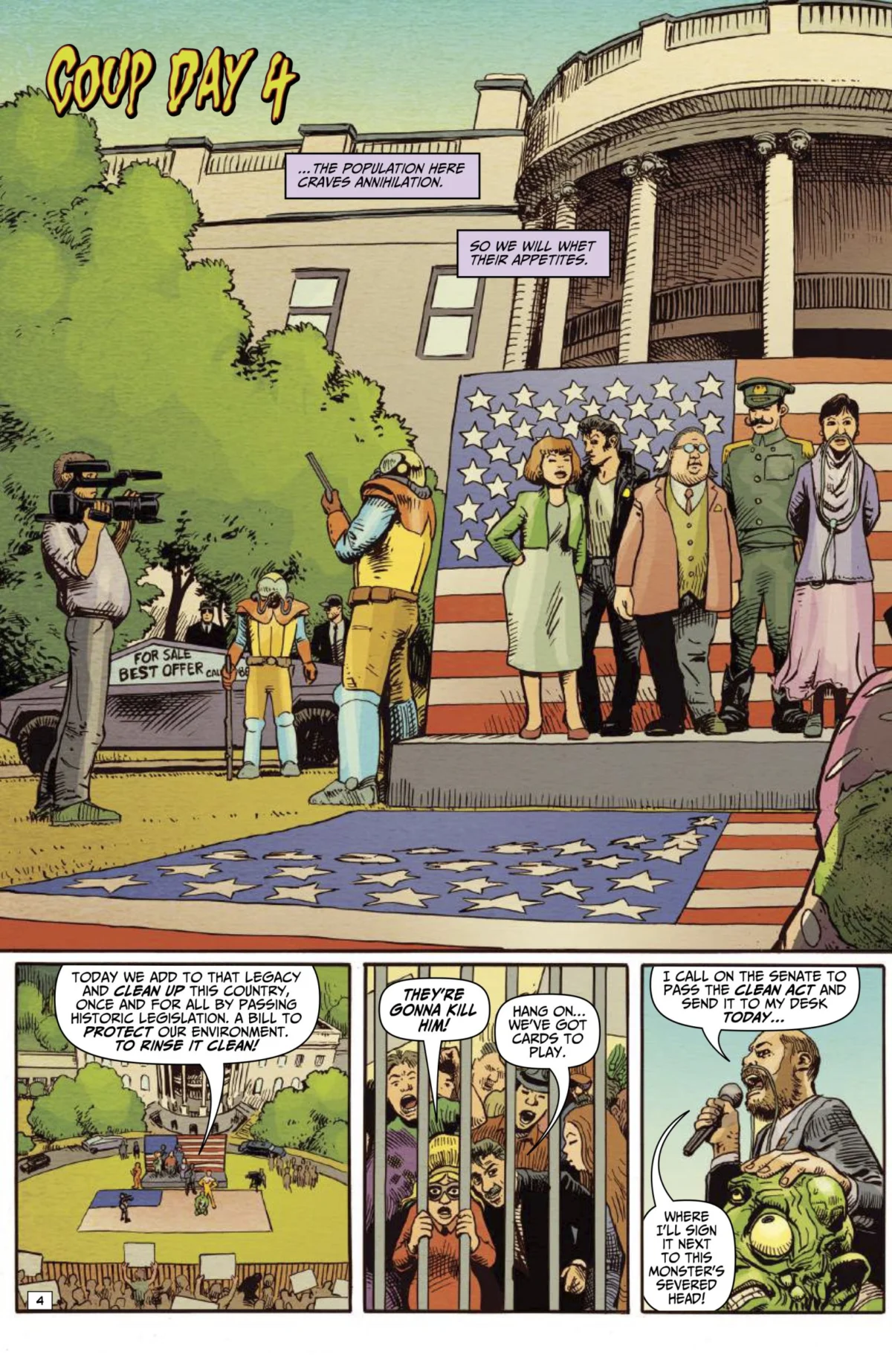
In the current landscape of American media, the line between biting political satire and the surreal absurdity of reality has never been thinner. For the creative team behind AHOY Comics’ Toxic Avenger Comics, the challenge of keeping pace with a volatile D.C. political climate is not just a narrative hurdle—it is the very engine of the series. With the release of Toxic Avenger Comics #9, the penultimate installment of the "Toxie Goes to Washington" arc, writers Matt Bors and artist Fred Harper have delivered what is arguably the most poignant, grotesque, and viscerally relevant issue of the series to date.
Main Facts: A Mutant in the Halls of Power
The premise of the current arc is as simple as it is chaotic: Toxie and his companion, Yvonne, have arrived in Washington, D.C., with the earnest, perhaps naive, intention of getting the "Clean Act" signed into law. Instead, they have been dragged into a legislative quagmire that reflects the darkest corners of modern governance.
The plot has spiraled into a sprawling conspiracy involving Vice President Shannon Karns—a character whose true nature as a potential Nazi-scientist-turned-robot adds a layer of sci-fi horror to the political thriller. The narrative features the manipulative Senator Greene, the shadowy influence of the Smogulans, and the ill-fated presence of Doctor Planet and the "Planet Teens." The issue masterfully weaves these disparate elements into a story that feels like a fever dream of current headlines, capturing the fecklessness and performative outrage of the American political establishment.

Chronology of the "Toxie Goes to Washington" Arc
The journey to issue #9 has been marked by a two-month gap between releases, a period that the creative team acknowledges is a lifetime in modern politics.
- Initial Infiltration: The arc began with the duo’s arrival in D.C., establishing the contrast between Toxie’s mutant idealism and the cynicism of the Beltway.
- The Escalation: As the arc progressed, the story moved from simple advocacy to a complex web of deceit involving the President’s death and the subsequent framing of our mutant protagonist.
- The Deepening Conspiracy: Issue #8 focused heavily on the tragic backstory of Doctor Planet, effectively humanizing a villain without stripping away the consequences of his actions.
- The Current Moment (Issue #9): This installment serves as the setup for the final confrontation, shifting the focus toward the origins of the Karns administration and the internal rot of the D.C. system.
- The Road Ahead: With the finale slated for July 22, 2026, the series is positioning itself to be a landmark critique of the American experience, arriving just in time for the nation’s 250th birthday.
Supporting Data: The Anatomy of Satire
The effectiveness of Toxic Avenger Comics #9 lies in the synergy between Matt Bors’ sharp, uncompromising script and Fred Harper’s singular visual language.
The Aesthetic of Decay
Fred Harper, assisted by colorist Lee Loughridge, manages to render a version of Washington that is both recognizably real and deeply unsettling. Harper’s work occupies a unique space in modern comics; while other titles in the "Toxie-verse" (such as the bubbly Toxic Crusaders) lean into the franchise’s campy roots, Harper’s art is intentionally "gross, peculiar, and depressive."

This aesthetic choice is crucial to the narrative’s success. By depicting senators with "squirrely" faces and utilizing visceral body horror—such as the aftermath of ray-gun fire—Harper creates a sense of unease that mirrors the reader’s own discomfort with the political state of the world. The liminal, almost claustrophobic portrayal of D.C. serves as a metaphor for a system that is failing, where the architecture itself feels as corrupt as the people inhabiting it.
The Power of the Pen
Matt Bors, a veteran of political cartooning, brings a level of socio-political dissection to the issue that is rare in the medium. The script in #9 explores two central pillars:
- Systemic Stagnation: A critique of the human tendency to double down on failing systems simply because they are familiar.
- Manufactured Reality: The exploration of how private interests and corporate entities (the "Smogulans") manipulate public sentiment using tactics that bear a striking resemblance to the modern "Trump playbook."
Official Responses and Creative Intent
In interviews and editorial commentary surrounding the release, the creative team has emphasized that their goal is not merely to mock, but to "capture the insanity" of the present. By grounding the story in the personal lives of the villains—such as the "oddly beautiful" yet repugnant relationship between the President and his wife—Bors prevents the characters from becoming one-dimensional caricatures.

The portrayal of the Karns’ relationship is a clear, albeit dark, allusion to the enigmatic dynamics often found in high-profile political marriages. By framing their villainy through a lens of human, albeit twisted, ambition, the book forces the reader to confront the reality that the architects of our misery are not monsters from another dimension, but people driven by very human—and very dangerous—desires.
Implications for the Future of Political Comics
The success of Toxic Avenger Comics #9 holds significant implications for the future of satirical storytelling in the comic book medium.
The Hope Factor
One of the most profound aspects of this issue is its treatment of hope. Despite the overwhelming cynicism of the setting, the narrative suggests that hope is not dead, but rather "undead"—ornery, punch-drunk, and still fighting. The character growth exhibited by Toxie, who begins to recognize the futility of his mission within the current system, serves as a mirror for the reader’s own potential for political development.

The "Super Banana" Metaphor
The issue’s focus on the "organic" nature of these political threats—likened to the controversial "super bananas"—underscores the idea that our current political crisis is not an anomaly, but a product of our own choices. The implication is clear: we cannot simply wait for a hero to save us. Instead, as the issue suggests, we must be willing to "rip off old skin," set new targets for our rage, and execute a resurgence based on community and collective action.
Conclusion: A Patriotic Admonition
As we look toward the 250th anniversary of the United States, Toxic Avenger Comics stands as an essential artifact of its time. It is a work that manages to be deeply funny, intensely tragic, and relentlessly critical of the powers that be.
While there is a minor critique to be made regarding the screen time for the protagonist himself—who occasionally takes a backseat to the political machinery of the story—the trade-off is more than compensated for by the depth of the world-building. If the series can maintain this momentum, the finale in July will not just be the end of a comic book arc; it will be a defining statement on the state of the American soul in 2026.

For readers seeking a story that respects their intelligence, challenges their comfort, and offers a glimmer of truth in a sea of political noise, Toxic Avenger Comics #9 is mandatory reading. It is a reminder that even when the system seems rigged beyond repair, the act of witnessing and naming that reality is, in itself, a revolutionary act.









No comments yet. Be the first to join the conversation!