In the high-stakes theater of global semiconductor manufacturing, few companies possess the ability to redefine the pace of technological adoption like Nvidia. As the primary architect of the artificial intelligence boom, Nvidia has consistently set records for revenue growth and market capitalization. However, its latest forecast for the Vera Rubin platform is set to shatter previous benchmarks. By the third quarter of fiscal year 2027, Nvidia expects its new platform to account for 20% of its total data center revenue—an staggering $20 billion haul in a single quarter—marking what the company describes as the fastest product ramp in its storied history.
The Magnitude of the Vera Rubin Launch
Nvidia’s trajectory in the AI infrastructure market has been nothing short of vertical. During the company’s recent earnings call, Chief Financial Officer Colette Kress confirmed that the Vera Rubin platform is already seeing unprecedented demand. With confirmed purchase orders from every major hyperscaler, AI cloud provider, and system original equipment manufacturer (OEM), the market is signaling that the era of Rubin-powered compute is arriving far sooner—and with greater intensity—than any preceding generation.
To put the scale of this launch into perspective, consider that Nvidia’s total revenue for Q3 FY2027 is projected at approximately $108 billion. Given that the data center segment has consistently accounted for roughly 92% of the company’s quarterly sales, the data center revenue is expected to land in the neighborhood of $99.36 billion. Within this colossal figure, the Vera Rubin hardware—comprising the Vera CPU, the Rubin GPU, and the BlueField-4 DPU—is expected to contribute nearly $19.9 billion. This is not merely a product refresh; it is a fundamental shift in how global data centers are being re-engineered for the next generation of generative AI and large-scale model training.
A Chronology of the Deployment
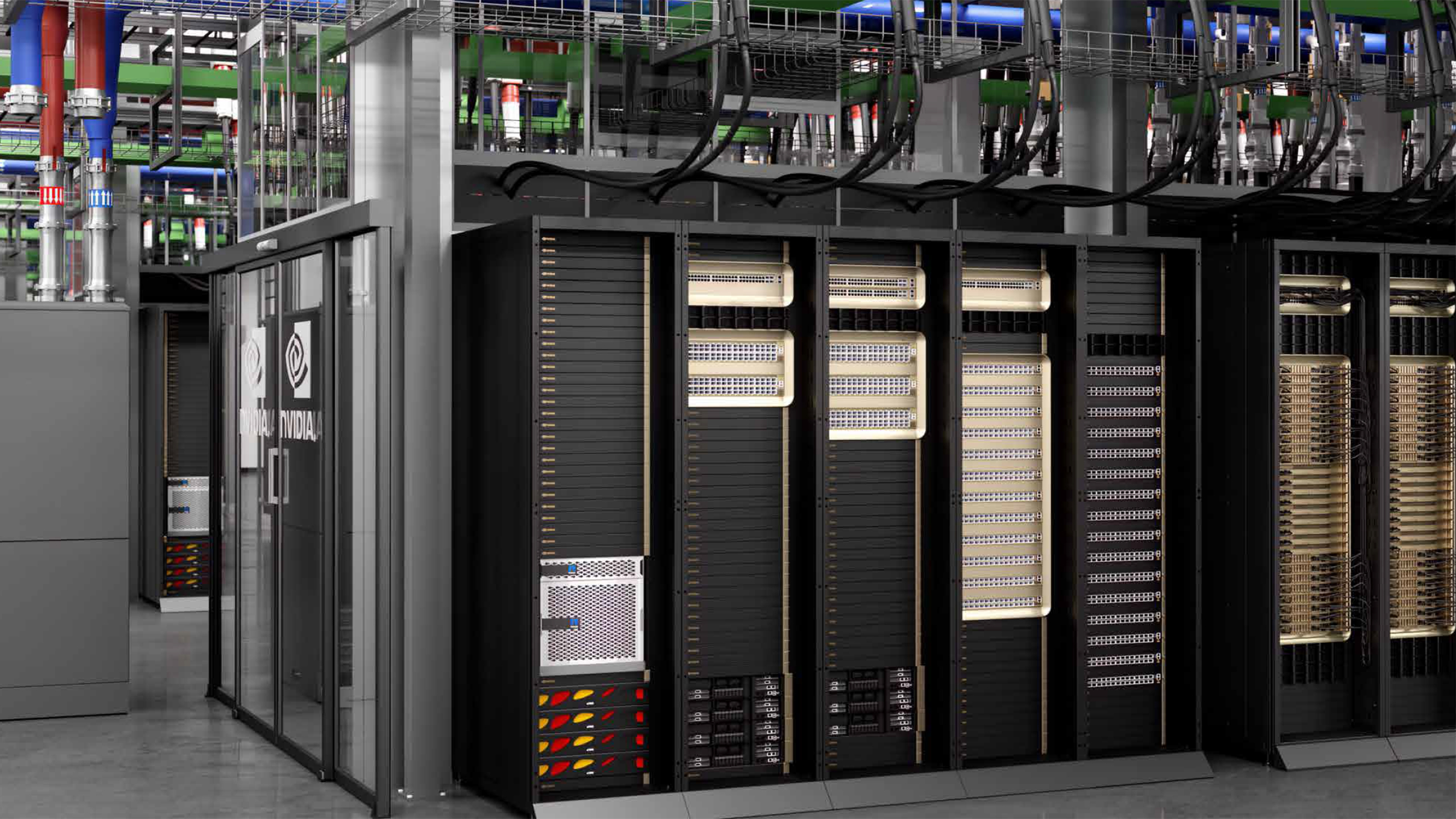
The transition to the Rubin architecture has been a masterclass in supply chain acceleration. While the company began ramping up production of individual components this past spring, the true milestone occurred in August. It was then that the first revenue-generating shipments of the VR200 NVL72 rack-scale systems began leaving manufacturing facilities.
- Spring 2026: Nvidia initiates large-scale production of the Vera CPU and Rubin GPU components, alongside the integration of the BlueField-4 Data Processing Units (DPUs).
- August 2026: First commercial revenue shipments of the VR200 NVL72 rack-scale systems commence.
- Late 2026: Microsoft, as confirmed by CEO Satya Nadella, becomes one of the first major hyperscalers to deploy these systems into commercial production, signaling the readiness of the stack for enterprise-grade workloads.
- Q3 FY2027 (Projected): Vera Rubin is expected to account for 20% of total data center revenue, cementing its status as the fastest-ramping product in Nvidia’s corporate history.
This timeline is remarkably compressed. Historically, data center platforms require multiple quarters of "soaking" in the market—where initial deployments are limited to testing and evaluation—before reaching mass-scale adoption. For Nvidia to move from near-zero revenue in Q2 to a 20% revenue contribution in Q3 is a feat that defies traditional hardware product lifecycles.
Analyzing the Economics of AI Infrastructure
The rapid adoption of the Vera Rubin platform raises critical questions regarding the unit economics of modern AI supercomputing. A single VR200 NVL72 rack-scale system is a marvel of engineering, but it comes with a price tag that reflects its complexity. Industry estimates place these units at between $5 million and $7.8 million apiece, depending on the configuration and the density of the memory subsystems.

If we extrapolate the projected $19.87 billion in revenue against these price points, the shipment volume becomes clear. Assuming a mid-range price of approximately $6.5 million per rack, Nvidia would be shipping roughly 3,000 to 3,500 units in a single quarter. Within these units reside a massive quantity of high-performance silicon:
- Estimated CPU/GPU requirements: Based on current rack specifications, this volume represents approximately 90,000 to 140,000 Vera CPUs and between 180,000 and 280,000 Rubin GPUs.
While these numbers may appear modest compared to the millions of units produced in the consumer electronics or smartphone markets, the context is entirely different. We are discussing rack-scale systems that consume massive amounts of power and require specialized cooling infrastructure. The fact that the industry is absorbing hundreds of thousands of these high-end processors in a three-month window highlights the insatiable demand for computational throughput in the AI arms race.
The "Catch": Quality Over Quantity
Despite the record-breaking revenue figures, industry analysts point to a subtle nuance in the shipment data. The shift to Vera Rubin is not necessarily a story of "volume" in the traditional sense, but one of "value density." Nvidia is increasingly moving toward shipping entire, pre-integrated rack systems (such as the MGX server designs) rather than individual chips.
By controlling the entire stack—from the CPU and GPU to the interconnect and the networking layer (via BlueField-4)—Nvidia is capturing a much larger share of the total system spend. In previous generations, server makers would buy individual GPUs and source their own CPUs, memory, and networking hardware. Today, the complexity of managing interconnect speeds and power delivery has forced hyperscalers to turn to Nvidia’s "factory-complete" solutions. This shift effectively raises the average selling price (ASP) of a "unit," allowing Nvidia to generate massive revenue growth even if the absolute number of silicon chips shipped does not grow at the same exponential rate as the dollar value.
Implications for the Tech Industry
The success of the Vera Rubin platform carries significant implications for the broader semiconductor ecosystem and the future of AI.
1. The Consolidation of the Data Center
Nvidia’s ability to generate $20 billion from a single platform in one quarter reinforces its position as the de facto "new IBM." By integrating CPU, GPU, and DPU into a singular, proprietary ecosystem, Nvidia is creating a platform lock-in that is becoming increasingly difficult for competitors like AMD or Intel to challenge. Hyperscalers are essentially buying into a "Nvidia-defined" data center architecture.
2. The Pressure on Memory and Power
The costs associated with these systems are shifting. Recent reports indicate that memory costs for these high-performance systems have soared by nearly 500% in recent cycles, with memory now accounting for as much as 25% of the total system cost. As Rubin GPUs become more efficient and specialized, the bottleneck for AI training is moving toward high-bandwidth memory (HBM) and the power delivery infrastructure required to support these massive racks.
3. The Margin Dilemma
While Nvidia is seeing record revenue, the pressure on system integrators and server OEMs is mounting. With the cost of these systems reaching as high as $8.8 million per rack, the margins for third-party server manufacturers are being compressed. As Nvidia continues to move closer to shipping entire, full-scale systems, the role of traditional server makers may be relegated to that of a logistics or assembly partner rather than a value-added system designer.
Conclusion: A New Standard for Scaling
Nvidia’s projection for the Vera Rubin platform is more than just a financial milestone; it is a signal of a maturing, yet accelerating, AI industry. The speed at which this technology is moving from the lab to the hyperscale data center floor is unprecedented.
As we look toward the remainder of fiscal 2027, the success of the Vera Rubin rollout will likely be used as the benchmark for all future compute architectures. Whether the market can sustain this level of investment—$20 billion per quarter on a single platform—remains to be seen. However, as long as the demand for larger, more capable AI models persists, Nvidia appears positioned not just to ride the wave, but to define the very shape of the ocean. The era of the "AI Factory" has arrived, and it is built on the foundation of the Rubin architecture.