

In a recent, unprecedented move, Pope Leo XIV issued an official letter to Catholic bishops, offering a stern critique of the unchecked proliferation of artificial intelligence. In his missive, the Pontiff famously likened the potential hubris of modern technology to the biblical "Tower of Babel," urging humanity to pivot toward building a society where God and mankind dwell in harmonious integration.
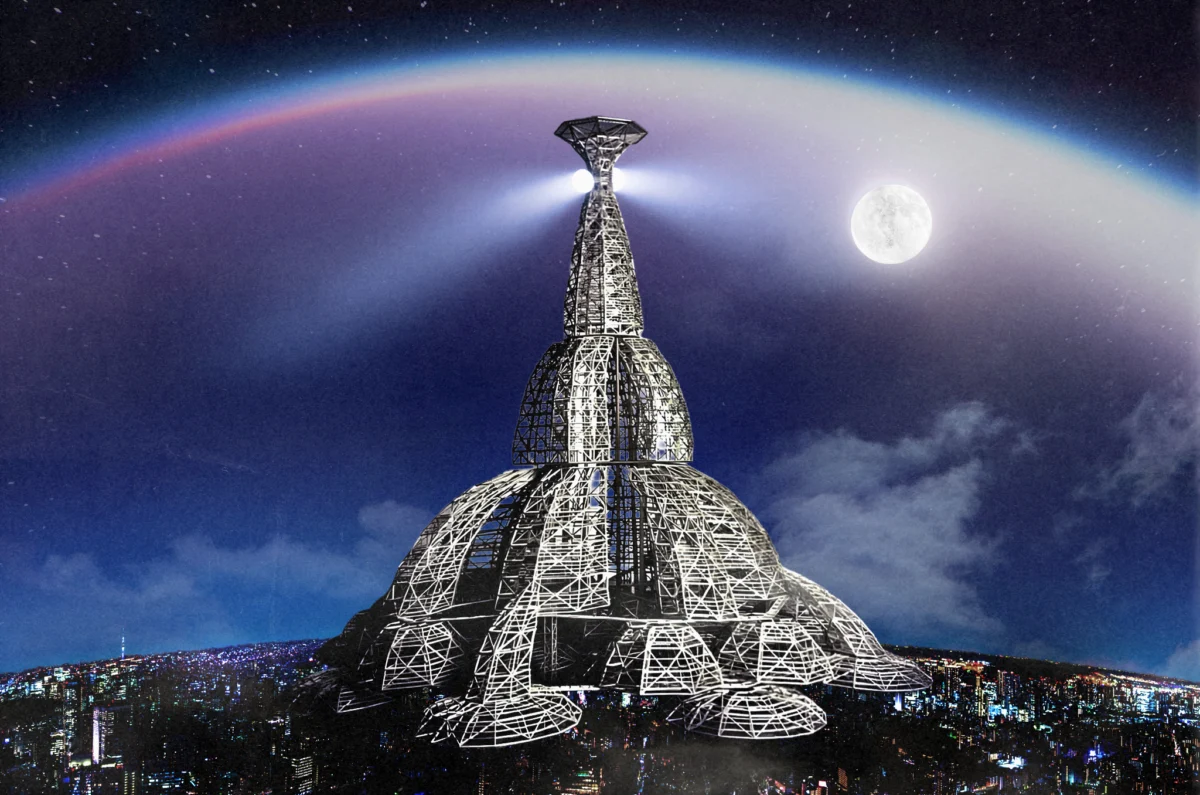
While the Pope’s theological warning was aimed at the digital frontier, the metaphor resonates with a chilling, literal precision in Japan. To those familiar with the annals of urban planning, the name "Tower of Babel" evokes not just a cautionary tale of divine retribution, but a tangible, blueprint-ready nightmare that was seriously proposed for the heart of Tokyo in the early 1990s. The "Tokyo Tower of Babel"—a 10-kilometer-high vertical city—remains the most audacious, expensive, and structurally impossible dream ever conceived by the human mind.
The Genesis of a Mega-Structure
The brainchild of Dr. Toshio Ojima, a distinguished professor at Waseda University, the project was envisioned during the height of Japan’s asset price bubble. In the late 1980s, Tokyo was the epicenter of global economic optimism. Land prices in the Ginza district were rumored to be worth more than all the land in California, and the city’s population was skyrocketing.
Dr. Ojima, an environmental engineer and urban scientist, looked at the dense, sprawling madness of the Tokyo metropolitan area and saw a systemic failure in the making. His solution was an "arcology"—a portmanteau of architecture and ecology. An arcology is a massive, self-contained structure designed to house a vast population while eliminating the need for traditional urban sprawl.

However, Ojima’s vision transcended the standard definition of a building. He proposed a structure that would essentially replace the entirety of central Tokyo. Designed to house 30 million people, the tower was to be 10,000 meters (6.2 miles) in height—twelve times taller than the Burj Khalifa and significantly taller than Mount Everest.
A Chronology of the Impossible
The history of the project is as much a timeline of Japanese economic fervor as it is a history of structural engineering.
- 1980s: The Conceptual Phase: As Japan’s economic bubble inflated, Dr. Ojima began calculating the limits of urban density. His projections suggested that by 2020, Tokyo’s population would exceed the physical capacity of the Kanto Plain.
- 1991: The Formal Proposal: Ojima presented the project to the public and the scientific community. It was not merely a sketch; it was a rigorous, if optimistic, set of engineering requirements that assumed humanity would master materials science at an exponential rate.
- 1992: The Rio Earth Summit: The vision was showcased in Brazil at the United Nations Conference on Environment and Development. It was framed as the ultimate environmental solution—by stacking the city vertically, one could theoretically return the surrounding land to nature.
- 2025: The Reflection: In an NHK documentary, an 88-year-old Dr. Ojima revisited the blueprints. He acknowledged that while the math was internally consistent, the cultural and demographic reality of modern Japan had rendered the project an impossibility.
The Economic and Material Cost
To comprehend the scale of the Tokyo Tower of Babel, one must look at the data—and the number of zeroes required to describe it. In 1991, the estimated cost was ¥3 quadrillion. Adjusted for the inflation and economic shifts of 2026, that figure stands at approximately ¥3.6 quadrillion—roughly $23 trillion USD.
To put that in perspective, $23 trillion represents nearly 5% of the total net wealth of the entire planet. This includes not just liquid cash, but every car, every painting, every piece of real estate, and every ounce of gold currently in existence. The construction would require 10 billion tons of steel—a volume of material that would likely require mining operations on a planetary scale.
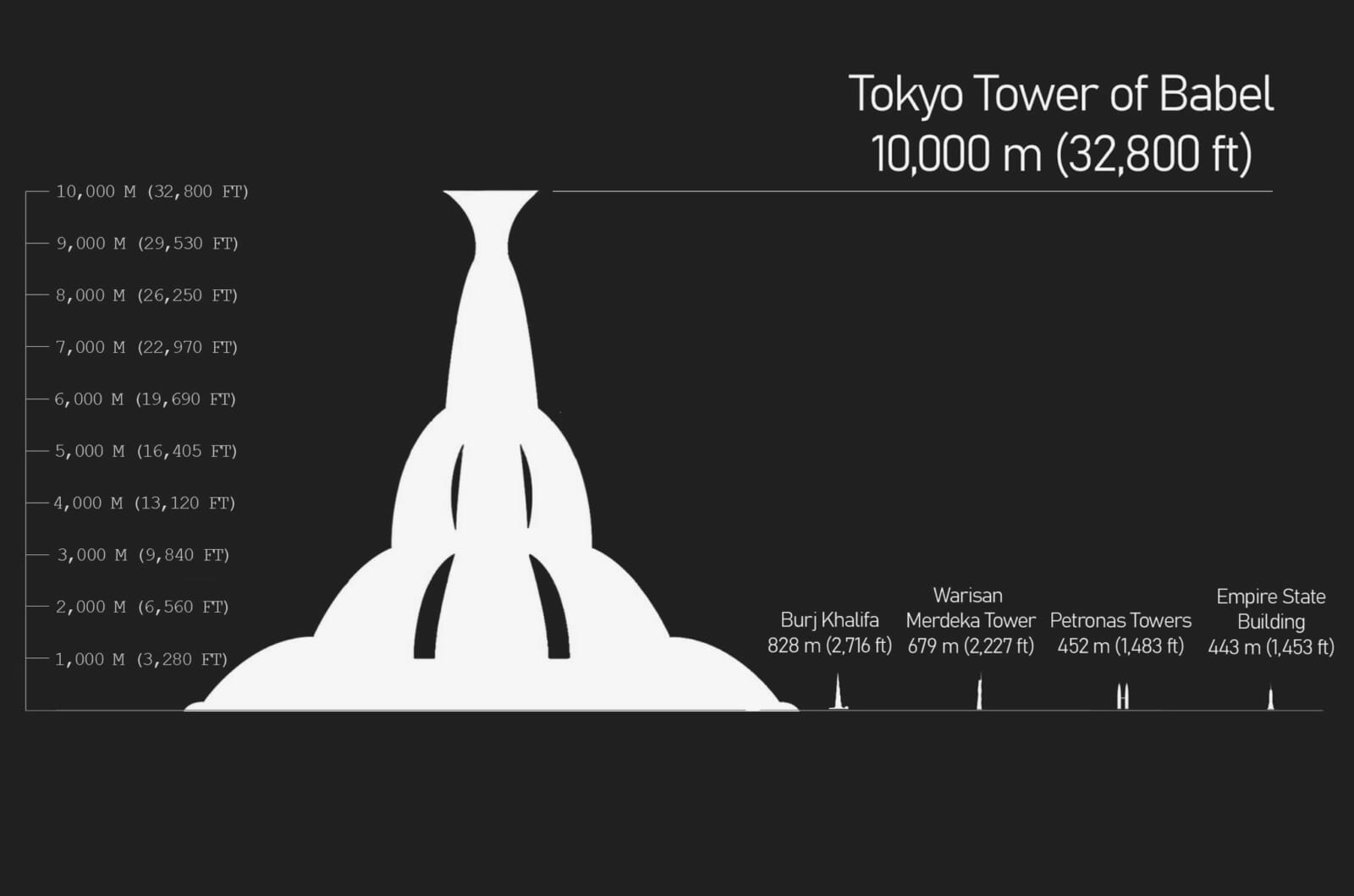
The footprint of the tower would cover 110 million square meters. To facilitate construction, the entirety of the JR Yamanote Line—the loop connecting Tokyo’s most vital districts like Shinjuku, Shibuya, and Akihabara—would have to be vacated and razed. It was an urban planning strategy that required the total destruction of the existing city to make room for its savior.
The Dystopian Geography: A Vertical Caste System
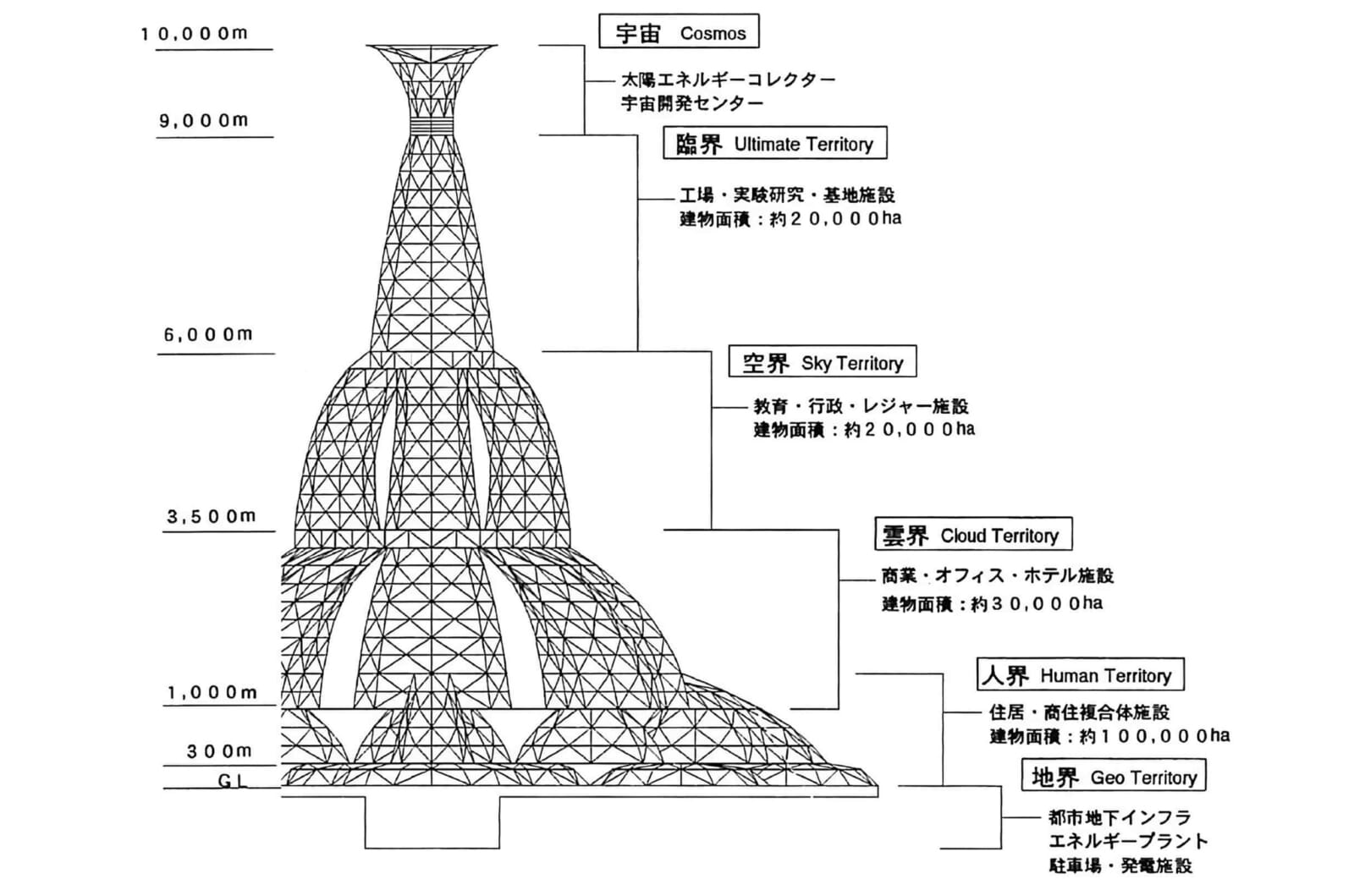
The structural design of the tower, brought to life through the illustrations of designer Masaki Yabuno, envisioned 1,969 floors categorized by "territories."
- The Geo Territory (Underground): The base level would contain the heart of the machine—fusion power plants, waste management, and heavy logistics.
- The Human Territory (0–1km): This was intended for the masses. Designed to mimic the organic, mixed-use feel of Tokyo’s street level, it would contain schools, bakeries, and residences.
- The Cloud and Sky Territories (1–9km): As one ascended, the environment shifted from residential to corporate and administrative. This creates an immediate sci-fi trope: the "upper crust" literally living above the commoners, a concept famously explored in films like Elysium and Battle Angel Alita.
- The Cosmos Territory (9km+): This was the final frontier. Reaching into the stratosphere, this zone was dedicated to aerospace and solar energy collection. With air pressure at 25% of sea level and temperatures dropping to minus 55°C, life here would be entirely dependent on artificial life-support systems, much like a pressurized submarine or a spacecraft.
Official Responses and Scientific Reality
The scientific community’s response to the Tokyo Tower of Babel has historically been one of polite skepticism mixed with professional admiration for the sheer complexity of the logistics. Civil engineers noted that the base of the structure would be under such extreme pressure that no existing concrete or steel alloy could sustain the load without collapsing under its own weight.
Furthermore, the meteorological impact of such a structure was never fully addressed. A 10-kilometer-high wall would fundamentally alter the wind patterns of the Kanto Plain, likely creating permanent micro-climates of severe turbulence or shadow-induced cooling for thousands of square kilometers.
However, the "official" legacy of the project is not one of mockery. Dr. Ojima remains a revered figure in urban design. His work earned him the Order of the Sacred Treasure and the Architectural Institute of Japan Award. Critics and historians suggest that the project was never intended to be built in the literal sense; rather, it was a "provocation"—a way to force architects and governments to think about the absolute limits of human growth and the necessity of radical, sustainable innovation.
The Implications: Why It Cannot Be Built
Today, the Tokyo Tower of Babel serves as a monument to the optimism of the "Bubble Era." The demographic shift in Japan—from a nation of explosive growth to one of rapid aging and population decline—has rendered the concept of the megastructure moot. Tokyo is no longer looking to build higher; it is looking to repurpose its existing, shrinking footprint.
Moreover, the ethical implications of such a tower—a literal vertical hierarchy that segregates the population by altitude—mirror the very "Tower of Babel" warnings issued by the Pope. The project suggests a detachment from the natural world, a hubris that seeks to override the environment rather than live within it.
As Dr. Ojima reflected in his later years, he had simply "dreamed too big." Yet, in the annals of architectural history, the Tokyo Tower of Babel stands as a masterwork of speculative design. It reminds us that while we are capable of calculating the structural requirements for a city that touches the stratosphere, the true challenge lies not in the steel and the engineering, but in the human question of whether we should build such a monument to our own ambition. Whether as a blueprint for a future dystopia or an inspiration for a cinematic masterpiece, the tower remains a testament to the fact that, for a brief moment in the 20th century, Japan dared to touch the heavens.












No comments yet. Be the first to join the conversation!