

In the rapidly evolving landscape of social commerce, TikTok stands as a dominant force, influencing consumer behavior and shaping global trends. For brands, creators, and entrepreneurs, the foundation of a successful TikTok strategy begins with a fundamental decision: choosing the right account type. As of 2026, TikTok offers two primary categories for users—Personal (formerly Creator) and Business—each serving distinct objectives. Understanding the nuances of these accounts is not merely a technical configuration; it is a strategic imperative that dictates how you monetize, advertise, and interact with your audience.
The Evolution of TikTok Accounts
TikTok’s account architecture has undergone significant consolidation. In the platform’s early stages, users navigated a complex array of "Creator" and "Personal" designations. Today, those categories have been streamlined into a unified Personal account type.
Every new user begins their journey with a Personal account by default. This account is designed to be the "all-access pass" for individual expression and community building. Conversely, the Business account is a purpose-built toolset for organizations and companies looking to scale their presence through sophisticated advertising, e-commerce integration, and third-party data analytics. While the transition between these two states is free and instantaneous, the implications for your content strategy and bottom line are profound.
The Personal Account: Flexibility and Creative Freedom
The Personal account remains the gold standard for influencers, content creators, and casual users. Its core philosophy is creative autonomy.
Key Advantages
- Unrestricted Audio Access: The most significant advantage of a Personal account is access to TikTok’s full commercial and non-commercial music library. Because Personal accounts are not subject to the same copyright restrictions as commercial entities, users can jump onto viral trends, use popular audio clips, and participate in audio-driven challenges the moment they emerge.
- Monetization Eligibility: Personal accounts are the only profiles eligible for the Creator Rewards Program, which compensates creators based on high-quality, long-form content. Additionally, features like Gifts, Diamonds, and Series (paid premium content) are exclusive to this account tier.
- Engagement Features: Personal accounts allow for more fluid interaction, including the ability to keep your account private and a more seamless integration with creator-focused tools within the app.
The Business Account: Scaling for Commercial Impact
For brands, agencies, and small businesses, the Business account is designed to act as a growth engine. It is not just a profile; it is a portal to professional-grade marketing infrastructure.
Key Advantages
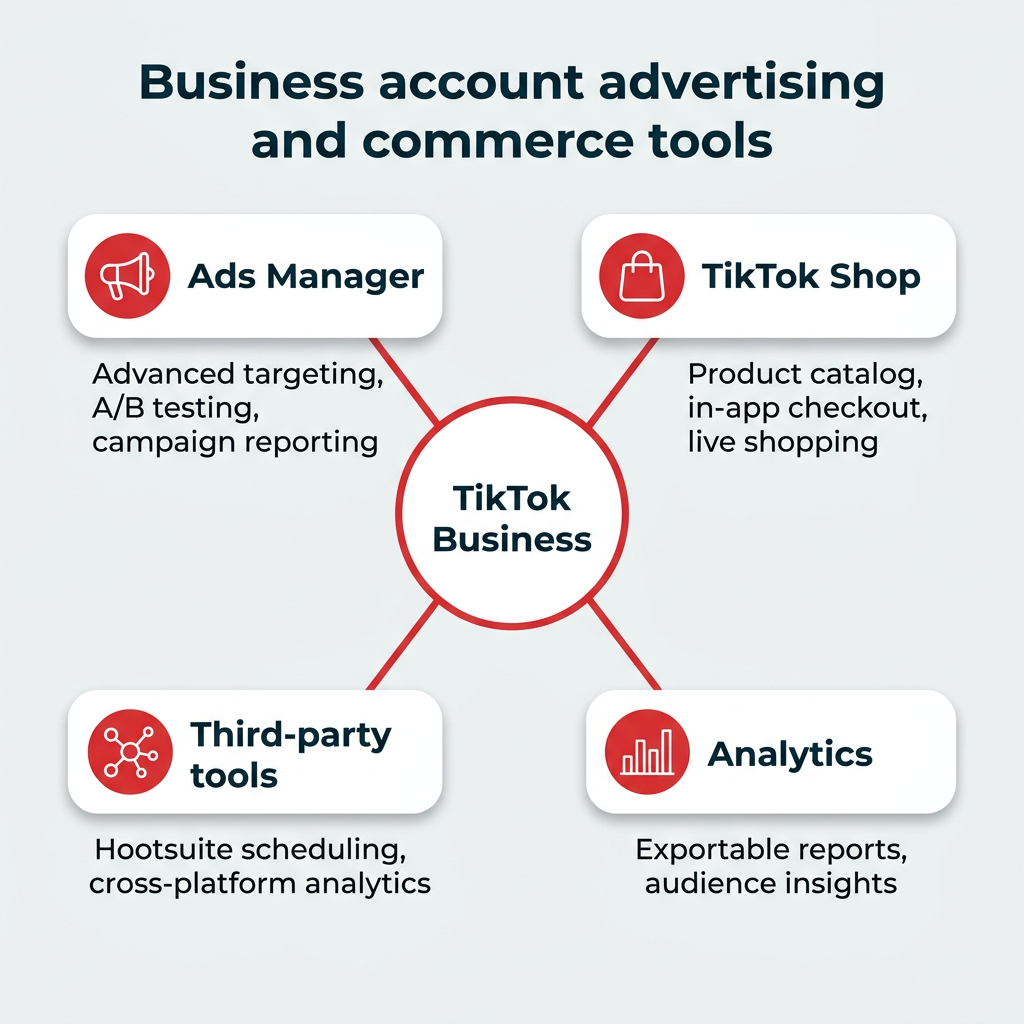
- TikTok Ads Manager: While both account types can "Promote" (boost) existing videos, only Business accounts grant access to the full TikTok Ads Manager. This platform allows for sophisticated campaign structures, granular audience targeting (by interest, behavior, and demographics), A/B testing, and comprehensive conversion tracking.
- Commerce Integration: The Business account is the gatekeeper to the TikTok Shop ecosystem. It allows brands to upload product catalogs, tag items directly in videos and live streams, and enable a frictionless checkout experience.
- Third-Party Integrations: Business accounts can connect to professional social media management platforms like Hootsuite. This is a critical factor for teams that need to schedule content, manage community engagement at scale, and generate cross-platform performance reports.
Comparative Analysis: Monetization and Advertising
The chasm between Personal and Business accounts is most evident when analyzing how they generate revenue.
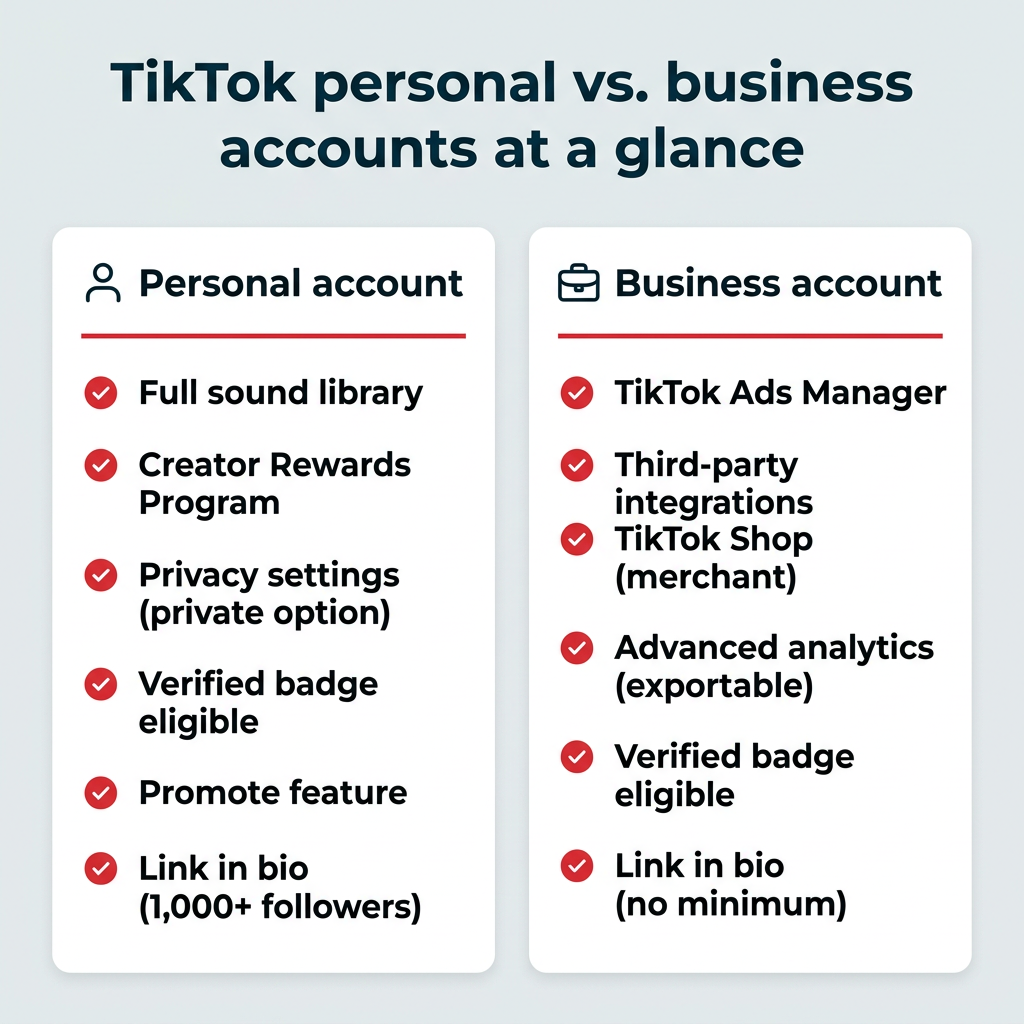
| Feature | Personal Account | Business Account |
|---|---|---|
| Creator Rewards Program | Yes | No |
| TikTok Shop (Merchant) | No | Yes |
| Full Ads Manager | No | Yes |
| Trending Music/Audio | Yes | Limited (Commercial Library) |
| Third-Party API Access | No | Yes |
For the solo creator, the choice is clear: prioritize the Personal account to maintain access to the Creator Rewards Program and the full audio library. For the brand, the Business account is non-negotiable if the goal is to drive sales, capture lead data, or run high-performing ad campaigns.
Addressing the "Organic Reach" Myth
A pervasive concern among marketers is whether switching to a Business account triggers a penalty from the TikTok algorithm. Official documentation and platform behavior indicate that TikTok does not explicitly throttle Business accounts.
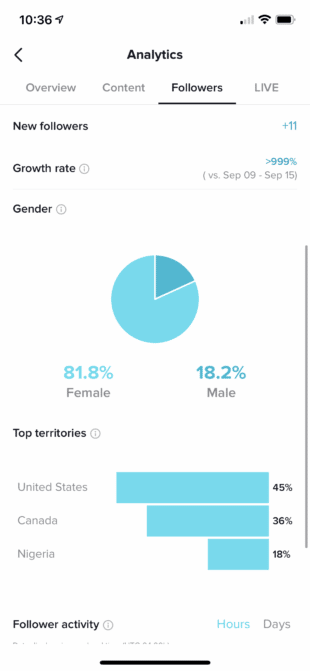
However, there is an indirect impact. Because Business accounts are restricted to the "Commercial Sounds" library, they cannot always participate in the specific, fast-moving audio trends that often provide a viral boost. Consequently, a brand that relies heavily on "trending audio" may perceive a dip in engagement after switching. The key takeaway is that the algorithm rewards high-quality, engaging content regardless of the account type. If your content is compelling and retains viewers, your reach should remain stable.
Strategic Implications: How to Decide
When determining the correct path for your organization, consider the following checklist:
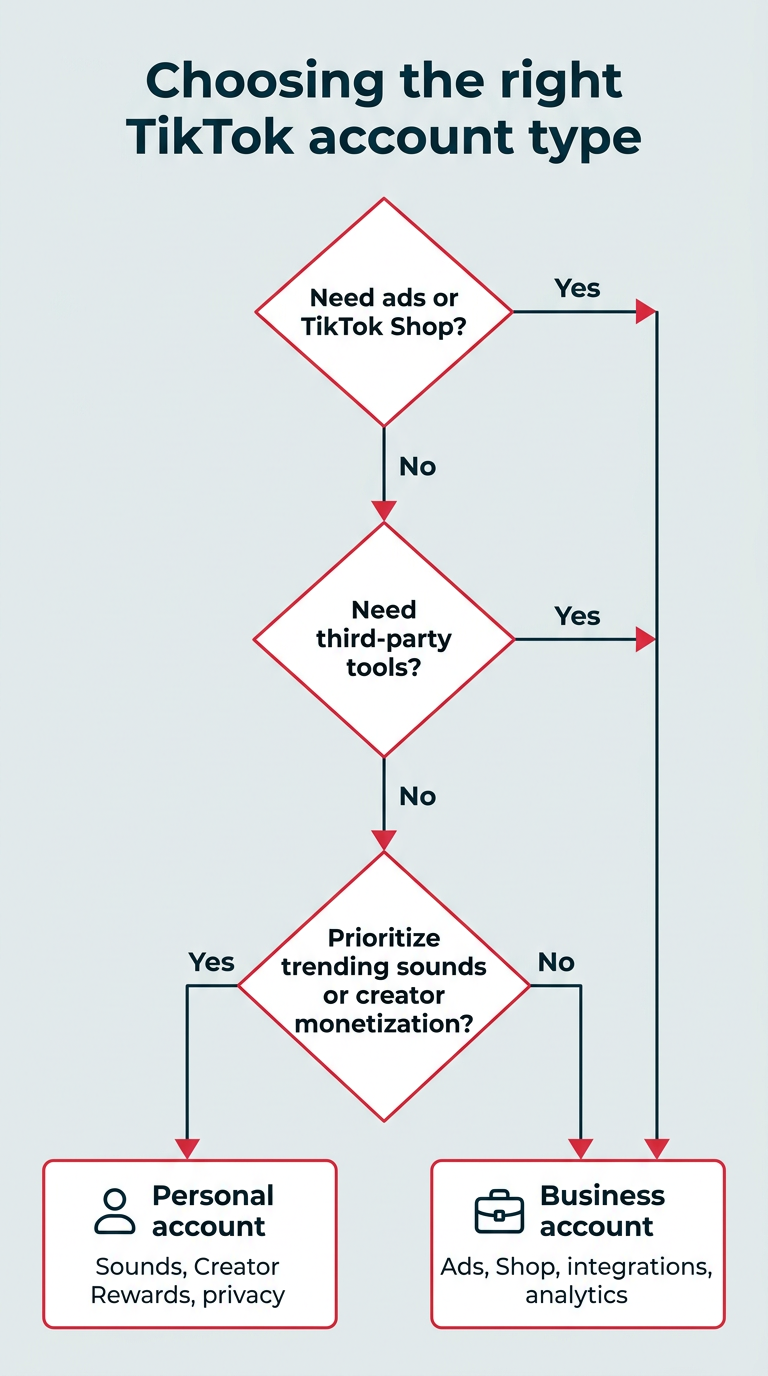
- Choose Personal if: You are an individual creator, your revenue comes from creator funds/brand deals, you rely heavily on trending music, or you prioritize community engagement over direct e-commerce sales.
- Choose Business if: You are selling physical or digital products, you need to manage multiple social channels via a dashboard, you have a budget for paid advertising, or you require professional-grade analytics for client reporting.
The Technical Transition: A Simple Process
TikTok has ensured that switching is frictionless. To switch, navigate to your "Settings and Privacy," select "Account," and choose "Switch to Business Account" or "Switch to Personal Account."
Crucial Note: While the switch is instantaneous, it is not recommended to flip-flop between the two. Frequent switching can cause fluctuations in your analytics reporting and may lead to temporary issues with content distribution. Once you commit to a strategy, it is best to remain consistent for at least one fiscal quarter to accurately measure the performance impact.

The Future of Social Commerce
As we look toward the remainder of 2026, TikTok continues to prioritize the "Shop" experience. With social commerce accounting for nearly 20% of U.S. online retail behavior, the Business account is becoming the backbone of modern digital marketing.
For businesses operating at scale, the ability to integrate inventory management systems with the TikTok API is a game changer. The ability to push scheduled content from a centralized dashboard like Hootsuite—while simultaneously tracking the ROI of a paid campaign in Ads Manager—creates a closed-loop marketing ecosystem that the Personal account simply cannot provide.
Conclusion
The choice between a Personal and Business account on TikTok is a choice between two distinct business models. The Personal account is built for the "Creator Economy," focusing on viral potential and community-led monetization. The Business account is built for the "Commerce Economy," focusing on advertising efficiency, data-driven insights, and seamless sales funnels.
By aligning your account type with your primary business objectives, you ensure that you are utilizing the right tools for your specific goals. Whether you are a creator aiming for a viral moment or a brand building a long-term e-commerce presence, the architecture of your TikTok account is the first step toward sustained success in the digital age.












No comments yet. Be the first to join the conversation!