

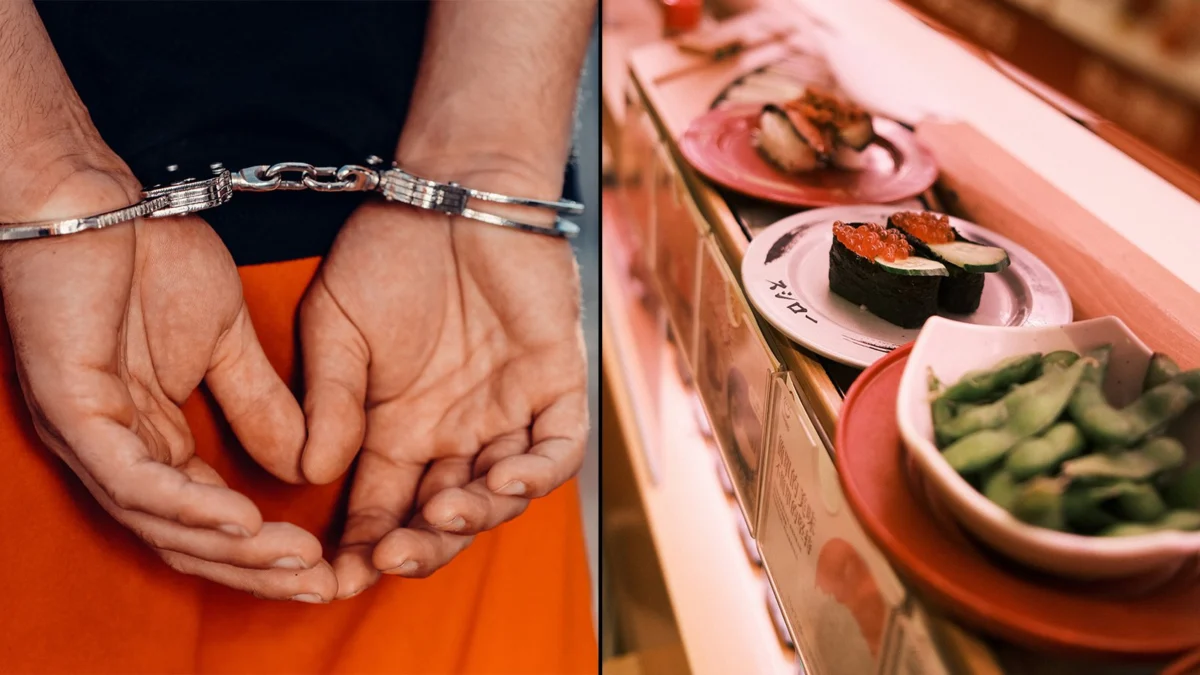
In an era defined by the pursuit of digital validation, the line between harmless pranks and criminal behavior has become increasingly blurred. A disturbing trend, colloquially dubbed “sushi terrorism” in Japan, has claimed another perpetrator. Yuta Shinishi, a 43-year-old unemployed man from Moroyama, Saitama Prefecture, was taken into police custody this week following the circulation of a video in which he sabotaged food at a popular conveyor belt sushi establishment. The incident serves as a stark reminder of the legal and social consequences that await those who trade public safety for social media engagement.
The Incident: A Bid for Virality
The catalyst for the arrest was a video uploaded to TikTok on May 27. The footage depicted Shinishi sitting in a booth at a Hama Sushi location—one of Japan’s most prominent sushi chains—as he performed a calculated act of vandalism. As a plate of sushi drifted past his table on the restaurant’s automated conveyor system, Shinishi reached out with a transparent squeeze bottle. He proceeded to spray the contents of the container directly onto the food.
While the video was intended to shock viewers and garner views, it instead sparked immediate outrage. The footage went viral, not for its entertainment value, but for the visceral disgust it elicited from the public. Authorities acted swiftly; within one week of the video’s emergence, police in Saitama Prefecture identified the suspect and executed an arrest warrant.
Chronology of a Criminal Stunt
The sequence of events leading to the arrest underscores the efficiency of modern digital forensics in police investigations:
- May 27: The suspect, Yuta Shinishi, records himself at a Hama Sushi branch in Saitama Prefecture. He intentionally contaminates a plate of sushi with a liquid stored in a detergent bottle and uploads the footage to TikTok.
- Late May: The video circulates across various social media platforms, drawing condemnation from netizens and the restaurant chain’s management.
- Early June: Law enforcement officials launch an investigation, utilizing digital footprints and surveillance data from the restaurant to identify the individual responsible.
- June 4: Police confirm the identity of the suspect as 43-year-old Yuta Shinishi. He is taken into custody on charges of "forced obstruction of business."
- Post-Arrest: During interrogation, Shinishi admits to the act. He claims his motivation was a desire to "increase the number of views on social media." Furthermore, he alleged that the bottle contained "water from a detergent container," rather than actual cleaning chemicals, though this assertion did little to mitigate the legal consequences of his actions.
The Legal and Ethical Implications of "Forced Obstruction of Business"
In Japan, the legal charge of "forced obstruction of business" is significant. It is not merely a charge for vandalism or a prank; it is a serious criminal offense that recognizes the economic and reputational damage caused to a commercial entity. By intentionally creating a scene that forces a business to halt operations, clean equipment, or suffer a loss of public trust, the perpetrator disrupts the core functionality of the establishment.
Shinishi’s defense—that the substance was merely diluted detergent or water—fails to address the fundamental issue of public trust. When a customer interacts with public food infrastructure in a way that suggests contamination, the business must effectively shut down to sanitize the area, reassure other customers, and investigate the potential health risks. This creates a tangible financial burden for the restaurant chain, which serves as the primary basis for the prosecution.
Official Responses and Corporate Stance
Hama Sushi, the victim of the incident, has been unequivocal in its condemnation. In a formal statement released following the arrest, the company expressed its absolute refusal to tolerate such behavior.

“Such disruptive behavior is completely unacceptable,” the statement read. “We will continue to fully cooperate with the police investigation.”
The chain has further indicated that it intends to pursue civil legal action against Shinishi. By signaling its intent to hold the perpetrator accountable, Hama Sushi is setting a precedent that these viral stunts will no longer be treated as harmless pranks, but as targeted attacks on the brand’s integrity and the safety of their patrons.
While Hama Sushi confirmed that its operational model involves sending plates directly to customers rather than leaving items circulating indefinitely, the presence of an unknown liquid still poses a hygiene risk. The potential for cross-contamination—or even the mere perception of it—is enough to drive away customers and damage the brand’s standing in a highly competitive market.
The Broader Context: A History of "Food Terrorism"
The case of Yuta Shinishi is far from an isolated incident. Over the past several years, Japan has witnessed a surge in "sushi terrorism" (or sushi-tero), where individuals film themselves licking soy sauce bottles, touching sushi with unwashed hands, or placing foreign objects on food items.
The phenomenon is not confined to Japan. In 2021, a woman gained notoriety for spitting into a bag of chips at a grocery store and resealing it, an act that triggered a massive backlash and raised questions about the safety of open-shelf food products. Similarly, in 2023, a couple was widely condemned for licking a tub of ice cream in a store and returning it to the shelf.
These incidents highlight a disturbing psychological pattern: the desire for "clout" or "likes" on social media platforms that prioritize shock value over human decency. The algorithmic nature of platforms like TikTok rewards high-engagement content, and for some, the most accessible way to generate that engagement is through transgressive, antisocial behavior.
The Impact on Consumer Experience
The long-term impact of these viral stunts is a degradation of the casual dining experience. In response to the rise of food tampering, many conveyor belt sushi chains have been forced to implement costly and intrusive security measures.

Some restaurants have shifted toward "on-demand" ordering systems, where sushi is only prepared and delivered to the specific table that ordered it, eliminating the traditional "conveyor belt" aspect that gave the industry its unique charm. Others have invested in high-tech surveillance cameras directed at the belts, or have encased plates in protective lids that can only be opened by the intended customer.
These measures, while necessary to ensure food safety, change the nature of the restaurant. What was once a relaxed, communal atmosphere is now under a state of constant, automated surveillance. The "fun" of selecting sushi from a moving belt is increasingly being replaced by a sterile, high-security environment, all because a minority of individuals seek to exploit the system for their 15 seconds of fame.
Moving Forward: Can Digital Ethics Catch Up?
The arrest of Yuta Shinishi serves as a sobering lesson for the digital age. As social media platforms continue to evolve, the challenge for law enforcement and society at large is to curb the incentive for such behavior.
Legal experts suggest that increasing the severity of sentencing for "forced obstruction of business" could act as a deterrent. However, many argue that the solution must also come from the platforms themselves. By de-platforming users who engage in dangerous or criminal stunts and removing content that promotes such acts, social media companies could play a pivotal role in curbing this trend.
Ultimately, the responsibility also lies with the audience. The viral success of these videos is fueled by the curiosity and clicks of everyday users. As long as the public continues to consume, share, and discuss these "pranks," the incentive for others to replicate them remains.
The case of the Saitama sushi incident is a reminder that the digital world has real-world consequences. A single moment of poor judgment, recorded and uploaded for the sake of an ephemeral metric like "views," has resulted in a criminal record, a potential lawsuit, and the public shame of an unemployed 43-year-old man. As the authorities in Japan continue their crackdown on "food terrorism," it is becoming increasingly clear that the price of viral fame is becoming too high to pay.












No comments yet. Be the first to join the conversation!