Laily UPN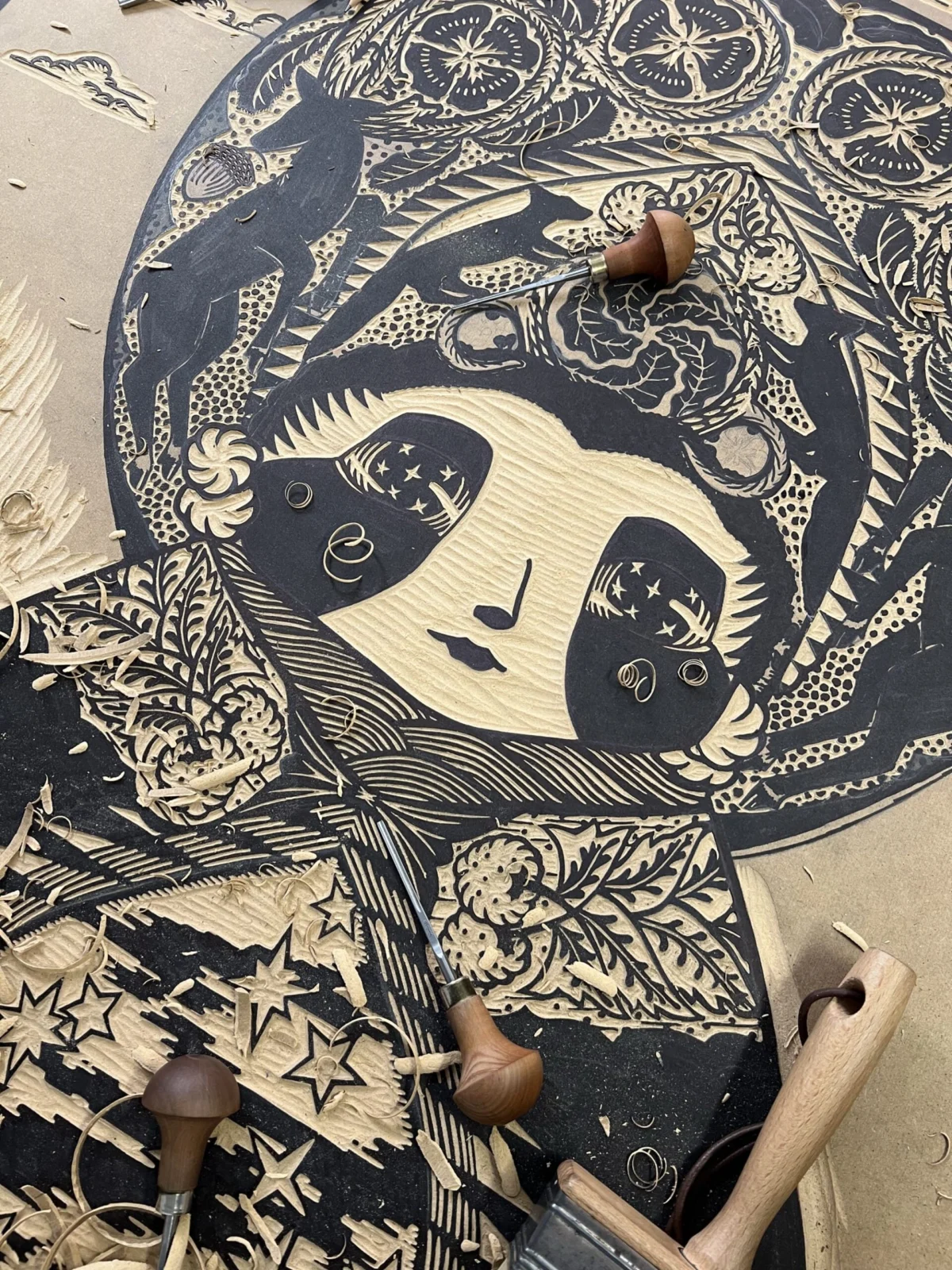
In the quiet, rhythmic act of carving into wood, Austin-based artist Annalise Gratovich attempts to answer a profound, existential question: When war, displacement, and migration sever the threads of one’s lineage, how does one reconstruct a sense of self? Her latest solo exhibition, Carrying Things From Home, currently hosted by the Santa Fe-based gallery Hecho a Mano, serves as both a public display of technical mastery and a deeply private excavation of ancestral trauma and healing.
Through a collection of eight large-scale, hand-carved woodblock prints created over an eleven-year span, Gratovich explores the intersection of Ukrainian heritage, personal mythology, and the enduring human need for belonging.

The Genesis of a Hybrid Identity
For Gratovich, the act of printmaking is far more than a technical endeavor; it is an act of spiritual cartography. Her practice, which she balances with her role running the High Low Print Co., is rooted in the "hybridization" of cultures—the process of finding one’s footing in a new homeland while honoring the ghost-memories of a lost one.
The exhibition features figures that are nearly life-size, standing as totemic witnesses to history. Clad in intricate garments reminiscent of traditional Ukrainian textiles and crowned with elaborate headpieces of flora and fauna, these subjects appear both regal and vulnerable. They are, in a sense, matryoshka dolls brought to life—layered, mysterious, and imbued with the weight of generations.

Chronology: A Decade of Carving (2014–2025)
The development of Carrying Things From Home spans over a decade, reflecting the painstaking nature of Gratovich’s process.
- 2014–2016: The Formative Years: Gratovich began experimenting with the scale and narrative potential of woodblock prints. This period saw the conceptualization of the "archetype" figures that would eventually define the series.
- 2017: Establishing the Language: The creation of The Builder solidified the aesthetic direction of the project, introducing the use of raptors and tools as symbolic markers of identity.
- 2018–2023: Refinement and Scale: During these years, the artist scaled up her physical output, perfecting the integration of chine collé—a technique that involves adhering thin, hand-dyed papers to the woodblock print.
- 2024–2025: The Climax of Complexity: The most recent additions, The Hunter, The Healer, and The Fool, represent the apex of her technical evolution. These works incorporate upwards of 70 individual hand-dyed paper pieces per print, signaling a shift toward maximum density and detail.
Technical Mastery and the "Chine Collé" Method
One of the most striking aspects of Gratovich’s work is the sheer labor involved. The creation of a single woodblock can span up to six months of continuous, high-precision carving. However, the completion of the print requires an even more granular level of dedication.

The chine collé process, which adds vibrancy and texture to the stark, carved woodcut, is an exercise in extreme patience. For The Healer and The Fool, Gratovich prepared nearly 2,000 individual pieces of hand-dyed paper. Each print acts as a mosaic, where colors are layered atop the ink to create a rich, multi-dimensional surface that feels alive.
The Community of the Press
The physical scale of the prints—often requiring a printing press larger than four by eight feet—renders the project a communal effort. "There’s a community aspect that’s engaging and fun," Gratovich explains. "My big woodcuts require a team of four people to print. We use a massive printing press, and everyone is integral in the printing process. It’s not just about the lone artist in the studio; it’s about the synchronized effort of a team to bring a vision to life."

The Ancestral Narrative: World War II and the "Loss of Place"
The impetus for Carrying Things From Home is the displacement of Gratovich’s own family during the chaos of World War II. Her grandparents, forced to flee Ukraine under the cover of darkness, were allowed to take only what they could physically carry. This forced minimalism is the central trauma that informs the exhibition.
"What was lost or left behind has become a source of mystery and mythology," Gratovich notes. By choosing to depict these figures as "carriers"—of knowledge, of nature, and of tradition—she is actively reversing the narrative of loss. The figures are not defined by what they have lost, but by the symbolic weight they have gathered in their new context. The embroidery on their clothes, the birds they hold, and the energy they balance in their hands are attempts to synthesize a new, durable identity from the remnants of the past.

Implications of the Work
Cultural Hybridization in the Modern Era
Gratovich’s work resonates deeply with the contemporary discourse surrounding migration. As populations move across borders, the question of how to maintain a cultural "self" while adapting to a "new home" is more relevant than ever. Her work suggests that identity is not a static inheritance but an active construction—a "hybridization" that is both beautiful and exhausting.
The Value of Materiality
In an increasingly digital world, the visceral, physical nature of Gratovich’s woodcuts serves as a grounding force. The "materiality" she speaks of—the wood, the ink, the paper, and the physical bodies of the people working the press—argues for the importance of tactile connection. In a time where our connections are often ethereal or virtual, she demands that we pay attention to the labor and the physical substance of our shared human history.

Future Trajectory: Beyond Santa Fe
The exhibition at Hecho a Mano remains open until June 28, 2026. However, the conclusion of this show is merely a pivot point for the artist.
Following the exhibition, Gratovich is slated for a residency at Hello Print Friend Studios in Chiang Mai, Thailand, a move that will likely influence the next stage of her artistic evolution. As she travels and works in new environments, the dialogue between her Ukrainian roots and her American, and now Southeast Asian, experiences promises to further complicate and enrich her visual language.

Upon her return, she will serve as the keynote speaker at the Guild of Bookworkers’ Standards of Excellence 2026 conference in Austin. This appearance will coincide with the continued operation of her studio at the Canopy Austin complex, where she continues to invite the public—by appointment—to witness the intersection of art, history, and community.
Conclusion
Annalise Gratovich has achieved something rare in the contemporary art world: a body of work that is simultaneously a public monument to the migrant experience and a quiet, domestic study of personal healing. Through Carrying Things From Home, she invites the viewer not just to look at a print, but to consider what they themselves are carrying. As she continues to carve, print, and teach, it is clear that her work will remain a vital touchstone for anyone exploring the boundaries of home, history, and the human spirit.

For those interested in following the evolution of these projects, or perhaps witnessing the collaborative energy of her printing process, the artist’s Instagram remains a primary portal into the inner workings of her Austin-based studio.

 Asro
Asro
 Sagoh
Sagoh