
 Lina Hope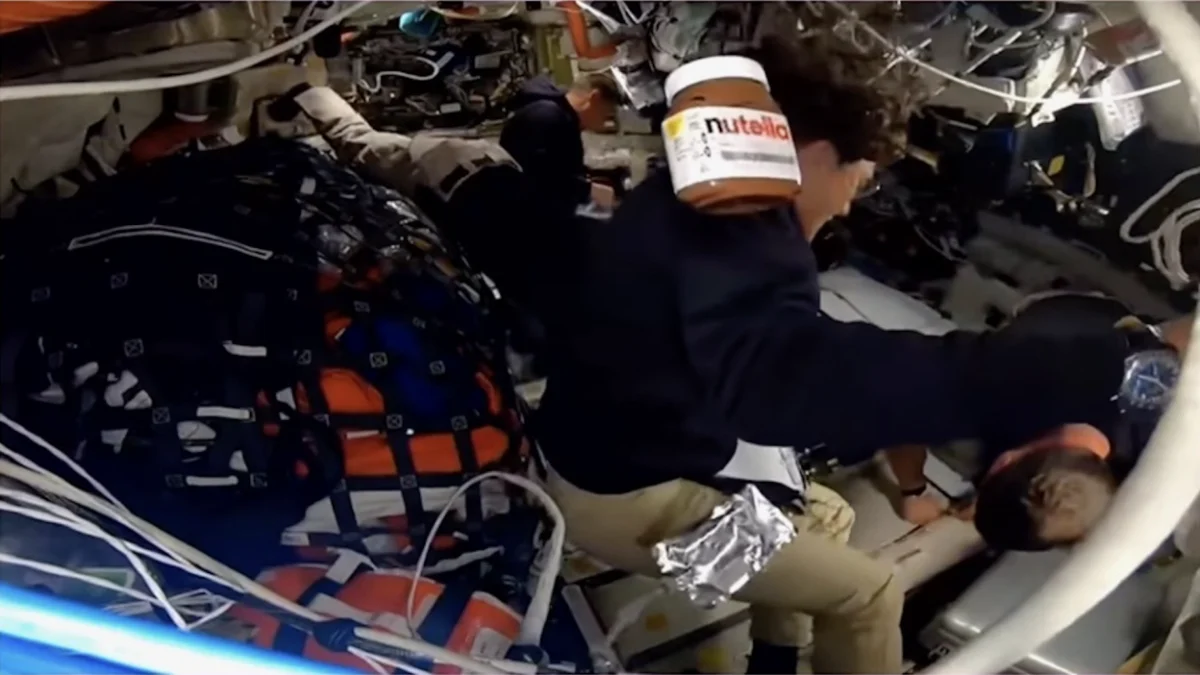
By Crystal Bell
April 6, 2026
As NASA’s Artemis II mission pushes the boundaries of human exploration, the world has been captivated by the high-stakes journey of the four-person crew orbiting the Moon. While the mission’s primary objectives involve testing the Orion spacecraft’s life support systems and navigation, a peculiar, terrestrial stowaway has captured the internet’s imagination: a standard-issue jar of Nutella.
Floating in the microgravity of the Orion cabin, the iconic hazelnut spread has inadvertently become the breakout star of the mission, sparking a global conversation about the intersection of space exploration, pop culture, and the deeply human need for comfort food in the vacuum of space.
The Moment the Internet Lost Its Mind
The spectacle occurred during a routine live feed broadcast by NASA as the Artemis II crew—Commander Reid Wiseman, Pilot Victor Glover, and Mission Specialists Christina Koch and Jeremy Hansen—approached a historic milestone. Just minutes before the crew broke the long-standing distance record set by the Apollo 13 mission in 1970, the camera panned across the flight deck.
There, tethered only by the laws of physics in the cabin’s zero-gravity environment, was a jar of Nutella.
The image was instantaneous internet gold. Within minutes, social media platforms were flooded with memes, speculative threads, and humorous commentary. Users quickly pointed out the irony of the situation: a jar of processed hazelnut spread had technically traveled farther from Earth than any human in history, aside from the four occupants of the capsule.

“One small step for man, one giant leap for Nutella,” one user quipped, echoing the legendary sentiment of Neil Armstrong, while others jokingly labeled the jar the “fifth crew member.” The visual of the chocolatey brown label against the stark, high-tech backdrop of the Orion spacecraft provided a jarring, relatable contrast that resonated with millions of viewers.
A Chronology of the Lunar Snack
To understand how a breakfast staple ended up in deep space, one must look at the meticulously planned logistics of the Artemis II mission.
- Pre-Launch Prep: Months before liftoff, NASA’s Space Food Systems Laboratory at the Johnson Space Center worked with the astronauts to curate a menu that is both nutritionally dense and palatable. Unlike the space food of the 1960s, today’s menu focuses on morale as much as sustenance.
- The Launch Phase: Following a successful launch, the crew began their transit to the Moon. During the initial days, the focus was on system checks and orbital maneuvers.
- The Viral Broadcast: On April 6, 2026, as the spacecraft entered the vicinity of the Moon, NASA conducted a scheduled livestream. It was during this segment that the jar made its unplanned debut, drifting into the foreground as the astronauts prepared for their distance record-breaking maneuver.
- The Record Breaking: Shortly after the video began circulating, the Orion spacecraft officially surpassed the distance record set by the Apollo 13 crew, marking the furthest point from Earth ever reached by a human-crewed vehicle.
Supporting Data: Why Nutella?
Why bring a jar of Nutella on a mission that costs billions of dollars and represents the pinnacle of human engineering? The answer lies in the psychological demands of long-duration spaceflight.
NASA’s Food Systems team has long recognized that food is a primary driver of astronaut morale. In the isolated, high-stress environment of space, the sensory experience of eating becomes critical. A study published by the Human Research Program (HRP) indicates that astronauts experience a "diminished sense of taste" in microgravity, often referred to as the "space cold" effect. Consequently, astronauts frequently request foods that are highly flavorful, spicy, or textured to compensate for these sensory changes.
The Artemis II menu is, by all accounts, quite extensive. According to NASA’s official mission briefings, the current supply includes:
- Protein-heavy staples: Barbecue beef brisket and grilled chicken.
- Vegetable options: Cauliflower, broccoli au gratin, and spinach.
- Comfort foods: Macaroni and cheese, tortillas, and, clearly, high-calorie spreads like Nutella.
- Beverages: Specialized coffee blends to help maintain the crew’s circadian rhythms.
The inclusion of Nutella fits this profile perfectly: it is calorie-dense, shelf-stable, and offers a comforting, familiar taste of Earth that helps mitigate the psychological fatigue of deep-space transit.

Official Responses: Addressing the "Product Placement" Theory
As the video went viral, cynical voices on the internet were quick to speculate. Was this a stealth marketing campaign? Did Ferrero, the manufacturer of Nutella, pay millions to have their product featured in a NASA broadcast?
The theory gained enough traction that NASA felt compelled to issue a formal clarification. In a statement provided to Futurism, NASA agency press secretary Bethany Stevens firmly dispelled the rumors.
"NASA does not select crew meals or food in association with brand partnerships," Stevens stated. "The presence of commercial food items in the cabin is based strictly on the nutritional and morale-based preferences of the crew, as vetted by our dietitians and food scientists. The appearance of the item was not a product placement, nor was any funding exchanged."
This clarification highlights the strict ethical guidelines that NASA follows. As a government agency, NASA is prohibited from engaging in commercial advertising. While the sight of a branded jar is jarring, it is ultimately a byproduct of allowing astronauts to bring "personal preference" items into the spacecraft.
Implications: The Humanization of Space Exploration
The "Nutella Incident" serves as a fascinating case study in how the public consumes space news. Modern space exploration often feels detached—a realm of cold steel, complex physics, and distant, untouchable heroes. However, the sight of a familiar grocery store item floating in space acted as a bridge, grounding the extraordinary nature of the Artemis II mission in something relatable.
1. The Power of "Relatability"
By seeing a jar of Nutella, the public was reminded that the astronauts are, at their core, just people. They get hungry, they have cravings, and they enjoy the same small comforts that we do on Earth. This "humanization" of the mission has likely contributed to higher engagement rates for NASA’s livestream, as audiences find it easier to connect with the mission through these small, organic moments.

2. The Future of Space Tourism and Branding
While this instance was not a commercial deal, it does raise questions about the future of space travel. As we move toward the commercialization of Low Earth Orbit (LEO) and eventually the Moon, the line between "personal choice" and "branded space" will continue to blur. Companies will undoubtedly look for ways to have their products featured in the next "giant leap."
3. Morale in Deep Space
As NASA prepares for future missions to Mars—which could take months or even years—the psychological challenge of eating the same rations will increase. The success of the "Nutella strategy" proves that allowing astronauts to curate their own menu is not just a luxury, but a necessity for mission success.
Conclusion
The Artemis II mission is a landmark event in human history, signaling our return to the Moon and our future trajectory toward Mars. While the history books will focus on the distance records, the engine performance, and the lunar trajectories, the "Nutella jar" will remain a quirky, beloved footnote of the journey.
It is a reminder that even as we reach for the stars, we carry our humanity—and our snacks—with us. As Commander Wiseman and his crew continue their orbit, the world watches on, reminded that the greatest achievements in history are often punctuated by the simplest of pleasures.
Whether it was a calculated morale booster or a simple coincidence, the floating jar of hazelnut spread has succeeded in one area many PR campaigns fail: it made the vast, intimidating expanse of space feel just a little bit more like home.


 Azzam Bilal Chamdy
 Sagoh
Sagoh





