

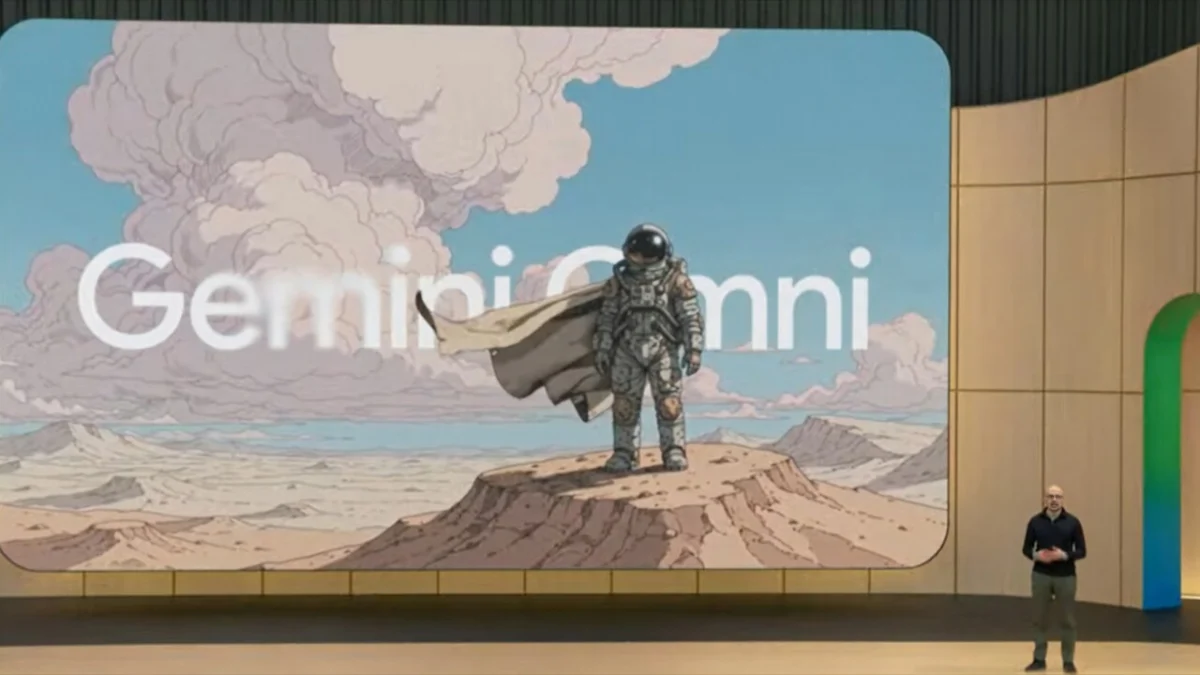
The landscape of generative artificial intelligence underwent a tectonic shift this week at Google I/O 2026. Following aggressive maneuvers by competitors OpenAI and Anthropic, Google has responded with a formidable double-header: the launch of Gemini 3.5 Flash, an efficiency-optimized powerhouse designed to fuel the next generation of autonomous agents, and Gemini Omni, a multimodal "world model" capable of simulating physical reality with unprecedented fidelity.
As the industry moves away from mere chatbot interfaces toward proactive, agentic workflows, Google’s announcements signal a clear strategic pivot. The company is no longer just building tools for text generation; it is architecting an ecosystem of digital assistants capable of persistent, autonomous operation.
Main Facts: The New Gemini Architecture
Google’s latest hardware and software integration strategy focuses on two distinct objectives: speed/utility and sensory intelligence.
- Gemini 3.5 Flash: Engineered for "agentic" tasks, this model optimizes the trade-off between reasoning depth and latency. It brings performance levels comparable to GPT-5.5 and Claude Opus 4.7, but with a throughput advantage that makes it the current gold standard for real-time background processing.
- Gemini Omni: This represents a leap in multimodal convergence. By fusing the architecture of the Gemini family with the visual-temporal capabilities of "Veo" and "Nano Banana," Google has created a model that understands the laws of physics—specifically gravity, kinetic energy, and fluid dynamics—within its generated video outputs.
Chronology: The Road to I/O 2026
The timeline leading to this announcement reflects the escalating arms race in Silicon Valley.
- Early 2026: OpenAI releases GPT-5.5, setting a new benchmark for reasoning, while Anthropic pushes the boundaries of long-context windows with Claude Opus 4.7. The market pressure on Google to demonstrate parity in coding and agentic reliability reaches a fever pitch.
- May 2026 (Google I/O): Google breaks its silence. The keynote confirms the shift from static LLMs (Large Language Models) to dynamic, agent-based systems.
- Immediate Rollout: Gemini 3.5 Flash becomes available via the Gemini app and Google Cloud on the day of the announcement, while Gemini Omni is gated behind the Google AI Plus, Pro, and Ultra subscription tiers.
Supporting Data: Efficiency and Benchmark Performance
Google’s internal benchmarks suggest that Gemini 3.5 Flash is not merely an incremental update. While the company admits that the raw latency is marginally higher than the preceding 3.1 Flash, the density of information processed per second is significantly higher.
In comparative analysis, Gemini 3.5 Flash sustains a token-per-second output that dwarfs its competitors when running complex multi-step reasoning tasks. For developers using the Antigravity coding assistant, this efficiency translates into fewer "hang times" during complex refactoring tasks, directly challenging the dominance of Claude Code and Codex in professional developer environments.
Furthermore, the introduction of Gemini Omni marks a shift in how "multimodality" is measured. Previous models could "see" and "hear," but Omni exhibits a grasp of causality. When prompted to generate video, the model’s internal simulation engine accounts for environmental physics, resulting in a reduction of the "hallucination" of physical laws (e.g., objects falling at correct speeds, liquids splashing realistically) that has plagued earlier video-generative AI.
Official Responses and Strategic Vision
During the keynote, Demis Hassabis, CEO of Google DeepMind, emphasized that the goal of these models is to transcend the "chat window."
"We are moving from a world where AI is a conversational partner to a world where AI is a digital colleague," Hassabis stated. "Gemini 3.5 Flash is the engine that makes that possible. By lowering the cost of inference and increasing the reliability of agentic workflows, we are enabling agents that don’t just answer questions, but execute long-term projects."
Regarding Gemini Omni, Hassabis noted that the synthesis of "Veo" (video) and "Nano Banana" (physical world modeling) was the most complex engineering challenge his team has faced to date. "Understanding the world isn’t just about reading text; it’s about understanding how matter interacts with space and time. That is the hurdle we have cleared with Omni."
Implications: The Rise of the Agentic Era
The release of these models carries profound implications for both the enterprise and the individual consumer.
1. The Proliferation of "Subagents"
Google is integrating "Subagents" directly into the Google Search experience. This is a departure from the traditional search model. Instead of receiving a list of links, users can now spawn a persistent agent to monitor a topic, conduct research, or synthesize updates over weeks or months. This suggests that Google is preparing to cannibalize its own traditional ad-based search model in favor of a value-added service model.
2. The "Spark" Paradigm
Perhaps the most ambitious announcement is Spark, a personal agent currently in beta. Spark is designed to operate autonomously in the background, handling administrative tasks that define daily life—scheduling, travel coordination, and email management. If successful, Spark could become the central operating system layer for the average smartphone user, potentially displacing traditional apps.
3. Developer Landscape: Antigravity vs. The World
Google’s coding assistant, Antigravity, has historically trailed behind its rivals. With the underlying power of 3.5 Flash, Google is positioning Antigravity as the primary tool for enterprise-level software development. By offering deep integration with the Google Cloud ecosystem, Google is attempting to create a "walled garden" for AI-assisted development, making it easier for companies to build, test, and deploy software using Google’s proprietary infrastructure.
4. The Future of Content Creation
Gemini Omni’s ability to understand physical dynamics sets a new bar for creative industries. Filmmakers, game designers, and advertisers now have access to a tool that understands the "physics of the frame." This will inevitably disrupt the stock footage and basic animation industries, as high-fidelity, physically accurate video content can now be generated from simple text or multi-modal prompts.
Conclusion: A New Standard for Interaction
As the dust settles on Google I/O 2026, the trajectory of the AI industry is clear: the focus has shifted from "can it answer?" to "can it act?"
Gemini 3.5 Flash and Gemini Omni are not just updates; they are the infrastructure for an autonomous future. While the integration of these models into everyday workflows will take time, the foundation has been laid. For Google, the goal is clear: to remain the indispensable layer between the user and the digital world, whether that interaction is a simple query, a complex coding project, or the creation of an entirely new, physically-simulated reality.
As we look toward the remainder of the year, the success of these models will depend not just on their technical benchmarks, but on their reliability. If Google can deliver on the promise of Spark and the efficiency of 3.5 Flash, the way we work, create, and interact with the internet will be fundamentally transformed by the end of the decade. The agentic era has begun, and Google is firmly in the driver’s seat.












No comments yet. Be the first to join the conversation!