Jia Lissa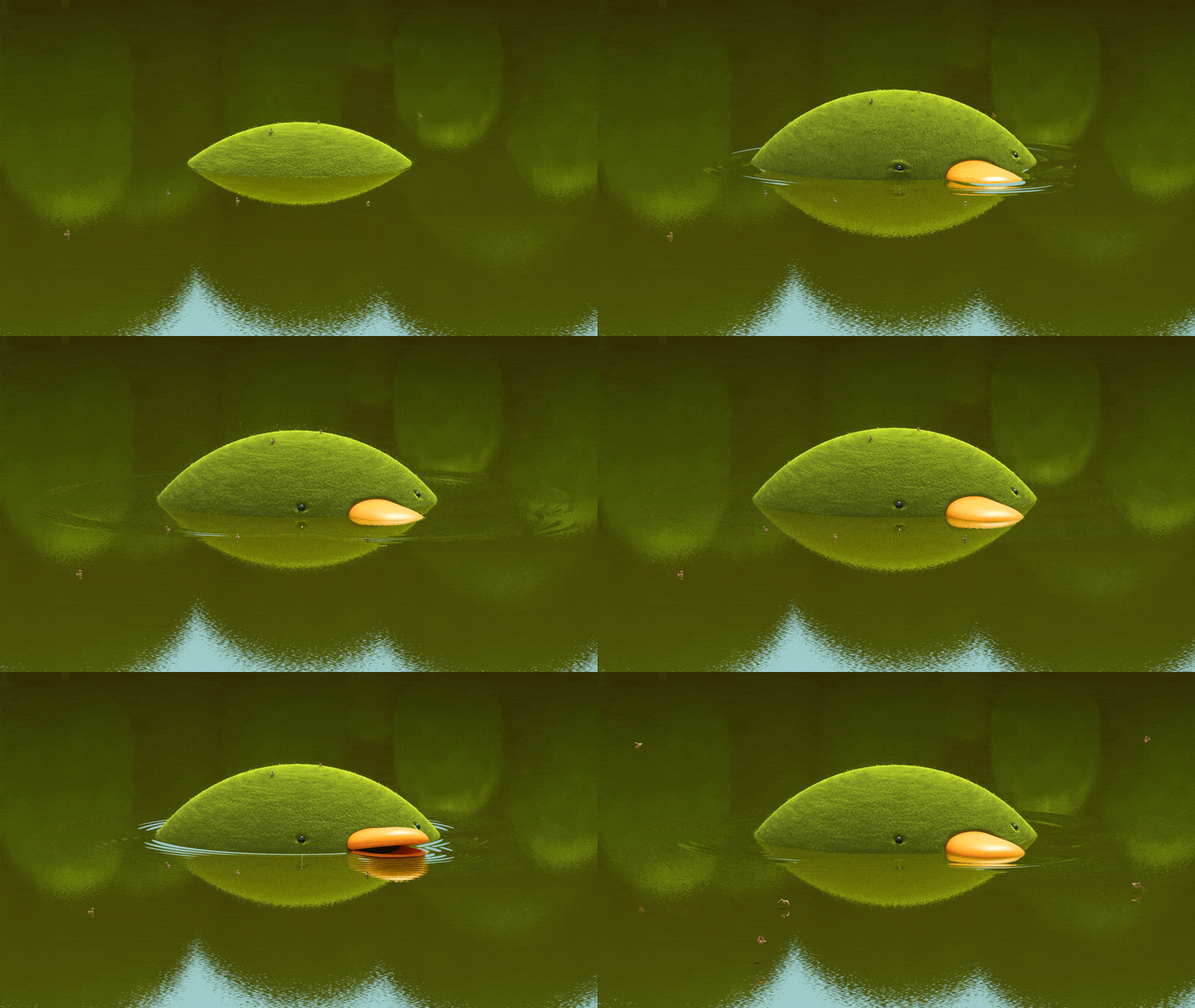
By [Your Name/Editorial Desk]
June 4, 2026
In the carefully manicured green spaces of our public parks, the duck has long served as a symbol of pastoral innocence. They are the perennial favorites of toddlers, the subjects of amateur photography, and the beneficiaries of countless loaves of tossed white bread. However, animator AJ Jeffries has decided that it is time to disrupt this peaceful tableau. In his latest animated short, DUCKS, Jeffries transforms these aquatic birds into the subjects of a grotesque, high-concept nightmare, challenging our cavalier attitude toward human-wildlife interactions through the lens of dark, surrealist comedy.
The Anatomy of an Animated Uprising
At its core, DUCKS is a masterclass in the "uncanny valley." The animation style employs fluid, often jarring movements that force the viewer to reconsider the biology of the common mallard. The short film, which premiered recently to critical interest, begins with the familiar iconography of a serene pond. Yet, within seconds, the familiar gives way to the bizarre.
Jeffries utilizes hyper-realistic texturing paired with impossible physics—most notably, ducks that sprout human-like, muscular legs to navigate the landscape. The animation serves as a cautionary tale, albeit a heavily satirical one. By projecting human physical traits onto avian anatomy, Jeffries creates a visceral reaction, making the viewer feel the awkwardness and potential aggression of a creature that has been pushed beyond its natural design.
Chronology of the Creation: From Sketches to Surrealism
The development of DUCKS follows a trajectory familiar to followers of Jeffries’ body of work. Known for his 2020 viral hit detailing the trials of a struggling, horse-themed character, Jeffries has spent the better part of the last three years refining his signature "distorted reality" aesthetic.
- Early 2024: Conceptualization begins. Jeffries notes in early development logs that he became fascinated by the dichotomy between the "cute" exterior of park ducks and the aggressive, territorial behavior they exhibit when food is withheld.
- Late 2024–Early 2025: Technical prototyping. Jeffries focused on skeletal rigging for his avian models, specifically experimenting with how leg displacement would alter the center of gravity for a duck-shaped character.
- Mid-2025: Narrative structuring. The decision was made to move away from a traditional narrative structure in favor of a "rhythm of discomfort," where the viewer is lulled into a false sense of security before a jarring visual reveal.
- May 2026: Final rendering and sound design integration. The film’s audio landscape—a mix of ambient pond noise and synthesized, heavy-footed thuds—was finalized to heighten the tension of the visual gags.
- June 4, 2026: Public release via Vimeo, accompanied by a curated release of GIFs showcasing the most surreal moments of the film.
Supporting Data: The Ecological Reality Behind the Fiction
While DUCKS is clearly a work of fiction, its premise is rooted in a very real ecological debate. Wildlife biologists and park management authorities have spent decades fighting the "bread-feeding" epidemic.
According to data from the National Wildlife Federation and various urban park departments, the consumption of processed bread by waterfowl leads to a condition colloquially known as "Angel Wing." This is a deformity where the bird’s wing feathers grow too quickly, causing the wing to twist outward and rendering the bird flightless. Furthermore, the excess of abandoned, rotting food in public ponds leads to:
- Increased Algae Blooms: Decaying bread releases nitrogen and phosphorus, fueling toxic algae that kill fish and degrade water quality.
- Overcrowding: Providing an artificial, constant food source causes unnatural population densities, which accelerates the spread of avian diseases like botulism.
- Loss of Foraging Instincts: When ducks become reliant on human handouts, they lose the ability to forage for natural nutrients, leading to malnutrition despite their appearance of "being fed."
Jeffries’ animation acts as an artistic hyperbole of these consequences. When his ducks emerge from the water with human-like limbs, it is a visual metaphor for the "unnatural" state humans have forced upon these animals through years of well-intentioned but ecologically disastrous interference.
Official Responses and Public Reception
The artistic community has responded to DUCKS with a mix of fascination and mild revulsion. Critics have noted that Jeffries’ work occupies a rare space between high-art experimental animation and internet-native surrealist memes.

"Jeffries isn’t just making a cartoon; he’s challenging our perception of nature," says animation historian Sarah Vane. "By making the ducks look like they’ve evolved to survive a human-dominated environment—sprouting legs to walk on our sidewalks and demanding more of the food we’ve accustomed them to—he’s holding up a mirror to the absurdity of our relationship with the wild."
On social media, the reaction has been polarized. On platforms like Instagram and Behance, the animation has sparked a trend of viewers posting their own "duck encounters" alongside clips of the film. While some viewers find the animation "traumatizing," others have praised it as the most effective public service announcement regarding wildlife feeding that they have ever seen.
Implications: The Ethics of Our Public Parks
The implications of DUCKS extend beyond the digital screen. As urban centers continue to expand, the interaction between human residents and local wildlife becomes increasingly complex. Jeffries’ film forces us to address the "flippant approach" many take toward park guidelines.
The Psychological Impact of Anthropomorphism
Anthropomorphism—the attribution of human traits to animals—is a significant driver of why people feed ducks. We see them as "little people in feathered coats." Jeffries’ work effectively weaponizes this tendency. By turning the ducks into literal human-bird hybrids, he makes the audience uncomfortable with their own desire to see themselves in the animals.
Future Directions in Wildlife Education
Could surrealist animation be the future of ecological awareness? Traditional signage in parks ("Do Not Feed the Ducks") is often ignored. However, content that goes viral—like DUCKS—has a unique reach. If a piece of art can make a person think twice before tossing a piece of sourdough into a pond, it serves an educational function that traditional media often fails to achieve.
Conclusion: A Feathered Warning
AJ Jeffries has managed to do what many environmental campaigns have failed to do: he has made the issue of duck feeding memorable. Whether or not you appreciate the dark, contorted aesthetics of his animation, the underlying message of DUCKS is undeniable.
The next time you find yourself standing at the edge of a pond, bag of bread in hand, you might want to pause. You might think of the legs—the long, human-like limbs—sprouting from the water. You might remember the dark comedy of a creature that has been fundamentally altered by human intervention.
AJ Jeffries’ work reminds us that when we disrupt the natural order, the results are rarely as cute as we imagine them to be. Sometimes, they are just plain strange. And perhaps, that is the most effective warning of all.
For those interested in exploring more of Jeffries’ unsettling and imaginative portfolio, his work remains available for public viewing across his Vimeo, Instagram, and Behance channels. His ongoing series, which consistently challenges the boundaries of 3D animation, continues to be a focal point for contemporary digital art discourse.

 Asep Darmawan
 Layla Zulfa