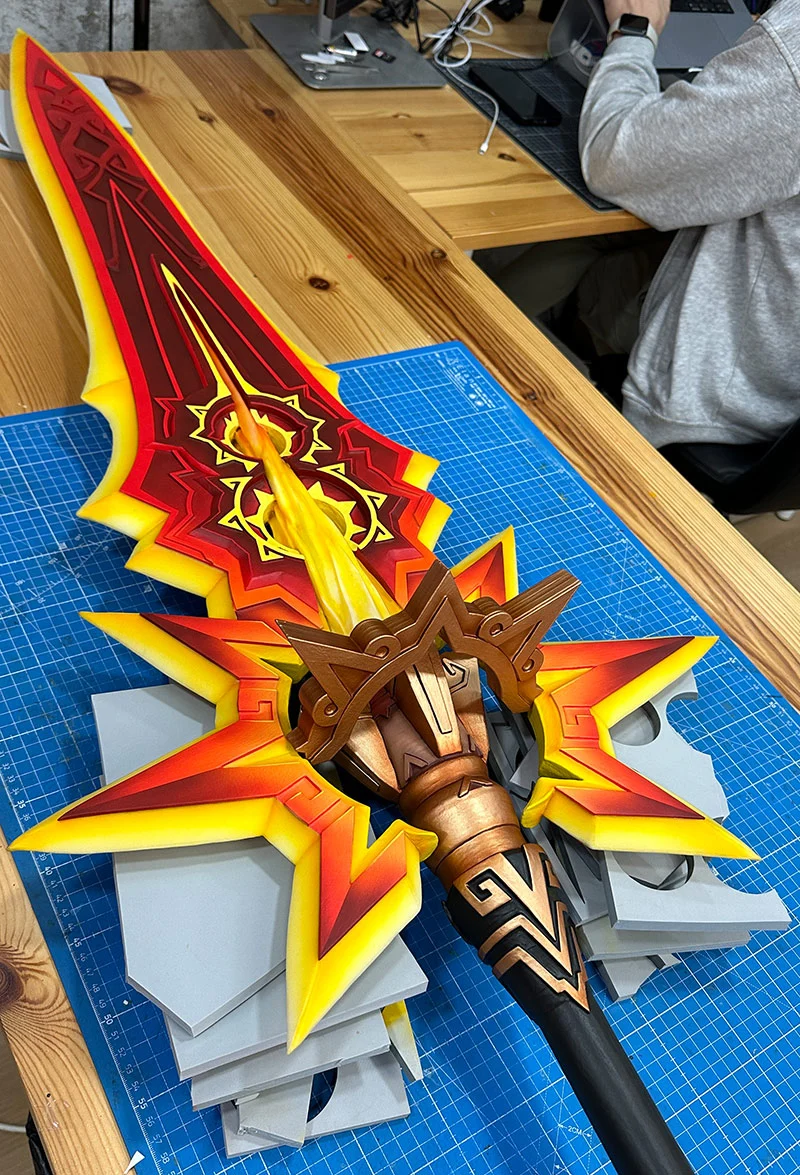
In the world of high-end cosplay, few creators bridge the gap between digital fantasy and physical craftsmanship as effectively as Kamui Cosplay. Known for their intricate armor builds and mastery of EVA foam, the duo recently embarked on a monumental project: replicating "A Thousand Blazing Suns," the massive, incandescent signature weapon of Mavuika, the Fire Archon from HoYoverse’s global phenomenon, Genshin Impact.
This project was not merely a passion endeavor; it was an official collaboration with HoYoverse, tasking the creators with producing promotional content to celebrate the release of the Fire Archon. The result is a masterclass in prop engineering, blending advanced material science, complex electronics, and high-stakes painting techniques to bring a piece of Teyvat into the real world.
The Genesis: Blueprinting and Design
The journey began with the daunting task of scaling a weapon designed for a larger-than-life deity. While in-game assets provide a visual foundation, transforming a digital 3D model into a physical prop requires precision. The team utilized official 3D models sourced from Aplaybox.com, a repository for HoYoverse assets.

"Navigating these resources requires a bit of detective work, often involving searching for character names in Chinese characters," the team notes. Despite the linguistic barrier—often mitigated by translation tools—the 3D files proved indispensable for calculating dimensions.
Crucially, the team made a deliberate design choice regarding scale. While the in-game version of the sword is gargantuan, the team opted for a two-meter length. This decision underscores a fundamental principle in professional prop-making: the "naturalistic" approach. A weapon that is perfectly scaled to a character’s fictional proportions can often become unwieldy, imbalanced, or physically impossible to carry at a convention. By scaling the sword to two meters, they achieved a balance between screen-accuracy and ergonomic feasibility, ensuring the piece remained a functional accessory rather than a purely static display.
Chronology of Construction: A Seven-Day Marathon
The construction process was a high-intensity, week-long sprint that tested the limits of their workshop capabilities.

Phase 1: Structural Integrity and Foam Engineering
The foundation of the sword relies on a robust internal core, specifically a PVC pipe, which serves as the "spine" of the prop. This provides the necessary rigidity to support the weight of the foam and the extensive electronic array. The team employed 10mm EVA foam, favored for its high density and structural stability.
To achieve the "rocket-engine" aesthetic of the blade’s core, the team integrated a lighting system directly into the build. By carving channels within the foam, they created a housing for the wiring and LED strips, allowing the weapon to glow from within. The layering of 10mm EVA foam was essential here, providing enough depth to hide the internal electronics while maintaining the sword’s distinct silhouette.
Phase 2: The Role of Digital Fabrication
A significant evolution in their workflow was the integration of a C02 laser cutter. Traditionally, cutting foam is a manual, time-consuming process prone to human error. By converting their blueprints into vector files, the team was able to automate the cutting process. While this increased efficiency, they caution that it requires a higher upfront investment in time: "Using a laser cutter might actually make things more complicated rather than easier, as you must have perfectly precise vector files ready before you ever touch the machine."

Phase 3: The Electronic Heart
Perhaps the most complex aspect of the build was the lighting. The sword features a dynamic, pulsating "fire" animation that can be interrupted by a physical trigger—a "stomp" mechanism that changes the LED state to a bright, solid white.
The electronic architecture is built around an Adafruit Feather M4 Express and a Prop-Maker FeatherWing. This setup, which the creators have documented extensively in their "Book of Light and Sound Effects," allowed for the installation of 300 individual digital RGB pixels. The wiring, batteries, and controllers were all cleverly concealed within the grip of the sword, ensuring a seamless aesthetic that hides the "technology" behind the magic.
Supporting Data: Techniques and Materials
The success of such an ambitious prop relies heavily on the quality of materials used. The team emphasizes the importance of specific industrial-grade products to achieve professional-level finishes:

- Material Selection: The use of Plastazote LD45 LED foam was critical for the light-diffusing areas. Unlike standard EVA foam, this material is specifically designed to distribute light evenly, preventing the "hot spots" often seen in cheaper LED projects.
- Adhesion: Contact cement remains the industry standard for foam bonding, ensuring that the heavy-duty layers do not delaminate under the stress of travel or convention usage.
- Surface Preparation: Achieving a smooth, paintable surface on EVA foam requires a rigorous sanding and sealing process, which remains the most labor-intensive part of any prop-making cycle.
The Painting Marathon
If the construction was a structural challenge, the painting process was a test of endurance. Working with Vallejo airbrush colors, the team faced a difficult technical hurdle: the need for intricate masking.
Because the sword required multiple layers of color to achieve the "glowing embers" effect, each section had to be masked off with tape. Masking tape, if left on too long, can lift the paint underneath, necessitating a strictly timed, high-pressure schedule. The team worked for twelve consecutive hours, finishing at 6:00 AM, to ensure the paint application remained consistent across both sides of the two-meter blade.
"Painting everything took us three full days, but the result is so worth it," the creators shared. The final touch involved hand-painting minute details with high-pigmentation acrylics, adding the weathered, battle-worn texture that defines Mavuika’s aesthetic.

Official Collaboration and Implications
This project stands as a prime example of the growing synergy between game developers and the creator community. By commissioning a high-profile creator to produce a "making-of" series, HoYoverse effectively bridges the gap between their digital assets and the physical world.
For the gaming industry, such collaborations serve a dual purpose. They act as high-quality marketing material that resonates with the dedicated "lore-seekers" and "crafting enthusiasts" within their player base. Simultaneously, they validate the labor of the cosplay community, treating props not just as costumes, but as engineering feats.
For the cosplay community, the implication is clear: the bar for "official" or "high-end" props continues to rise. With access to advanced tools like laser cutters and programmable microcontrollers, the distinction between a hobbyist prop and a professional cinematic replica is blurring.

Conclusion: The Final Blade
The finished version of "A Thousand Blazing Suns" stands as a testament to the power of combining traditional foam-smithing with modern digital tools. Despite being smaller than the in-game asset, the prop feels "correct" in the hands of the creator, demonstrating that successful design is about capturing the essence of a character rather than adhering to rigid, often impractical, mathematical scaling.
As the team notes, the process of building such props is "highly addictive." With the sword now complete, it joins an extensive portfolio of work that continues to influence how thousands of aspiring creators approach their own projects. For those interested in the technical minutiae of the build, the team has made their blueprint available in their shop and continues to provide detailed tutorials, ensuring that the legacy of the Fire Archon’s blade will live on through the hands of the community it inspired.