Pevita Pearce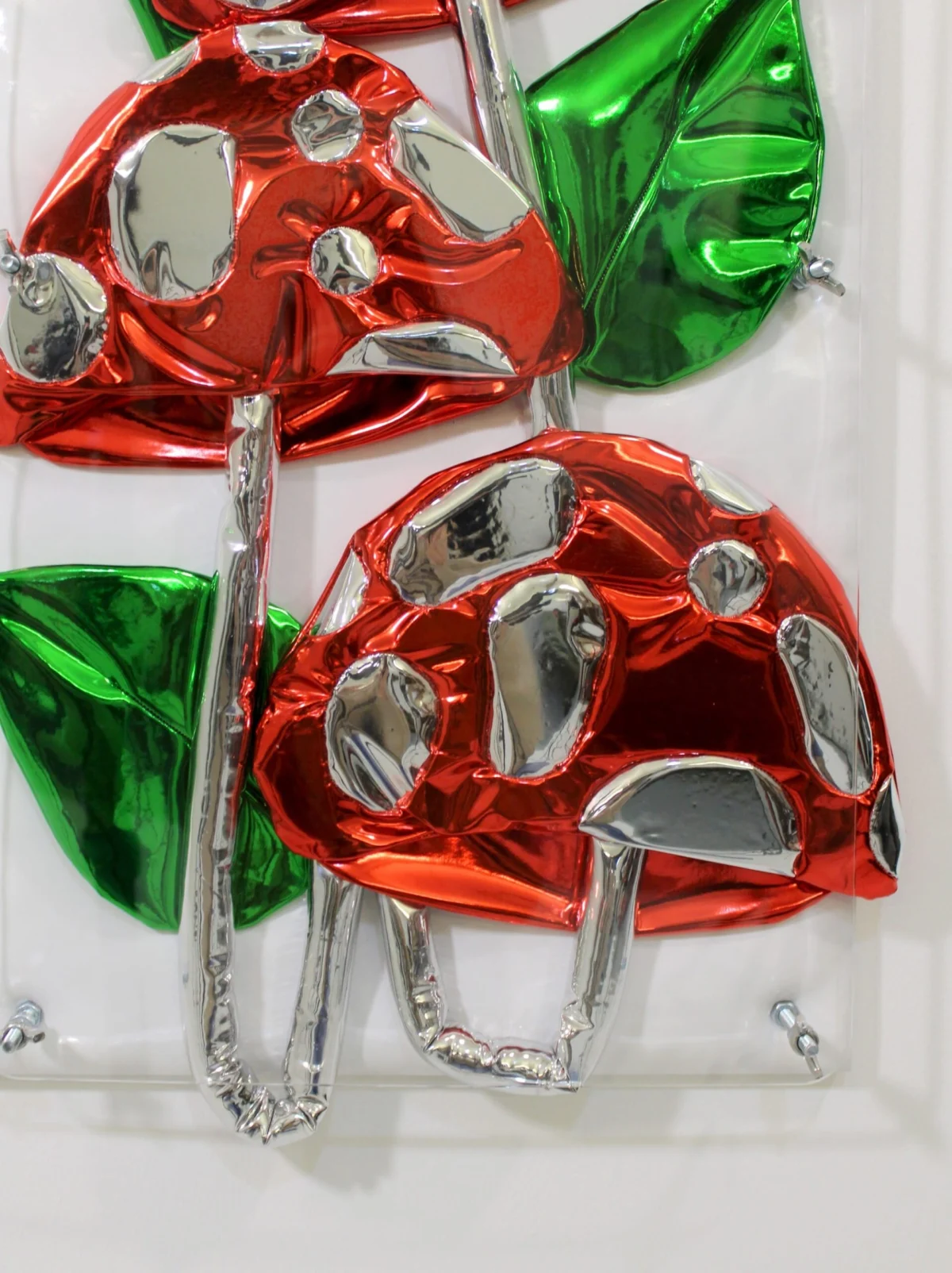
In the quiet, curated spaces of Stuttgart, a new exhibition is challenging the boundary between the organic and the manufactured. Soft // Chrome, the latest solo exhibition by artist Ant Hamlyn, presents a series of botanical sculptures that appear to have been plucked from a high-definition, Y2K-era computer simulation. These are not flowers meant to be watered or admired for their fragrance; they are complex, high-gloss artifacts of a digital consciousness, trapped in states of compression that mirror the anxieties of our contemporary, screen-saturated lives.
The Intersection of Memory and Manufacture: Main Facts
Ant Hamlyn’s work serves as a stylistic bridge between the neon-soaked optimism of the late 1990s and the complex, often overwhelming reality of the post-digital world. His latest collection features series of sculptural works—ranging from "Pink Daisies" to "Forget-Me-Nots" and "Mushrooms"—constructed from a tactile blend of hand-sewn metallic fabrics, fiber stuffing, and polyurethane-coated textiles.

These works are defined by their unique presentation: they are literally "squashed" between panels of extruded acrylic, held in place by industrial-grade stainless steel fixings. This forced preservation creates a visual paradox. The subject matter—flowers and fungi—is inherently ephemeral and fragile, yet Hamlyn’s execution renders them permanent, glossy, and suspiciously synthetic. By juxtaposing the soft, rounded forms of nature with the rigid, transparent geometry of architectural fiberboard and Plexiglas, Hamlyn invites viewers to reconsider what we define as "natural" in an era where the digital landscape has become our primary environment.
A Chronological Descent into the Y2K Aesthetic
To understand the gravity of Soft // Chrome, one must look at the lineage of the aesthetic Hamlyn inhabits. The Y2K era (roughly 1997–2003) was a distinct, short-lived cultural epoch characterized by a profound, if naive, optimism regarding the trajectory of human technology. It was a time when the internet was still a frontier, computer graphics were just beginning to lose their jagged edges in favor of "liquid metal" aesthetics, and subcultures like teen punk and rave culture were colliding with the polished sheen of corporate futurism.

The Rise of the Synthetic
In the late 1990s, the "look" of the future was defined by materials that were cold, smooth, and artificial. Polyurethane miniskirts, inflatable furniture, and the reflective surfaces of CDs and flip phones formed a visual shorthand for a world that was moving away from the earth and toward the cloud.
The Evolution of the "Soft"
As we progressed through the 2010s and into the 2020s, that Y2K aesthetic underwent a transformation. It stopped being a "future" and became a "memory." Hamlyn’s work functions as an archeological dig into that memory. By using materials like polyurethane—a substance often associated with cheap, disposable consumer goods—to replicate the delicate structure of a daisy, he creates a friction between the mass-produced and the bespoke. The transition from the "hard" chrome of the 2000s to the "soft" tactile reality of his sculptures reflects our current desire for physical connection in a world that is increasingly abstracted into data.

Supporting Data and Technical Composition
The materiality of Soft // Chrome is essential to its conceptual weight. Each piece in the exhibition is a testament to meticulous craft, involving a rigorous assembly process that contrasts sharply with the "disposable" appearance of the final product.
Technical Breakdown of a Typical Work (e.g., "Soft // Chrome Mushrooms"):

- Surface: Polyurethane-coated fabrics provide a high-gloss, light-reflective sheen.
- Structural Integrity: Hand-sewn metallic fabrics are used to define the sculptural form, which is then reinforced with fiber stuffing to create a sense of volume.
- The "Frame": Upholstered architectural fiberboard acts as a base, while the entire composition is compressed behind sheets of extruded acrylic.
- Industrial Anchor: Stainless steel fixings provide the necessary tension to hold the compressed botanical forms in place, acting as both a functional necessity and a visual marker of human intervention.
These specifications are not merely artistic choices; they are a direct commentary on the human impulse to "archive" or "contain" nature. By mounting these items like biological specimens in a laboratory—or like digital files stored in a folder—Hamlyn highlights our tendency to flatten the complex, chaotic systems of the natural world into digestible, aestheticized icons.
Official Responses and Curatorial Intent
The exhibition is presented by Better Go South, a gallery that has positioned itself at the forefront of contemporary discussions on materiality and technology. In their official statement regarding the exhibition, the curators note:

"Hamlyn’s approach is a celebration of our human capacity to find beauty and connection even within the most manufactured environments. We are living in a moment where the digital and the physical have become inextricably tangled. Soft // Chrome is not just about the past; it is about the way we currently relate to our environment, using the visual language of our technological history to process the anxiety of our present."
Critics have observed that the "squashed" nature of the flowers serves as a metaphor for the modern attention span. In a digital landscape where images are scrolled past in milliseconds, Hamlyn forces the viewer to pause. By trapping the flower behind glass, he makes the act of "looking" a deliberate, almost claustrophobic experience. It is a critique of the "post-digital" condition—a state where we have all the tools of creation at our fingertips, yet feel increasingly disconnected from the reality of the physical world.

Implications: The Future of "Liquid Metal" Art
The implications of Hamlyn’s work extend beyond the walls of the gallery in Stuttgart. His practice is part of a broader movement in contemporary art that seeks to reclaim the "synthetic." For decades, artists were encouraged to look to nature for inspiration. Today, many are looking to the interface.
The Anxiety of the Post-Digital
As artificial intelligence and high-fidelity rendering become standard, the "uncanny" becomes our new baseline. Hamlyn’s flowers look almost real, but they are clearly artificial. This intentional "wrongness" triggers a cognitive dissonance in the viewer. We recognize the form of a flower, but our brain identifies the texture of a computer-generated object. This friction is where the "anxiety" of the post-digital age resides. It is the fear that we have become so good at creating simulations that the original has lost its value.

The Resilience of Beauty
Despite this underlying anxiety, there is an undeniable sense of optimism in Soft // Chrome. By choosing to represent flowers—symbols of growth, life, and renewal—Hamlyn suggests that even in a world of polyurethane, stainless steel, and fiberboard, the impulse to create beauty remains. We are not just consuming the technology; we are reconfiguring it to speak our own language.
Conclusion: A Reflective Future
Ant Hamlyn’s Soft // Chrome is a profound meditation on the trajectory of human progress. It asks us to consider what happens when the natural world is viewed through the lens of a screen for too long. Do we lose the ability to see the chaotic beauty of a real flower? Or do we simply find new ways to honor the organic by translating it into the materials of our time?

By visiting the exhibition in Stuttgart—or by observing the artist’s evolution through his digital archives on Instagram—one gains a clearer understanding of the path we are walking. We are moving toward a future that is, in many ways, "soft" and "chrome"—a world that is both highly engineered and deeply human. Whether that is a cause for celebration or a sign of our disconnect remains a question for the viewer to answer. One thing is certain: in the hands of Ant Hamlyn, the synthetic has never looked more alive.

 Sagoh
Sagoh
 Dwi Wanna