Azzam Bilal Chamdy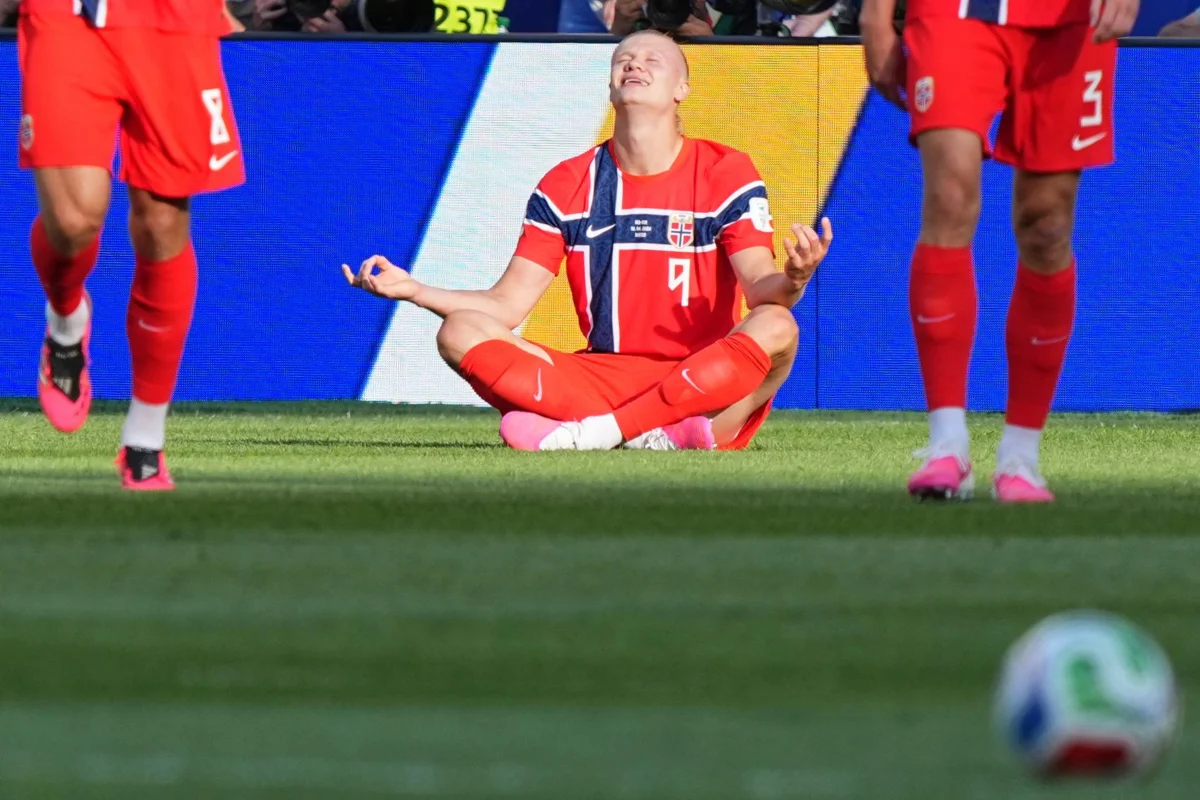
By Sports Desk
Tuesday, June 9, 2026
DOHA – The ghost of 1998 has finally been exorcised. In a display of clinical precision and brute physical dominance, Erling Haaland announced his arrival on the world’s grandest stage on Tuesday, netting a brace and providing an assist to steer Norway to a comprehensive 4-1 victory over Iraq in their Group I opener.
For Norway, this was more than just a win; it was a reclamation of their footballing heritage. Competing in their first World Cup since the tournament in France 28 years ago—a time before the global superstar Haaland was even born—the Norwegians looked every bit the dark horse of the 2026 edition.
The Chronology of a Masterclass
The match, held under the intense lights of the stadium, began with palpable tension. Iraq, appearing in only their second-ever World Cup, displayed early tactical discipline, frustrating Norway’s attempts to build from the back. However, the dam broke in the 29th minute. David Møller Wolfe delivered a whipped cross into the danger zone, finding Haaland, who showcased the unorthodox athleticism that has made him a household name. Sliding toward the ball, the Manchester City talisman used his right heel to flick the ball past the keeper, igniting a cacophony of sound from the red-clad Norwegian supporters, who broke into their trademark rhythmic "Viking row" chants.
The lead, however, proved fragile. Iraq’s resilience, buoyed by a passionate, concentrated block of fans behind the goal, bore fruit in the 38th minute. Amir Alammari, operating with poise on the baseline, fired a pinpoint cross that sliced through the Norwegian defensive line. Aymen Hussein, Iraq’s talisman, rose to meet it, heading the ball firmly into the turf and past the diving Orjan Nyland. It was Hussein’s 34th international goal—a continuation of the form that secured Iraq’s dramatic qualification in April.
Just as the momentum seemed to be shifting, the "Haaland Factor" struck again. In the dying moments of the first half, a lapse in concentration from the Iraqi backline proved fatal. A wayward back pass toward goalkeeper Jalal Hassan invited pressure, and Haaland, reading the play with predatory instincts, surged forward. He beat Hassan to the ball, using his shin to redirect it into the empty net, restoring Norway’s lead heading into the tunnel.
The second half saw Norway tighten its defensive structure. In the 76th minute, the lead extended to 3-1 when Leo Ostigard rose high to meet a perfectly flighted corner from captain Martin Ødegaard, hammering a header into the net. The exclamation point came just before the final whistle, with Haaland turning provider to set up Kristian Thorstvedt for the fourth and final goal of the evening.
The Haaland Phenomenon: Supporting Data
The statistics underscore the sheer magnitude of Haaland’s impact on the international stage. With his brace on Tuesday, he moved his career international tally to 57 goals. At just 25 years old, he is already rewriting the record books for the Norwegian Football Federation.
- International Goals: 57 (in 64 appearances)
- World Cup Debut Performance: 2 goals, 1 assist, 8 shots on target
- Tournament Context: First Norwegian player to score in a World Cup since 1998.
Beyond the raw numbers, Haaland’s movement off the ball continues to be his most dangerous asset. His ability to anticipate the "defensive blunder"—a hallmark of his Premier League success—was on full display against Iraq. Analysts noted that while Iraq’s back four remained compact, they struggled to track Haaland’s diagonal runs, a tactical failure that Norway exploited throughout the second half.
Official Responses and Perspectives
Following the match, the mood in the post-game press conference was starkly divided between the jubilation of the Nordic contingent and the measured disappointment of the Iraqi camp.
"We knew the history, we knew the weight of the jersey," said Norway manager Ståle Solbakken. "Erling is a world-class talent, but today was about the collective. The way the boys responded after conceding the equalizer showed a maturity that this team has been building for years."
When asked about his performance, Haaland remained typically understated, focusing on the team’s long-term goal. "It’s special to be here. We’ve waited a long time for this, not just me, but the whole country. Scoring is my job, but winning as a group is what matters today. We have two more matches in the group, and we need to stay focused."
Iraq’s manager, while disappointed with the result, praised his side’s tenacity. "We played against one of the best strikers in the world. We made a mistake just before halftime that changed the complexion of the game. But I am proud of Aymen and the way we stayed in the match for an hour. We learned today what it takes to compete at this level."
Implications for Group I
The implications of this result are significant. With this 4-1 victory, Norway immediately vaults to the top of Group I, boasting a superior goal difference that could prove vital as the tournament progresses.
For Iraq, the path to the Round of 16 has become significantly steeper, but not insurmountable. They must now look to capitalize on their next fixture, where a win would be essential to keep their knockout stage dreams alive. The Iraqi supporters, who provided one of the loudest atmospheres of the tournament so far, will be expected to return in force for the next round.
For Norway, the pressure now shifts from "can they win?" to "how far can they go?" The 1998 squad set the benchmark by reaching the Round of 16. The 2026 squad, anchored by the brilliance of Haaland and the tactical leadership of Ødegaard, is clearly aiming for heights unseen in Norwegian football history.
The Cultural Impact: A Nation United
The scene in the stands spoke volumes about the cultural impact of this Norwegian resurgence. The "Viking row" chants were more than just a celebration of a goal; they were a manifestation of a nation re-emerging on the global map. Since the late 90s, Norway has struggled to convert its individual talents into a cohesive international unit. Under the current coaching staff, the shift toward a high-pressing, transition-heavy style has perfectly complemented the strengths of its star players.
As the team bus departed the stadium, fans were already chanting in the streets of Doha. The narrative of the 2026 World Cup has officially been touched by the presence of a new, terrifyingly efficient force. Whether this performance is a flash in the pan or the beginning of a historic run remains to be seen, but one thing is certain: the world is now watching Norway, and Erling Haaland is just getting started.
Copyright 2026 The Associated Press. All rights reserved. This material may not be published, broadcast, rewritten, or redistributed without permission.


 Neng Nana
 Asro
Asro