Basiran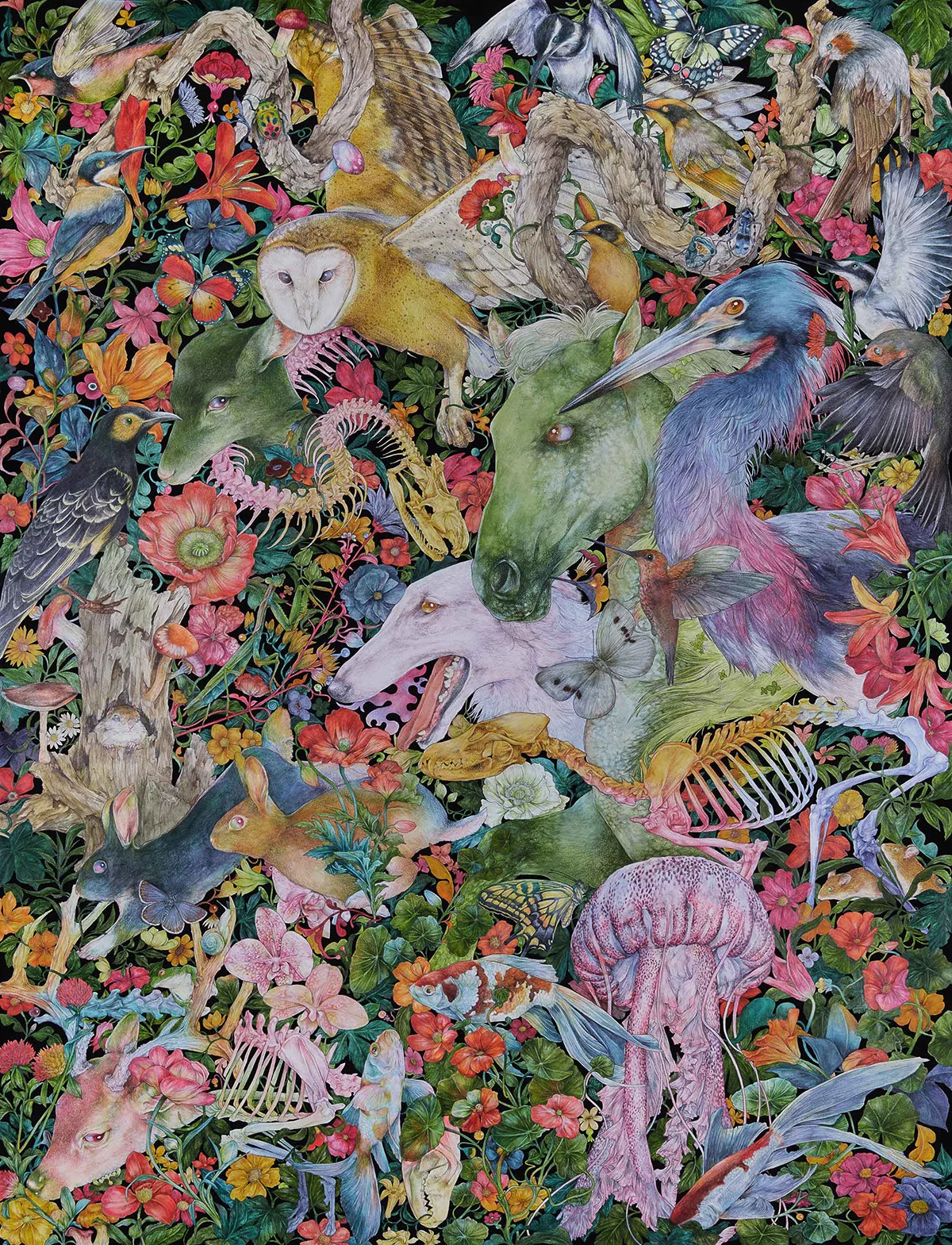
In the contemporary art world, few illustrators manage to capture the fragile intersection between the organic world and the human psyche as poignantly as Fumi Nakamura. A Japanese-born artist currently navigating the bustling, concrete landscape of New York City, Nakamura has carved out a distinct visual language—one defined by graphite, colored pencils, and a meditative obsession with the cycle of life and death. Recently recognized as a standout talent in the 2025 Booooooom Illustration Awards, her work serves as a reminder of the power of stillness in an increasingly accelerated world.
The Foundations of an Artist: A Chronology
Fumi Nakamura’s creative journey is a narrative of geographical transitions, each location leaving an indelible mark on her aesthetic identity.
Roots in Shizuoka
Nakamura’s foundational years were spent in Shizuoka, Japan. A prefecture defined by its dramatic coastline, the imposing silhouette of Mount Fuji, and dense, lush forests, Shizuoka provided the raw materials for her artistic subconscious. In her youth, the natural environment was not merely a backdrop but a primary educator. It was here that she first observed the rhythmic, often harsh, yet inherently beautiful processes of decay and rebirth that would later become the central motifs of her portfolio.
The California Transition
Seeking to broaden her creative horizons, Nakamura moved to the United States to pursue formal education at San Jose State University. This period proved pivotal. Transitioning from the Japanese landscape to the technological and suburban landscape of Northern California, Nakamura began to refine her technical abilities. While the Bay Area offered a starkly different sensory experience than the forests of Shizuoka, the region’s unique flora and the proximity to the Pacific Ocean helped bridge the gap between her upbringing and her evolving artistic intent. She remained in the Bay Area for a short period post-graduation, soaking in the region’s diverse art scene before seeking the greater intensity of the East Coast.
The New York Era
Currently based in New York City, Nakamura faces the challenge—and the reward—of maintaining a connection to nature amidst one of the world’s most urbanized environments. This contrast has arguably deepened her work. By living in a city that rarely sleeps, her focus on tranquility, silence, and the slow pace of nature has become a form of resistance. Her studio practice in New York is an exercise in intentionality, where she reconstructs the natural world from memory and observation, distilling it into the delicate, layered compositions that have earned her critical acclaim.
The Philosophy of the Pencil: Technical and Conceptual Framework
To understand Nakamura’s work is to understand her reverence for the material. She eschews digital manipulation in favor of the tactile intimacy of graphite and colored pencils.
Layering the Narrative
Nakamura’s process is laborious and intentional. She builds her images through a meticulous layering process, where each stroke of the pencil contributes to a larger texture of variable density. This layering is not merely aesthetic; it is conceptual. By stacking graphite and pigment, she mirrors the geological and biological strata of the world she depicts. The resulting textures—ranging from soft, atmospheric washes to sharp, defined contours—allow her to capture what she describes as the "tranquility" of her subjects.
The Cycle of Life and Death
At the heart of her work is an exploration of the ephemeral. Nakamura does not shy away from the darker aspects of nature; rather, she embraces them as vital components of existence. Her drawings frequently depict creatures and botanical elements caught in the "continuous cycle of life and death." In her own words:
"Spending many years surrounded by forests, mountains and the oceans have taught and given me value to appreciate nature and life itself. My drawings focus on the heavy influences from the relationship with it, where I depict the subject on a continuous cycle of life and death, and the emotions that all brings together. Colored and graphite pencils create layers of variable textures that capture the tranquility, and it helps to breathe life into drawings."
Supporting Data and Recognition
Nakamura’s trajectory has been marked by significant institutional support and peer recognition. Her representation by the renowned Thinkspace Projects in Los Angeles has provided her with a platform to reach international collectors and art institutions. Thinkspace has been instrumental in placing her work in various group exhibitions and art fairs, further cementing her status as a "one to watch" in the figurative art movement.
The 2025 Booooooom Illustration Awards
The most recent validation of her impact came during the 2025 Booooooom Illustration Awards. Booooooom, a platform known for its rigorous curation of contemporary art and illustration, selected Nakamura for its prestigious shortlist. This recognition is significant, as it places her within a curated cohort of artists who are currently defining the direction of modern illustration. The selection committee highlighted her ability to evoke profound emotional responses through minimalist yet technically dense compositions, noting that her work stands out for its lack of cynicism and its commitment to raw, organic storytelling.
Implications for Contemporary Illustration
The rise of Fumi Nakamura offers a compelling case study for the direction of contemporary illustration. In an era dominated by AI-generated imagery and high-speed digital workflows, Nakamura’s commitment to the slow, physical process of pencil-on-paper holds deeper implications for the art world.
The "Slow Art" Movement
Nakamura’s success suggests a growing audience appetite for "Slow Art." As digital saturation reaches a breaking point, there is a tangible shift toward work that bears the marks of human labor—the slight imperfections, the weight of the hand, and the time required to build a surface. Her work reminds the viewer that illustration can be a meditative act, providing a necessary counterweight to the frantic pace of the digital age.
The Integration of Emotional Ecology
Furthermore, Nakamura’s work bridges the gap between scientific observation and emotional projection. By focusing on the "emotions" that the cycle of life and death brings together, she elevates her illustrations from mere representations of nature to explorations of human condition. She posits that by observing the forest, we are effectively observing ourselves. This "emotional ecology" is becoming a recurring theme in the work of emerging artists who are grappling with climate anxiety and the human desire for a deeper connection to the planet.
Conclusion: Looking Ahead
As Fumi Nakamura continues to evolve within the vibrant but challenging landscape of New York City, her trajectory remains one of the most promising in the field. Her ability to synthesize the quietude of her Japanese upbringing with the raw, fast-paced intensity of her current reality creates a tension that is palpable on the page.
For collectors, curators, and fans of contemporary illustration, Nakamura’s inclusion in the 2025 Booooooom Illustration Awards is not an endpoint, but rather a checkpoint in a long-standing career. Her dedication to the craft of the pencil and her unwavering focus on the beauty of life’s cycles ensure that her work will continue to resonate. Whether she is depicting a bird in flight or the silent decay of a fallen tree, Fumi Nakamura reminds us that even in the quietest, smallest strokes, there is a vast and interconnected world waiting to be understood.
For those interested in exploring her full body of work, or tracking the next steps in her career, her portfolio remains a testament to the enduring power of the pencil. Her ongoing collaboration with Thinkspace Projects continues to provide a vital window into her evolving practice, ensuring that her voice—and her delicate, textured visions of the natural world—will remain at the forefront of the contemporary artistic conversation for years to come.

 Suro Senen
 Laily UPN