Siti Muinah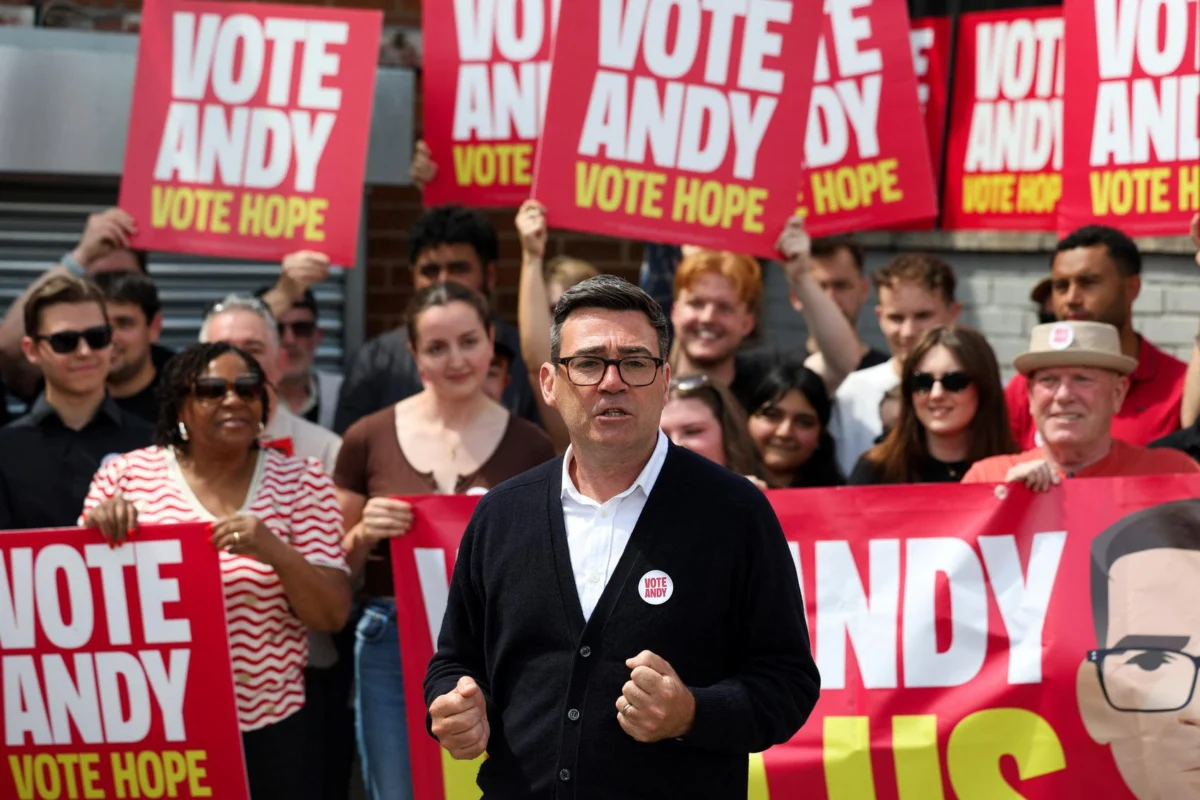
By Political Correspondent
London, 2026
In a political earthquake that has fundamentally altered the trajectory of the British government, Andy Burnham, the Mayor of Greater Manchester, has secured a decisive victory in the parliamentary constituency of Makerfield. His return to the House of Commons—winning with a commanding 24,927 votes against a surging Reform UK challenger—has transformed him overnight from a powerful regional figure into the primary existential threat to Prime Minister Keir Starmer’s premiership.
The result is being hailed by political analysts as the most consequential local election outcome in over six decades. By clearing the procedural path to challenge the leadership of the Labour Party, Burnham has signaled the end of the political truce that has characterized the last two years of Starmer’s increasingly embattled administration.
The Turning Point: A Chronology of a Leadership Crisis
The ascent of Andy Burnham to the doorstep of Downing Street is not an isolated event but the culmination of a long-simmering discontent within the Labour Party.
- Mid-2024: Following a landslide general election victory, Keir Starmer’s administration begins to struggle under the weight of mounting economic pressures and a series of high-profile policy U-turns.
- Early 2025: Popularity ratings for the Prime Minister begin a steady, unprecedented decline, driven by perceptions of indecision and a failure to deliver on the "change" mandate promised during the campaign.
- Q1 2026: Following catastrophic losses in local elections, the internal rebellion gains momentum. Approximately 25% of Labour lawmakers formally signal their lack of confidence in Starmer’s leadership.
- Mid-2026: Senior cabinet members, including the Secretaries of State for Defence and Health, resign in rapid succession, citing a fundamental disagreement with the direction of the government.
- Friday, 2026: Andy Burnham wins the Makerfield by-election, providing him the parliamentary standing necessary to trigger a leadership contest under party rules.
The Challenger: Why Burnham Commands the Party
Andy Burnham, 56, has spent the last decade building a reputation as the "King of the North." His governance of Greater Manchester has been marked by a pragmatic, yet distinctly left-leaning, approach to devolution and public services.
Burnham’s political platform is built upon a critique of the "four decades of failed neoliberal economics." He has consistently advocated for the nationalization of key public services, a stance that resonates deeply with the party’s grassroots base, which has grown disillusioned with what they perceive as Starmer’s drift toward the political center.
In his victory speech on Friday, Burnham’s tone was both conciliatory and ultimatum-driven. "I do say to my own party, this is a final chance to change," he declared to a cheering crowd. "There will be no second chance."
Data from recent polling confirms that Burnham is currently Labour’s most popular political figure. Should a leadership contest be triggered, internal party sentiment suggests he would be the overwhelming favorite to defeat Starmer among party members. His appeal cuts across the traditional divides of the party, bridging the gap between the metropolitan urban centers and the "Red Wall" constituencies that feel neglected by Westminster.
The Prime Minister’s Defiance and the Party’s Dilemma
Keir Starmer, 63, finds himself at the lowest point of his political career. Having entered office with a massive mandate, he is now statistically one of the least popular British prime ministers since reliable polling began. The accumulation of scandals and the perception of a government paralyzed by internal indecision have left the administration in a state of suspended animation.
Despite the mounting pressure, Starmer remains defiant. In a statement issued from Downing Street this week, the Prime Minister insisted he would stand in any leadership contest, warning his party that such a maneuver would invite "chaos" and produce a "bitter and divisive" environment that would only benefit the opposition.
However, the Prime Minister’s warnings are falling on increasingly deaf ears. Wes Streeting, the former health minister and a long-time rival of Starmer, has emerged as a key agitator. Streeting stated unequivocally this week that he would be prepared to force a contest unless the Prime Minister provides a clear, public timeline for his resignation.
Structural Implications: How a Challenge Happens
Under the current Labour Party rulebook, the threshold for triggering a leadership challenge is precise. To force a ballot, 20% of the parliamentary party—totaling 81 lawmakers—must formally announce they are backing a single candidate.
The political math currently suggests that the rebels are within striking distance of this number. The combination of Burnham’s new parliamentary status and the vocal support from backbenchers creates a "scissors effect" that could force Starmer’s hand.
The Options Facing Downing Street:
- A Managed Transition: Some senior Labour figures are advocating for a "graceful exit" for Starmer, where he would hand over power voluntarily to avoid the optics of a public, bruising contest.
- The "Hammer and Tongs" Contest: If Starmer refuses to stand down, the party faces a formal vote. This would likely freeze government business for weeks, potentially allowing opposition parties, particularly Nigel Farage’s Reform UK, to capitalize on the instability.
- A Snap General Election: Should the internal fighting become untenable, there is a risk that the government could collapse entirely, necessitating a national vote—a scenario that, given current polling, would be high-stakes for a divided Labour Party.
Supporting Data: A Government in Freefall
The instability within Labour is backed by empirical evidence of a shifting political landscape. Reform UK, led by Nigel Farage, finished a strong second in the Makerfield by-election, securing over 15,000 votes. This underscores a significant movement of working-class voters away from the Labour Party, signaling that the "King of the North" is not just fighting Starmer; he is fighting for the very soul of the party in regions where it once held undisputed hegemony.
Furthermore, the resignation of senior ministers has hollowed out the government’s front bench. The loss of key institutional knowledge in the Defence and Health portfolios has left the administration struggling to manage day-to-day crises, from the cost-of-living index to the crumbling state of public infrastructure.
Implications for the Future of British Politics
The potential transition from Starmer to Burnham represents a significant ideological pivot. While Starmer prioritized a professional, technocratic approach to government, Burnham offers a more populist, interventionist style of leadership. His willingness to challenge the economic orthodoxy of the last forty years suggests that a Burnham-led government would likely pursue significantly more aggressive taxation and nationalization policies.
The implications for the UK’s international standing are equally significant. A period of intense internal leadership flux will likely be viewed with concern by global markets and diplomatic partners, who have grown accustomed to the relative stability of the post-2024 election period.
As the dust settles on the Makerfield result, the focus shifts to the corridors of Westminster. The next few weeks will be defined by backroom negotiations, public statements of loyalty or dissent, and the constant, ticking clock of the 81-lawmaker threshold.
"Politics is the art of the possible," one senior party strategist noted anonymously. "But right now, for Keir Starmer, the impossible is becoming inevitable."
For Andy Burnham, the path is clear. He has the mandate, the popularity, and now, the seat. The question that remains is whether he will be the man to lead Labour into a new era, or if his challenge will prove to be the final act of a party that has lost its way.
© Thomson Reuters 2026. All rights reserved.


 Neng Nana
 Asro
Asro