Iffa Jayyana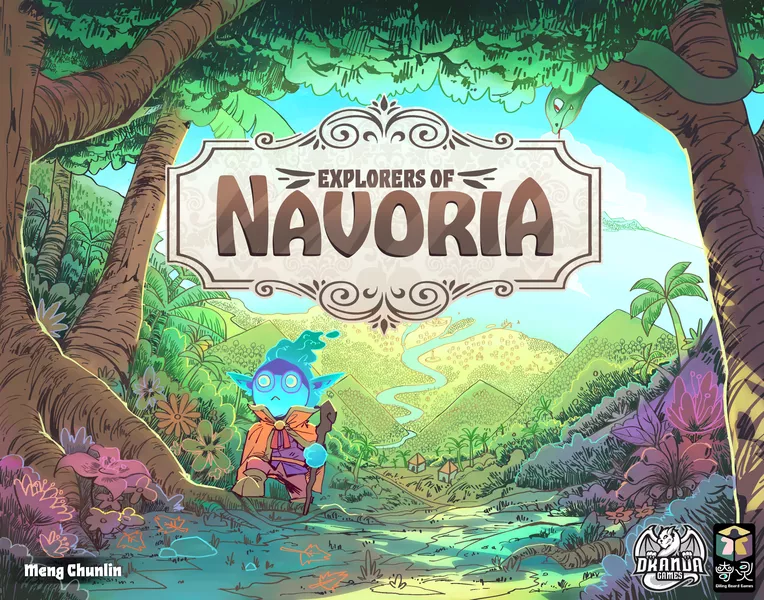
In the ever-expanding landscape of modern board gaming, the "gateway-plus" category—games that offer more mechanical depth than a classic family title but less intimidation than a heavy strategy simulation—has become a fiercely competitive arena. Enter Explorers of Navoria, the latest release from Qiling Board Games, designed and illustrated by Meng Chunlin. By blending the tactile satisfaction of bag-building with the strategic foresight of tableau-building, Explorers of Navoria carves out a niche as a vibrant, accessible, and deeply satisfying journey into a fantasy frontier.
Main Facts: The Anatomy of an Expedition
At its core, Explorers of Navoria is a game of discovery, resource management, and engine building for 2 to 4 players. With a playtime ranging from 40 to 80 minutes, it fits perfectly into an evening session where time is limited but the desire for meaningful tactical play remains high.
The game is structured across three distinct rounds, each broken down into two primary phases: the Recruit Phase and the Gather Phase. During the Recruit Phase, players draw action tokens from a communal bag, determining which adventurers and resources they can secure from the market display. Should the luck of the draw prove unfavorable, players have the strategic recourse of visiting the town center to claim tokens discarded by their opponents, adding a layer of reactive decision-making.
The Gather Phase serves as the engine-driven climax of each round. Players deploy their collected tokens onto the main board to trigger actions ranging from military influence and exploration to resource gathering and income generation. This dual-phase structure creates a satisfying loop: you draft the tools needed to build your tableau, and then use that tableau to refine your ability to draft better tools in subsequent rounds.
A Chronological Breakdown of Play
To understand the rhythm of Explorers of Navoria, one must view the game as a series of cascading decisions.
The Opening: Establishing the Foothold
The first round is defined by scarcity. Players begin with minimal resources, focusing on laying the groundwork for their tableau. The choice of which adventurer to recruit is paramount, as early-game cards provide the engine that will sustain the player through the second and third acts.
The Mid-Game: The Expansion Phase
By the second round, the "engine" begins to hum. Players are no longer just gathering; they are optimizing. The interaction becomes more pronounced here, as the shared pool of action tokens in the town center becomes a treasure trove of missed opportunities for opponents. This is where the game’s "hate-drafting" potential surfaces—a subtle, non-confrontational way of blocking a rival’s path to a specific exploration track.
The Endgame: The Final Scrutiny
In the final round, the focus shifts to maximizing points. Players must balance their military strength, exploration progress, and set collection rewards. The tension is palpable, not because of direct combat, but because the finite number of card displays creates a race to claim the final pieces of one’s scoring puzzle.
Supporting Data: Why the System Works
The success of Explorers of Navoria lies in its accessibility. The game relies almost exclusively on iconography, stripping away the need for heavy text reading. This design choice is a massive boon for family-weight gaming, allowing players to grasp complex concepts like resource conversion and tableau synergy through visual cues alone.
Furthermore, the game’s pacing is its strongest asset. By capping the experience at roughly 20 minutes per player, Meng Chunlin ensures that the "analysis paralysis" often associated with tableau builders is minimized. The turn structure is brisk: draft, perform an action, collect rewards, repeat. There is no downtime spent waiting for an opponent to resolve a sprawling, multi-minute combo chain.

From a component perspective, the game is a triumph of production. The use of a canvas bag for token drafting provides a tactile, sensory experience that digital games cannot replicate. The artwork—a whimsical, cozy fantasy aesthetic—is cohesive and inviting, featuring bird-faced hot air balloons and vibrant, colorful landscapes that turn the tabletop into a living map.
Official Perspectives and Designer Intent
While Qiling Board Games has positioned Explorers of Navoria as an entry-level title, the designer’s intent was clearly to bridge the gap between "gateway" and "hobbyist" gaming. By removing the harsh, aggressive player-versus-player mechanics common in many fantasy titles, Meng Chunlin has created a "co-opetition" environment.
In official playtesting notes, the emphasis is placed on the "satisfaction of progression." The goal was not to punish players for mistakes, but to reward them for finding synergies. The inclusion of military symbols on cards, for example, is thematic rather than literal; it represents the expansion of one’s influence rather than the destruction of an opponent’s assets. This design decision makes the game significantly more palatable for younger players or those who prefer a "multiplayer solitaire" style of play where the challenge comes from one’s own efficiency rather than the interference of others.
Implications for the Future of Gateway Games
The release of Explorers of Navoria signals a broader trend in the board game industry: the professionalization of the "Gateway-Plus" segment. As the hobby grows, newcomers are increasingly looking for games that have the aesthetic appeal of a modern hit like Wingspan or Everdell, but with a faster learning curve.
1. The Expansion Potential
As noted in early critiques, while the game is excellent as a base experience, it is primed for expansion. Adding new modules—perhaps asymmetric player powers or variable end-game goals—could easily elevate the game from a "great starter" to a "staple of the collection." The foundation is robust enough that it could support significant additional complexity without breaking the current, elegant ruleset.
2. Replayability and Longevity
The game utilizes a modular setup where only a portion of the available cards are seen in any single session. This creates a high degree of variance. One game might reward a player who focuses heavily on the military track, while the next might demand a pivot to resource-heavy income generation. This variability ensures that the game does not "solve" itself after a few playthroughs.
3. The "Gateway" Ceiling
It is important to note the limitations of this design. Because Explorers of Navoria prioritizes flow and accessibility, it lacks the "crunch" that heavy-strategy veterans might crave. It is not designed to be a 4-hour epic, and those looking for deep, multi-layered economic simulations may find the game’s simplicity a double-edged sword. However, for the vast majority of gaming groups, this is a feature, not a bug. It provides a satisfying, intellectually stimulating experience that respects the player’s time.
Final Verdict: A Must-Have for the Right Table
Explorers of Navoria is a rare example of a game that succeeds because it knows exactly what it wants to be. It does not try to be a heavy war game, nor does it try to be a complex economic engine. It is a charming, beautiful, and tightly designed drafting game that offers just enough depth to keep veteran players engaged while remaining welcoming enough for a family game night.
For those who have already cut their teeth on Ticket to Ride or Sushi Go! and are looking for their next step up, Explorers of Navoria is the ideal choice. It offers the satisfaction of building a miniature empire in under an hour, all while being presented in a package that is as pleasing to the eye as it is to the brain.
Ultimately, Meng Chunlin has delivered a title that feels like a classic in the making. It is a testament to the idea that you do not need complex, convoluted rules to create a deep and rewarding experience. Whether you are charting the lands of Navoria for the first time or the fiftieth, the journey remains as fresh and inviting as a new continent waiting to be mapped. If you enjoy games that celebrate the joy of building something beautiful and functional, Explorers of Navoria deserves a permanent place on your shelf.


 Sagoh
Sagoh
 Ammar Sabilarrohman