Nila Kartika Wati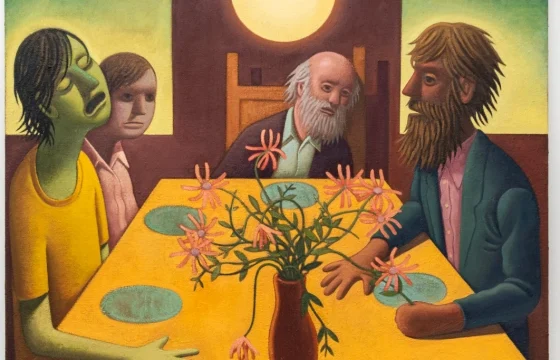
By Arts & Culture Correspondent
HESSE FLATOW has officially unveiled Franklin, a poignant and evocative new exhibition featuring the latest paintings and works on paper by artist Nat Meade. Marking his third solo presentation with the New York-based gallery, the exhibition serves as a profound meditation on the human condition, viewed through the prism of personal history, the weight of paternal legacy, and the hopeful horizon of future generations. The exhibition will remain on view to the public through April 18, 2026.
Thematic Foundations: A Life in Flux
At the core of Meade’s practice lies a sophisticated ability to translate the emotional turbulence of daily existence into a visual language that feels both intimate and universal. As a father, son, partner, and academic, Meade draws from the granular experiences of his own life; however, he is quick to clarify that his subjects are not literal portraits. Instead, they function as archetypes—timeless figures that traverse the landscape of existential inquiry.
In Franklin, Meade employs what he terms an "allegorical distance." By distancing his personal challenges from his own likeness, he creates a theatrical stage where the absurd, the somber, and the humorous coexist. This stylistic choice allows the viewer to engage with the paintings not as biography, but as a mirror reflecting the complexities of the human psyche.
Chronology of an Artistic Evolution
Meade’s trajectory as an artist has long been defined by his interest in the struggle between the individual and the environment. In previous bodies of work, his figures were often depicted as victims of, or participants in, overwhelming natural forces—men struggling against gale-force winds or being subsumed by crashing, turbulent waves.
The current exhibition represents a distinct pivot in this narrative arc. Following the recent passing of his father, Meade’s work has undergone a period of intense re-evaluation. The "calmer seas" depicted in his current canvases signal a thematic transition: moving away from the chaotic, externalized struggles of the past toward an internalized process of reconciliation. The chronology of his work reflects a journey from the raw, physical confrontation with "rocky histories" to a more meditative acknowledgment of the need for healing and the subsequent release of intergenerational burdens.
Supporting Data: Symbols, Archetypes, and Art History
The exhibition’s title, Franklin, provides the first clue to its layered psychological depth. The name serves as a subtle, perhaps unsettling, nod to the 1974 horror classic The Texas Chainsaw Massacre, specifically referencing the character of Franklin Hardesty. By invoking a film renowned for its depiction of a deranged, claustrophobic, and violent patriarchal family, Meade invites viewers to consider the "inner turmoil" of the male experience—specifically the impulse toward aggression, power, and dominance.
The Iconography of Mortality
Meade’s visual lexicon is dense with historical and literary references that anchor his modern concerns in the bedrock of Western culture:
- The Prometheus Motif: In one work, a vulture circles a corpse, a direct visual parallel to the eternal suffering of Prometheus. Here, the imagery serves as a critique of the lust for power and the inescapable nature of punishment.
- The Nebuchadnezzar Echo: A bearded figure, captured on hands and knees, evokes William Blake’s haunting portrayal of King Nebuchadnezzar, whose hubris led to his descent into bestial madness.
- Spiritual Transience: In the piece Poise, legs dangle from a cloud, leaving the viewer to contemplate whether the figure is ascending or descending—a metaphor for the fluid boundary between birth and death, physical life and the ethereal spirit.
The Intergenerational Shift
If the adult figures in the exhibition represent the "heavy" aspects of life—inherited trauma, ghost-like specters of the past, and the burden of patriarchal expectation—the younger figures represent a radical departure. Meade introduces a sense of light, agency, and renewal through these adolescent protagonists.
One striking image features a young boy steering a boat with a radiant torch, his path illuminated and unburdened by the societal pressures that plague his adult counterparts. Another work captures an adolescent in a secluded cove, ankle-deep in water, reaching down to touch a seabed teeming with life—starfish, anemones, and mussels. This return to the tactile, wonder-filled experience of the natural world serves as a counterweight to the darker, more cynical elements of the exhibition.
Official Commentary and Perspectives
HESSE FLATOW’s decision to mount this exhibition highlights the gallery’s ongoing commitment to artists who engage with the "unequivocal resonance" of human nature. While the gallery has not issued a formal press statement beyond the exhibition overview, the response from the critical community has focused on the "courageous vulnerability" Meade displays.
By tackling the "unbearable lightness" of death alongside the "insurmountable heaviness" of grief, Meade has created a space that is as much a clinic for emotional processing as it is an art exhibition. The inclusion of the father-son motif—where a parent is seen tenderly guiding a child in the same shallow pool where the adult once struggled—is being hailed as a pivotal moment of artistic maturity. It marks a shift from the artist as a victim of his circumstances to the artist as a steward of the future.
Implications for Contemporary Figurative Painting
The implications of Franklin for the broader art world are significant. In a contemporary landscape often dominated by digital abstraction or hyper-conceptual installations, Meade’s return to the figurative, narrative tradition serves as a reminder of the power of the painted image to address universal emotional states.
- The Reclamation of Masculinity: Meade’s work does not shy away from the darker aspects of masculinity—violence, power-lust, and trauma. However, by balancing these with images of care, nurturing, and guidance, he contributes to a vital cultural conversation about the potential for men to break cycles of inherited trauma.
- Narrative as Catharsis: The exhibition suggests that painting can function as a form of ritual. By externalizing his grief and re-imagining his role as a parent, Meade suggests that the act of creation is not merely an aesthetic pursuit but a necessary component of the healing process.
- The Persistence of Wonder: By contrasting the "ghostly specters" of inherited trauma with the "radiant torch" of the child, Meade posits that progress is not only possible but inevitable, provided we acknowledge the past without being consumed by it.
Conclusion: The Resilience of the Human Spirit
Franklin is more than an exhibition of paintings; it is a testament to the "stubborn resilience" of the human condition. Through his masterful use of color, shadow, and archetype, Nat Meade has invited us into a world that feels both hauntingly familiar and refreshingly new.
As we look at these works, we are reminded that while the cycles of life—birth, struggle, and eventual expiration—are unavoidable, our capacity to find joy, to teach, and to guide the next generation remains our greatest triumph. The exhibition stands as a powerful call to action for the viewer: to examine our own "rocky histories," to acknowledge the phantoms of the past, and to ultimately reach toward the calm, clear waters of the future.
Visitors are encouraged to visit HESSE FLATOW through April 18, 2026, to witness this compelling body of work, which promises to linger in the mind long after the gallery lights have dimmed. Through Franklin, Meade has solidified his place as a profound chronicler of the modern family, proving that even in the face of death, there is a space for the light of discovery.

 Siti Muinah
 Asep Darmawan